
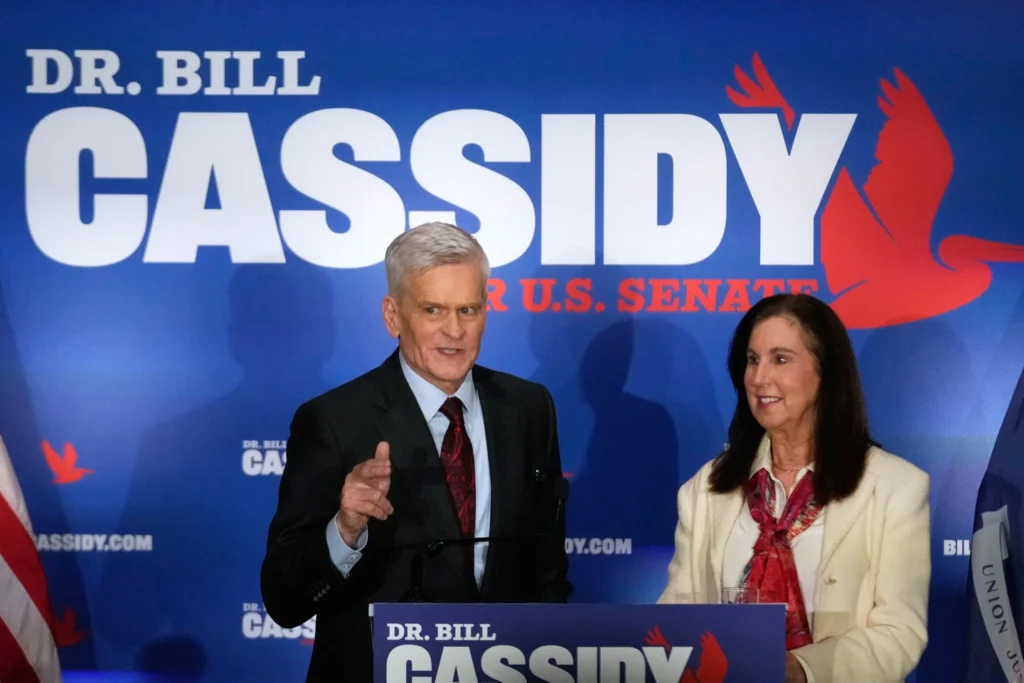
May 16 – Louisiana Senator Bill Cassidy’s political career suffered a major setback Saturday after the two-term Republican failed to secure re-election in the state’s closely watched Senate primary. The loss marked a significant victory for President Trump’s ongoing effort to reshape the Republican Party by targeting officials who opposed him during key moments of his presidency.
Cassidy, who became one of seven Republican senators to vote in favor of convicting Trump during the 2021 impeachment trial following the January 6 Capitol attack, was defeated after a heated campaign dominated by questions of loyalty to the president. Republican Representative Julia Letlow and Louisiana State Treasurer John Fleming advanced to a June runoff election after emerging as the top two finishers in the three-way race.
With nearly all ballots counted late Saturday night, Letlow held a commanding lead over Fleming, while Cassidy trailed in third place, ending his attempt to remain in the Senate after more than a decade representing Louisiana in Washington.
The runoff winner will move on to face Democratic candidate Jamie Davis in the November general election. Political observers widely view Louisiana as a strong Republican state, making the GOP nominee the likely favorite to win the seat.
Trump Retribution Campaign
The Louisiana contest quickly became one of the clearest examples of Trump’s continued dominance over Republican primary elections. Cassidy’s impeachment vote remained a central issue throughout the campaign, with many conservative voters viewing it as an act of betrayal against Trump and his supporters.
Letlow entered the race carrying Trump’s endorsement, a powerful advantage in a state where the president continues to enjoy overwhelming support among Republican voters. Throughout the campaign, she repeatedly emphasized her alignment with Trump’s policies and conservative agenda.
Following the results, Letlow celebrated the outcome on social media, thanking Louisiana voters and describing the primary as a victory for conservative leadership aligned with Trump’s movement. Trump also reacted publicly, congratulating Letlow while criticizing Cassidy for what he described as disloyalty during his presidency.
Cassidy, meanwhile, delivered a concession speech focused on democratic values and public service. He thanked Louisiana voters for allowing him to serve in the Senate for 12 years and acknowledged that election outcomes do not always favor incumbents. His remarks avoided direct attacks on Trump or his opponents, reflecting a restrained tone after a bruising campaign.
The senator’s defeat carries national significance because elected U.S. senators rarely lose their party’s nomination. Political analysts noted that Cassidy became the first elected senator in more than a decade to fail in a re-nomination effort, underscoring the growing influence Trump continues to hold inside Republican politics.
The race also reflected broader tensions within the GOP between traditional conservatives and candidates more closely aligned with Trump’s political style. Cassidy attempted to highlight policy experience and his long record in healthcare and public service, while Letlow focused heavily on loyalty to Trump and conservative grassroots support.
Fleming, who also campaigned as a staunch conservative, now faces Letlow in a runoff that is expected to revolve around which candidate can best represent Trump’s agenda in the Senate.
Cassidy’s Impeachment Vote Continued to Define His Political Future
Cassidy’s political troubles can largely be traced back to February 2021, when he joined six other Republican senators in voting to convict Trump during the president’s second impeachment trial. The impeachment centered on accusations that Trump encouraged the events leading to the January 6 attack on the U.S. Capitol.
That decision immediately sparked backlash from Republican voters in Louisiana and placed Cassidy at odds with many within his own party. While Cassidy defended his vote at the time by arguing that constitutional principles mattered more than political pressure, the issue remained a lasting source of anger among Trump supporters.
Over the years that followed, Cassidy occasionally distanced himself from Trump on other major political issues. He publicly questioned Trump’s conduct after federal investigations into classified documents and stopped short of fully endorsing him during the 2024 presidential campaign.
Despite those disagreements, Cassidy later attempted to rebuild relations with Trump after Republicans regained power nationally. He supported some administration health initiatives and backed several nominees connected to Trump’s healthcare agenda. Still, divisions between the two men never fully disappeared.
More recently, tensions resurfaced after disagreements over federal health policy appointments, including debates surrounding the nomination process for U.S. surgeon general. Those conflicts reinforced criticism from Trump allies who argued Cassidy was obstructing parts of the administration’s broader agenda.
Before his Senate career, Cassidy built a reputation in Louisiana as a physician specializing in liver disease treatment. He also helped establish a healthcare clinic serving lower-income residents in Baton Rouge. His background in medicine later shaped much of his work in Congress, particularly on healthcare and education policy.
Cassidy first entered national politics through the U.S. House of Representatives before winning his Senate seat in 2014, defeating longtime Democratic Senator Mary Landrieu. His victory at the time was considered historic because it marked the first Republican capture of the Louisiana Senate seat in more than a century.
For many years, Cassidy maintained strong approval ratings among Louisiana Republicans and won re-election comfortably in 2020. However, Trump’s enduring influence over Republican voters gradually transformed the political landscape, leaving little room for elected officials viewed as insufficiently loyal to the president.
The Louisiana primary now adds to a growing list of Republican contests shaped heavily by Trump’s endorsements and personal political battles. Similar trends have recently appeared in several states where Trump-backed candidates challenged Republicans who criticized him or opposed his priorities.