
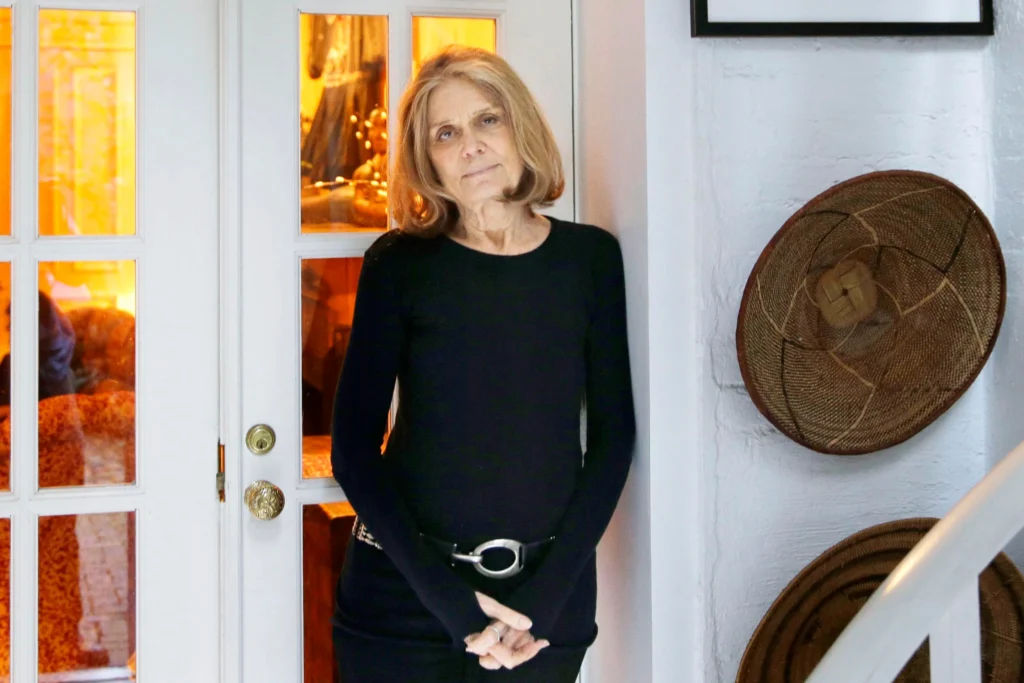
NEW YORK, Sep 3 – Gloria Steinem, the influential writer, activist and co-founder of Ms. Magazine whose voice helped shape the modern women’s rights movement in the United States, has died at the age of 92.
Steinem died Wednesday at her home in New York City after a period of declining health, according to a statement shared through her social media accounts. She had recently completed a memoir that is expected to be released later this year.
For more than six decades, Steinem remained one of the most recognizable and outspoken advocates for gender equality. Known for her distinctive aviator glasses and streaked hair, she traveled extensively, speaking at universities, rallies, community gatherings and political events.
Her death marks the end of an extraordinary public life that transformed her from a journalist struggling to find serious assignments into one of the defining figures of the American feminist movement.
A statement announcing her death remembered Steinem for her ability to make others feel valued and understood, saying that her words, activism and personal example encouraged people to embrace their true identities.
Her longtime friend and fellow activist Abigail Disney, who visited Steinem shortly before her death, said her physical health had weakened but her personality had not.
“She was just as funny and just as sharp as I have ever known her,” Disney said, describing Steinem’s activism as being deeply rooted in kindness.
From Journalism to a Life of Activism
Steinem did not initially set out to become one of the country’s best-known activists. Her professional life began in journalism during an era when women writers were frequently assigned stories about fashion, food and domestic life rather than politics or public affairs.
One of her most famous early assignments came in 1963 when she went undercover as a Playboy Bunny for Show magazine. Her investigation exposed difficult and degrading working conditions inside Hugh Hefner’s Playboy empire. Although the story brought her widespread attention, Steinem later said she regretted the experience and believed it complicated her career.
She later recalled that the assignment became both a personal and professional burden. In the short term, she said, it made obtaining other writing assignments more difficult, while critics continued to use the experience to diminish her achievements.
A turning point came in 1969 while Steinem was covering a gathering where women publicly discussed their experiences with abortion. The event helped push her toward activism.
Steinem herself had undergone an illegal abortion at age 22 while in London, a deeply personal experience she kept private for years. Decades later, while discussing the U.S. Supreme Court’s reversal of Roe v. Wade, she argued that control over one’s own body was fundamental to democracy and equality.
Her political involvement steadily grew, and in 1971 she joined Betty Friedan, Shirley Chisholm and Bella Abzug in establishing the National Women’s Political Caucus.
A Reluctant Speaker Who Found Her Voice
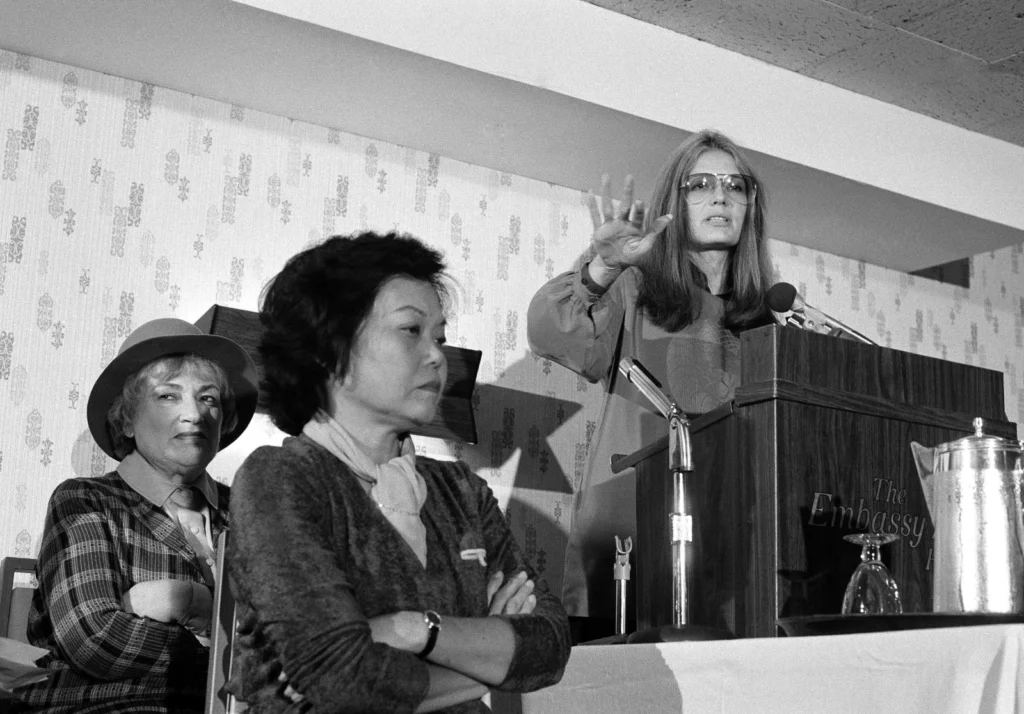
Despite eventually becoming a powerful public speaker, Steinem openly acknowledged that she once feared speaking before audiences.
She had initially hoped to remain primarily a writer, but editors showed little interest in publishing serious coverage of the growing women’s movement. As a result, Steinem began traveling and speaking directly to audiences.
The experience terrified her at first.
In a 2015 interview, Steinem explained that she remained nervous about public speaking even after decades on the stage. Yet the work also convinced her that activism required personal interaction.
She believed people could not fully understand one another from a distance. Speaking directly with people, she said, created a level of empathy that could not easily be achieved through telephones or digital communication.
Her partnership with Dorothy Pitman Hughes, a Black feminist and child welfare advocate, became particularly significant during this period. The two spoke together across the country at a time when the women’s movement was frequently criticized for representing primarily white, middle-class women.
A famous photograph showing Steinem and Hughes raising their fists together became one of the most enduring images associated with the era.
The Rise of Ms. Magazine
In 1972, Steinem co-founded Ms. Magazine, creating a publication that gave women’s rights, gender discrimination and feminist ideas a prominent national platform.
The magazine faced skepticism almost immediately. Many male commentators dismissed the project and predicted it would quickly disappear.
Steinem later said she had been deeply concerned that its failure would damage the broader women’s movement. Instead, Ms. became one of the most influential publications associated with American feminism.
Even President Richard Nixon was among those who ridiculed Steinem and the use of the title “Ms.,” according to recordings from the Nixon administration. Steinem responded to criticism with the sharp humor that became one of her trademarks.
Her wit helped her confront hostility throughout her career. She was criticized, mocked and sometimes personally attacked, including during television appearances and in magazine profiles. Yet she often argued that open hostility was, in some ways, preferable to having feminist ideas dismissed as irrelevant.
A Childhood That Shaped Her Worldview
Gloria Marie Steinem was born on March 25, 1934, in Toledo, Ohio. Her childhood was far from conventional.
Her father worked as a traveling antique dealer, and Steinem spent much of her early life moving from place to place with her parents. She did not attend a traditional school regularly and instead spent much of her time reading.
Her parents divorced in 1944, leaving the 10-year-old Steinem with major responsibilities for her mother, who had once been a promising journalist but later experienced serious personal struggles and a nervous breakdown.
Steinem attended Smith College during the 1950s, when she believed many women were being educated primarily for marriage and motherhood. She briefly became engaged but decided marriage was not the life she wanted at that stage.
Instead, she accepted a fellowship that allowed her to travel to India. The experience broadened her worldview before she eventually moved to New York City to pursue journalism.
There, she encountered the discrimination that would later inform much of her activism. She spoke about difficulties faced by unmarried women in securing housing and about workplace sexual harassment during a period when the behavior had not yet been widely identified by that term.
A Global Voice for Women’s Equality
Steinem’s activism continued long after the height of the women’s liberation movement.
Well into her 80s, she traveled internationally and spoke about issues ranging from women’s rights and reproductive freedom to international reconciliation and violence against women.
In 2020, her life story reached a new generation through the film The Glorias. More recently, at age 91, she collaborated with Liberian peace activist and Nobel Peace Prize laureate Leymah Gbowee on the children’s picture book Rise, Girl, Rise: Our Sister-Friend Journey. Together for All, encouraging young people to participate in efforts to improve the world.
Although her public image remained strong, Steinem often expressed frustration that discussions of her appearance continued to overshadow her work.
She noted that she had rarely been described as glamorous or beautiful before becoming publicly associated with feminism. To her, such labels sometimes appeared to distract from the work and achievements of women.
A Legacy That Extended Across Generations
Steinem’s life changed again in 2000 when, at age 66, she married British activist and businessman David Bale, the father of actor Christian Bale.
She had long been known for joking about her decision to remain unmarried, once saying she could not “mate in captivity.” But she later explained that her understanding of marriage had changed.
Bale became ill with brain lymphoma, and Steinem cared for him until his death in 2003.
Steinem never had children and repeatedly said she did not regret that decision. She argued that genuine equality required women to have meaningful choices about how to live their lives.
Her 2015 memoir, My Life on the Road, reflected on decades spent traveling, even though she never learned to drive. Steinem said she preferred being a passenger because it gave her more opportunities to talk with people, including taxi drivers and those who picked her up from airports.
One of her most memorable later public appearances came during the Women’s March in Washington on Jan. 21, 2017. Addressing a massive crowd, Steinem emphasized the power of people coming together and supporting one another.
For many women, she remained a defining voice of the movement. Yet Steinem consistently resisted the idea that history should focus on a single individual.
She often suggested that social movements succeed because of countless people working together, not because of one famous figure.
In the end, perhaps that belief best captured Steinem’s legacy. Although she became one of the most recognizable faces of modern feminism, she repeatedly encouraged younger generations to define themselves rather than simply follow her example.
Her influence will remain visible in the institutions she helped build, the conversations she changed and the generations of activists who followed.
For Gloria Steinem, equality was never simply a historical debate. It was an unfinished project, one that required people to listen, speak out and recognize their own power.