

What’s happening?
- • Ceasefire staggers as Israel intensifies bombardment of Beirut
- • Iran maintains blockade on the strategic Strait of Hormuz
- • Dispute erupts over whether Lebanon is included in the truce deal
- • US Vice President JD Vance to lead peace negotiations in Islamabad
- • Beirut suffers deadliest day of conflict amid collapsing ceasefire hopes
April 9: A Day of High-Stakes Diplomacy and Deepening Uncertainty
As we conclude our live coverage for Thursday, the geopolitical landscape remains incredibly volatile ahead of the Islamabad talk. Here are the key developments from today:
- Diplomatic Pressure: President Trump confirmed he requested PM Netanyahu to “low-key” operations in Lebanon, while Washington announced direct Israel-Lebanon talks starting next week.
- The “Victory” Narrative: Ayatollah Mojtaba Khamenei declared a “definitive victory” over the U.S. and Israel, signaling a defiant stance even as ceasefire talks loom.
- Ceasefire Violations: Kuwait and Saudi Arabia reported drone and pipeline attacks, accusing Iranian proxies of undermining the truce, though the IRGC has issued a denial.
- Strait of Hormuz: Ship-tracking data shows the waterway remains under tight Iranian control, with traffic at a mere fraction of peacetime levels.
- Global Impact: Rising jet fuel costs are beginning to hit travelers worldwide, and South Korea is dispatching a special envoy to Tehran to secure its stranded vessels.
Stay tuned to THE INFO ZONE NEWS for continued reporting on the escalating regional crisis and its impact on global stability.
You can find the latest developments here.
South Korea announced on Friday that it will send a senior diplomat to Iran to negotiate the safe passage of its vessels and citizens currently caught in the Middle East conflict. The Foreign Ministry in Seoul has appointed Chung Byung-ha, the current ambassador for polar affairs and former ambassador to Kuwait, as a special envoy for this high-priority mission.
The decision follows a critical phone conversation on Thursday between South Korean Foreign Minister Cho Hyun and his Iranian counterpart, Abbas Araghchi. During the call, Araghchi reportedly welcomed the dispatch of an envoy to discuss maritime safety. South Korea’s primary objective is to secure the release of at least 26 Seoul-linked vessels that remain stranded in the Strait of Hormuz due to strict Iranian military restrictions and the ongoing blockade.
In addition to seeking the release of its own ships, Ambassador Chung is tasked with pushing for broader “freedom of navigation” for all international commercial vessels in the strategic waterway. Seoul has emphasized that the safety of South Korean crews and the stability of global energy supply lines are non-negotiable interests that require direct coordination with Tehran’s armed forces.
The move highlights the growing international pressure on Iran to ease its “chokehold” on the strait during the 14-day ceasefire. As Ambassador Chung prepares to depart for Tehran, South Korean officials are hopeful that this bilateral track will complement the larger multi-party peace talks currently unfolding in Islamabad.
New ship-tracking data released on Thursday night highlights Iran’s continued and absolute control over the Strait of Hormuz, despite the ongoing ceasefire. In a notable incident, the Nidi, a Botswana-flagged liquefied natural gas (LNG) tanker, attempted to exit the Persian Gulf via a designated route ordered by the Revolutionary Guard. However, tracking data showed the vessel suddenly performed a U-turn and retreated early Friday morning, indicating the extreme volatility and strict Iranian oversight of the waterway.
According to the data firm Kpler, four tankers and three bulk carriers successfully navigated the strait on Thursday. This brings the total number of verified vessels passing through the strategic chokepoint since the ceasefire began to at least 12. While some ships may be transiting without broadcasting their locations (AIS), the current traffic remains a staggering decline from peacetime operations, where the strait typically averaged well over 100 ships daily.
The slow trickle of maritime traffic underscores the significant hurdles facing the Trump administration’s demand for a complete reopening of the waterway. Shipping companies remain hesitant to resume normal operations as the IRGC continues to enforce arbitrary routes and inspection protocols. The Nidi’s abrupt reversal is being viewed by maritime security experts as a clear signal that the “free flow of commerce” has not yet been restored.
As international negotiators prepare to gather in Islamabad, the status of the Strait of Hormuz remains the most critical point of contention. While the 14-day truce has paused direct military exchanges, the economic blockade persists, keeping global energy markets in a state of high alert and leaving billions of dollars in cargo stranded within the Persian Gulf.
Iran’s Islamic Revolutionary Guard Corps (IRGC) issued a formal statement on Thursday night, categorically denying involvement in the drone attacks reported by Kuwait and Saudi Arabia. The statement, carried by the state-run IRNA news agency, comes as a direct response to accusations that Tehran violated the 14-day ceasefire just 48 hours before high-level negotiations are set to begin in Islamabad.
“If these reports published by the media are true, without a doubt it is the work of the Zionist enemy or America,” the IRGC stated, suggesting that the strikes were a “false flag” operation designed to sabotage the peace process. The Guard maintained that its forces have strictly adhered to the Supreme Leader’s directives regarding the temporary truce and have not launched any projectiles toward neighboring Gulf states since the ceasefire took effect.
However, regional security analysts and Western intelligence agencies remain skeptical of the denial. Throughout the conflict, the IRGC has been linked to numerous strikes on civilian and energy infrastructure, often utilizing Shia militias in Iraq and Houthi rebels in Yemen to maintain a degree of “plausible deniability.” The use of proxy forces allows Tehran to exert military pressure while officially claiming diplomatic compliance.
The timing of the denial is critical, as any confirmed violation of the truce could lead to an immediate resumption of U.S. and Israeli airstrikes. As the Iranian delegation, led by Parliament Speaker Mohammad Bagher Qalibaf, arrives in Pakistan, the shadow of these “mystery” attacks hangs over the summit, with Kuwait and Saudi Arabia demanding verifiable guarantees for their national security.
Tensions in the Gulf escalated sharply on Thursday as Kuwait formally accused Iran and its regional proxies of launching a wave of drone attacks against vital national facilities. According to a statement from Kuwait’s Foreign Ministry, carried by the state-run KUNA news agency, the strikes occurred late Thursday night, causing “significant material damage” to a National Guard site. Kuwait denounced the acts as a flagrant violation of its sovereignty and warned that such aggression directly undermines the fragile 14-day ceasefire between the United States and Iran.
Simultaneously, Saudi Arabia’s state-run Press Agency (SPA) confirmed that a recent attack has severely damaged the kingdom’s crucial East-West pipeline. The facility, which is the primary alternative route for transporting oil to the Red Sea while bypassing the blocked Strait of Hormuz, reportedly saw its throughput capacity slashed by 700,000 barrels per day. The Ministry of Energy also disclosed damage to the Manifa oil field, resulting in a further production cut of 300,000 barrels per day. One security officer was reportedly killed and seven others wounded in the strikes.
The Revolutionary Guards in Tehran have issued a public denial, claiming they have launched no new attacks during the ceasefire period. However, the timing of these incidents—just 48 hours before high-level peace talks are set to begin in Islamabad—has placed immense pressure on the diplomatic track. U.S. President Donald Trump reacted to the developments on social media, accusing Iran of “dishonorable” conduct for maintaining its chokehold on global energy supplies despite the agreed pause in fighting.
With Saudi Arabia’s strategic reserves dwindling and Kuwait placing its military on high alert, the upcoming Pakistan summit is now being viewed as a “make-or-break” moment. Analysts suggest that if Iran cannot control its proxies or guarantee the security of regional infrastructure, the U.S. and its Gulf allies may consider the 14-day truce effectively void before the weekend negotiations even begin.
Air travelers worldwide are facing a sharp increase in ticket prices and widespread flight disruptions as the conflict in the Middle East continues to destabilize global energy markets. Volatile oil and jet fuel prices have fluctuated wildly since the war began on February 28, with the ongoing blockade of the Strait of Hormuz cutting off nearly 40% of the world’s aviation fuel supply.
Airlines have responded to the crisis by trimming flight schedules, cancelling thousands of routes, and implementing aggressive fuel surcharges. Industry data shows that jet fuel prices have surged by more than 60% in recent weeks, forcing carriers to pass these costs directly to consumers. Budget airlines and price-sensitive travelers are feeling the impact most acutely, though premium cabins and business travelers are also seeing double-digit fare hikes.
The European Union Aviation Safety Agency (EASA) has extended airspace restrictions across 11 countries in the Gulf and Middle East through late April, further complicating global travel. Airlines must now utilize longer, more expensive flight paths to bypass conflict zones, adding hours to journey times and significantly increasing operational expenses. In Europe, some airports have already begun emergency fuel rationing as strategic reserves dwindle.
Aviation experts warn that even if the current 14-day ceasefire leads to a drop in crude oil prices, travelers should not expect immediate relief. Due to the lag in airline pricing models and the time required to restabilize supply chains, high airfares and reduced flight options are likely to persist for several months. For many, the rising cost of travel is forcing difficult decisions about whether international trips remain financially viable.
As the international community prepares for the Islamabad peace summit, China is increasingly being viewed as a central player in the diplomatic endgame of the U.S.-Iran war. President Donald Trump, in a recent interview with Agence France-Presse (AFP), appeared to confirm Beijing’s influence, stating, “I hear yes,” when asked if China had encouraged Tehran to accept the current 14-day ceasefire.
Diplomatic sources suggest that Chinese Foreign Minister Wang Yi held over 25 high-level calls in the lead-up to the truce, utilizing Beijing’s status as Iran’s largest oil buyer to nudge the leadership toward negotiations. This involvement is being interpreted by experts as a strategic move to position China as a global stabilizing force, potentially shifting the geopolitical balance of power in the Middle East away from traditional Western-led frameworks.
The timing of China’s intervention is particularly significant as President Trump is scheduled to visit Beijing in mid-May for a high-stakes summit with President Xi Jinping. Analysts believe that by facilitating the reopening of the Strait of Hormuz—a key priority for the Trump administration—Beijing may gain substantial leverage in upcoming trade negotiations, potentially softening the U.S. stance on tariffs and technology restrictions.
While the U.S. has publicly welcomed China’s assistance in de-escalating the conflict, there are concerns in Washington that Beijing’s growing role as a “peace guarantor” could weaken American influence in the region. For now, the focus remains on whether China can use its unique relationship with Iran to turn the temporary pause into a permanent settlement during the discussions in Pakistan.
British Prime Minister Keir Starmer held a phone conversation with President Donald Trump on Thursday while traveling in Qatar, focusing on urgent efforts to restore international shipping through the Strait of Hormuz. The call follows Starmer’s two-day diplomatic tour of the Gulf, which included stops in Saudi Arabia, Bahrain, and the United Arab Emirates to build momentum for the current ceasefire.
According to a statement from Downing Street, both leaders agreed that with a truce now in place, the priority must shift to a “practical plan” for resuming tanker traffic. Starmer emphasized the need for “freedom of navigation” and rejected suggestions that Iran could impose tolls or conditions on vessels passing through the vital waterway. The UK has reportedly been leading a coalition of over 30 countries to coordinate maritime security once the strait officially reopens.
Despite the constructive tone of the call, tensions remain between the two leaders. President Trump has frequently criticized Starmer’s initial reluctance to allow the U.S. and Israel to use British military bases for offensive strikes at the war’s onset. While the UK later permitted “defensive” use of its facilities, Starmer has remained vocal about his opposition to “regime change from the skies” and has criticized recent Israeli strikes in Lebanon as “wrong.”
Starmer described the current ceasefire as “fragile” and warned that regional stability depends on turning the temporary pause into a lasting peace agreement. He is expected to continue coordinating with Gulf allies to ensure that energy markets are protected from further disruptions as the Islamabad summit approaches.
A senior U.S. official confirmed on Thursday that the State Department will host direct negotiations between Israel and Lebanon starting next week in Washington. The talks represent a major diplomatic push by the Trump administration to resolve the escalating conflict between Israel and Hezbollah, which has continued despite the broader U.S.-Iran truce.
According to sources familiar with the planning, the American delegation will be led by the U.S. Ambassador to Lebanon, Michel Issa. Israel will be represented by its Ambassador to the United States, Yechiel Leiter. On the Lebanese side, reports indicate that Ambassador Nada Hamadeh-Moawad is expected to lead the delegation, marking a rare instance of direct diplomatic engagement between the two neighboring states.
While the exact agenda remains confidential, the primary focus is expected to be a sustainable ceasefire and a framework for Hezbollah’s disarmament. The announcement follows intense pressure from the White House on Prime Minister Netanyahu to “low-key” military operations and shift toward a political settlement.
The first in-person meeting is reportedly scheduled for Tuesday at the State Department. This Washington-based track will run parallel to the high-level summit in Islamabad, signaling a multi-front diplomatic effort to stabilize the Middle East and prevent a full-scale regional war.
In a phone interview with NBC News on Thursday, President Donald Trump revealed that he has personally requested Israeli Prime Minister Benjamin Netanyahu to scale back military operations in Lebanon. The move is seen as an effort to stabilize the regional environment before high-level peace negotiations commence in Islamabad this weekend.
“I spoke with Bibi and he’s going to low-key it. I just think we have to be sort of a little more low-key,” Trump stated. The President’s intervention follows the deadliest day of the conflict in Lebanon, where intensified Israeli strikes on Wednesday resulted in record casualties and threatened to derail the fragile U.S.-Iran truce.
Prime Minister Netanyahu, while maintaining that “there is no ceasefire in Lebanon” until security is fully restored in northern Israel, confirmed on Thursday that he has authorized the opening of direct negotiations with the Lebanese government. These talks, which Netanyahu aims to begin “as soon as possible,” will focus specifically on the disarmament of Hezbollah and the establishment of a sustainable peace agreement.
The White House believes that shifting from military escalation to a diplomatic track in Lebanon is crucial for the success of the broader Islamabad summit. However, despite the “low-key” agreement, the Israeli military has continued targeted operations against Hezbollah infrastructure, albeit at a noticeably reduced intensity following the President’s call.
In a phone interview with NBC News on Thursday, President Donald Trump expressed strong optimism regarding the upcoming peace negotiations in Islamabad. Trump revealed that while Iranian leaders maintain a defiant public stance, their tone in private diplomatic channels is significantly different and “much more reasonable.”
“They talk much differently when you’re at a meeting than they do to the press,” Trump stated. He suggested that the 14-day ceasefire is holding because Tehran understands its current military disadvantage. Using characteristic hardline rhetoric, the President added, “They’re agreeing to all the things that they have to agree to. Remember, they’ve been conquered. They have no military.”
Despite the confidence, Trump issued a stark warning that failure to reach a permanent agreement during the Pakistan summit would result in “very painful” consequences for the Islamic Republic. He confirmed that Vice President JD Vance, along with Jared Kushner and Steve Witkoff, are heading to Islamabad with a clear mandate to finalize the deal.
The President also noted that he had spoken with Israeli PM Netanyahu to “low-key” operations in Lebanon to give the talks a better chance of success. “I am very optimistic about the prospects,” Trump concluded, even as he maintains a “maximum pressure” posture until a final document is signed.
In a significant statement broadcast on Iranian state television Thursday, Supreme Leader Ayatollah Mojtaba Khamenei declared the Iranian people the “definitive victors” in the current conflict. The message, read by an anchor, described the Islamic Republic as an emerging great power while characterizing the U.S. and Israel as being on a “downhill slope of weakness.”
This address marks a pivotal moment for the younger Khamenei, who assumed leadership on March 8 after his father, Ali Khamenei, was killed in an Israeli airstrike on the war’s first day. Notably, the Supreme Leader has not been seen or heard in public since his appointment. Intelligence reports suggest he may have suffered severe injuries in the same strike that killed his father, leading to widespread speculation about his physical condition.
In the written message, Khamenei also touched upon the upcoming ceasefire negotiations in Islamabad, pledging that the management of the strategic Strait of Hormuz will enter a “new era.” While the U.S. has demanded the immediate reopening of the waterway as a condition of the truce, Tehran appears to be positioning the blockade as a permanent shift in regional leverage.
Despite his public absence, state media continues to project Mojtaba Khamenei as a “janbaz” (wounded hero) who remains mentally sharp and firmly in control of the state’s strategic decisions during this transition toward diplomatic talks.
Asim Iftikhar Ahmad, Pakistan’s permanent representative to the United Nations, addressed reporters on Thursday to clear the mounting confusion surrounding the scope of the regional truce. He asserted that the inclusion of Lebanon in the ceasefire deal involving the U.S., Israel, and Iran was “clearly” outlined in the Prime Minister’s original statement.
“I don’t know why there was confusion about Lebanon being included… when it was clearly cited,” Ahmad remarked, downplaying recent conflicting reports. He emphasized that the situation in Lebanon is a priority and will be a key part of the formal agenda during the high-stakes negotiations in Islamabad this weekend.
The envoy’s comments come at a critical juncture as the 14-day ceasefire faces its first major diplomatic test. Ahmad urged all stakeholders to remain focused on the broader peace process, stating, “I think we should not let anything come in the way of these talks, which are very important” for regional and global stability.
With delegations arriving in the Pakistani capital, Islamabad is doubling down on its role as a neutral mediator, attempting to bridge the gap between Israel’s security demands and Lebanon’s sovereignty within the framework of the current truce.
Israeli Prime Minister Benjamin Netanyahu clarified on Thursday that the recently brokered truce with Iran does not extend to Lebanon. In a video statement, Netanyahu asserted that Israel will continue its military operations against Hezbollah “with full force” until security is completely restored for residents in northern Israel.
Despite the ongoing strikes, Netanyahu confirmed he has instructed his cabinet to initiate direct negotiations with the Lebanese government. He stated that this move follows “repeated requests” from Beirut and will focus on two primary objectives: the complete disarmament of Hezbollah and the establishment of a sustainable, long-term peace agreement between the two nations.
While U.S. President Donald Trump has reportedly urged a more “low-key” approach in Lebanon to protect the broader 14-day ceasefire, Netanyahu remains firm that military pressure will be maintained alongside diplomatic efforts. “Israel will continue striking Hezbollah with force, precision, and determination,” he added.
The announcement of direct talks marks a significant diplomatic shift, as both countries have technically remained at war for decades. However, the Lebanese government has emphasized that a total ceasefire remains a prerequisite for any meaningful progress in these negotiations.
Iranian President Masoud Pezeshkian confirmed on Thursday that the decision to accept a two-week ceasefire with the United States was made unanimously by the country’s top leadership and received the formal approval of Supreme Leader Ayatollah Ali Khamenei. The statement aims to project a unified front in Tehran as the nation prepares for high-stakes diplomatic negotiations.
In a statement shared via Telegram, Pezeshkian clarified that the pause in hostilities should not be interpreted as a sign of weakness. Instead, he described the ceasefire as a calculated move to “solidify Iran’s proud victories” achieved during the past month of intensified regional conflict. He credited the Iranian public’s resilience and unwavering support as the driving force behind the government’s current diplomatic leverage.
The President’s remarks echo a broader narrative within Tehran that the 14-day ceasefire is a strategic achievement, allowing the state to regroup and negotiate from a position of strength. This rhetoric comes at a critical time as international observers watch for signs of Iran’s true intentions regarding the reopening of the Strait of Hormuz.
With the Supreme Leader’s explicit backing, the Iranian delegation heading to the Islamabad summit is expected to maintain a firm stance on regional sovereignty and the lifting of economic sanctions as part of any permanent peace agreement.
In a brief but high-tension “pro forma” session on Thursday, House Republicans successfully blocked an effort by Democrats to pass a resolution that would have required President Trump to obtain congressional approval for further military actions against Iran. The symbolic move, while expected to fail, signals deep-seated frustration among lawmakers over the administration’s unilateral military strategy.
Representative Glenn Ivey (D-MD) attempted to force a vote on the War Powers Resolution via unanimous consent. However, Representative Christopher Smith (R-NJ), acting as Speaker pro tempore, refused to recognize Ivey and promptly gavelled the session to an end. The move sparked immediate outcry on the floor, with Rep. James Walkinshaw (D-VA) shouting, “Let us vote!” as Republicans adjourned the chamber.
Democrats have argued that despite the current two-week ceasefire agreement, the President’s recent rhetoric—including threats of “total annihilation”—necessitates immediate legislative oversight. Rep. Ivey later told reporters that it is time for Congress to “take control of the wheel” to prevent an unhindered escalation of the conflict.
While legislative business is rarely conducted during these brief sessions, the confrontation serves as a preview of the political battle ahead. Democratic leadership has vowed to force a formal vote on the measure next week when the full House returns from its recess on April 14.
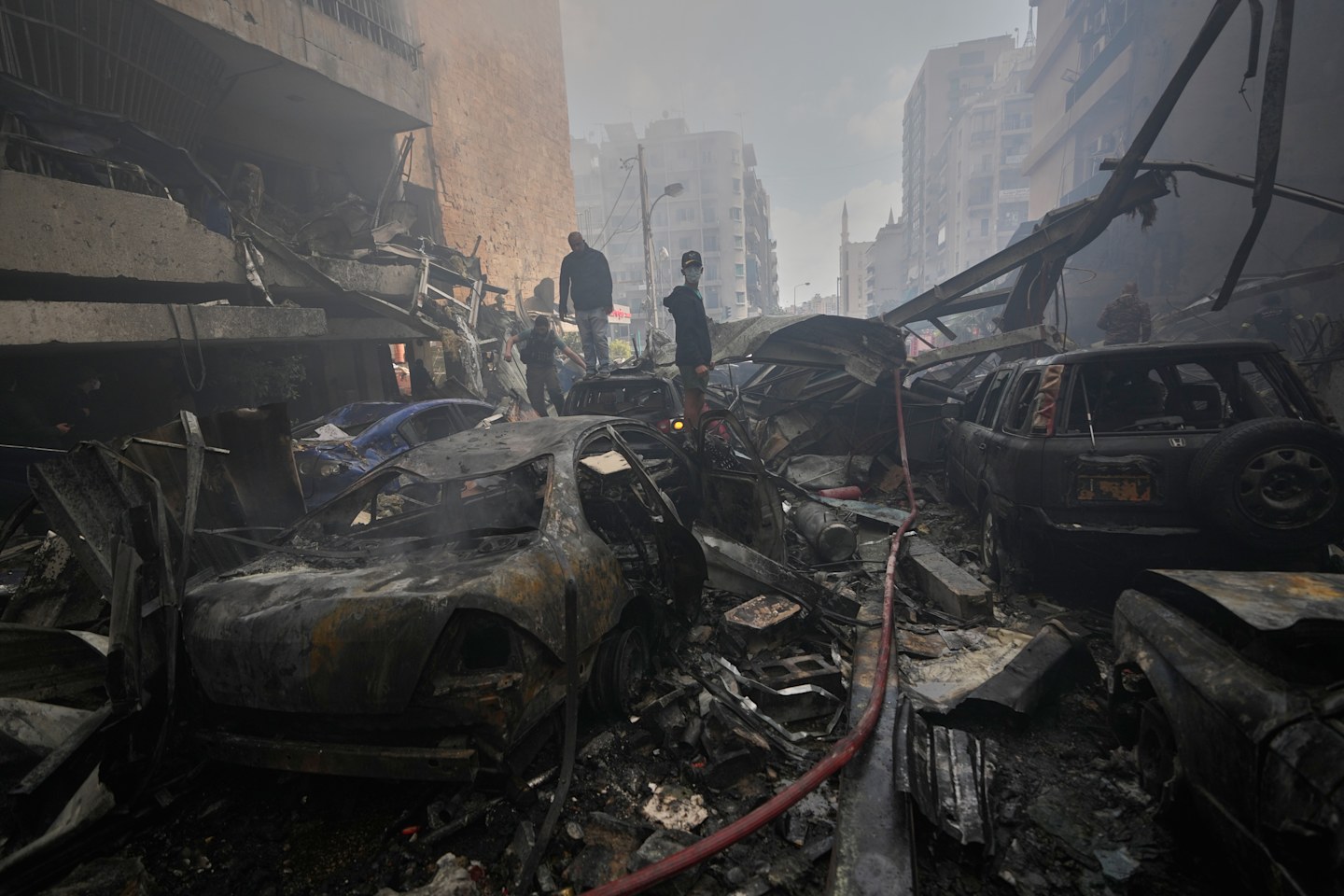
Residents check the site of an Israeli airstrike in central Beirut. (Photo: AP)
In a powerful display of international concern, more than 80 countries issued a joint statement on Thursday strongly condemning the persistent military attacks in Lebanon and the recent killings of United Nations peacekeepers. The coalition denounced the “unacceptable aggressive behavior” directed at the personnel and leadership of the UNIFIL mission.
The statement was delivered by Indonesia’s U.N. Ambassador Umar Hadi. Indonesia has been directly impacted by the violence, recently mourning the loss of three peacekeepers in southern Lebanon. While a preliminary U.N. report attributed two of those deaths to Israeli forces and one to Hezbollah, the joint statement called for broad accountability without naming specific parties, emphasizing that attacks on peacekeepers may constitute war crimes.
Notably, the United States was absent from the list of signatories. The U.S. has recently advocated for the conclusion of the UNIFIL mission by the end of 2026. Despite this, the 80+ nations reaffirmed their unwavering support for the peacekeeping force and called on all warring parties to urgently return to the 2024 ceasefire framework to prevent further regional destabilization.
Prime Minister Shehbaz Sharif held a high-level meeting with the Chief of Army Staff, Field Marshal Asim Munir, on Thursday to review the progress of Pakistan’s diplomatic efforts in brokering the U.S.-Iran ceasefire. The meeting comes as a critical precursor to the official delegation-level talks scheduled to begin in Islamabad this weekend.
According to a statement from the Prime Minister’s Office, both leaders expressed satisfaction over the current de-escalation but stressed the absolute necessity for all parties to maintain the 14-day ceasefire. Field Marshal Munir, who has been credited with maintaining a direct back-channel with the Trump administration, emphasized that regional stability depends on the strict adherence to the truce by both state and non-state actors.
The leadership reiterated Pakistan’s commitment to providing “all-out support” to ensure the upcoming negotiations yield a permanent settlement. Prime Minister Sharif lauded the restraint shown by all sides so far and renewed his invitation to the arriving foreign delegations, promising the highest level of security and facilitation in the capital.
Pakistan has emerged as the primary facilitator in this conflict, leveraging its unique diplomatic position to bridge the gap between Washington and Tehran. The upcoming talks in Islamabad are viewed globally as the last best hope to prevent a total regional conflagration.
Abdul Malik al-Houthi, the leader of the Iran-backed Houthi movement in Yemen, characterized the recently announced ceasefire between the United States and Iran as a “big victory” for the Islamic Republic. In a video statement released Thursday via Telegram, al-Houthi claimed that Tehran’s strategic resilience allowed it to “defeat the enemy.”
The rebel leader also praised Hezbollah’s operations in Lebanon, stating that the group is currently engaged in one of its most significant military battles. He reaffirmed the Houthis’ role in the regional conflict, claiming his group successfully prevented Israel and the U.S. from utilizing the Red Sea as a launchpad for attacks against Iran, while confirming continued Houthi strikes targeting Israel.
Furthermore, al-Houthi defended Iran’s decision to close the Strait of Hormuz, describing the blockade as a “major pressure tactic” that effectively neutralized the influence of the U.S. and its regional allies. These comments underscore the unified stance of the “Axis of Resistance” as diplomatic tensions remain high ahead of the Islamabad negotiations.
— محمدباقر قالیباف | MB Ghalibaf (@mb_ghalibaf) April 9, 2026
Iranian Parliament Speaker Mohammad Bagher Ghalibaf has asserted that Lebanon and the broader “Resistance Axis” are integral components of the ongoing two-week ceasefire with the United States. In a firm statement released on Thursday, Ghalibaf warned that any further violations would lead to severe repercussions.
“Lebanon and the entire Resistance Axis, as Iran’s allies, form an inseparable part of the ceasefire,” Ghalibaf stated in a post on X. His remarks follow a series of devastating Israeli strikes across Lebanon that have tested the limits of the fragile diplomatic truce.
The Speaker emphasized that the costs for breaking the agreement would be explicit, promising “STRONG responses” to continued military escalations. This warning underscores Tehran’s position that the ceasefire cannot be limited to direct U.S.-Iran hostilities while its regional allies remain under fire.
South Korea has announced plans to dispatch a special envoy to Tehran to address the escalating Middle East crisis and advocate for the immediate reopening of the Strait of Hormuz. The move highlights the growing international pressure on Iran to restore maritime stability in the Persian Gulf.
In a high-level phone call on Thursday, South Korean Foreign Minister Cho Hyun urged his Iranian counterpart, Abbas Araghchi, to ensure the swift resumption of safe and free navigation for all commercial vessels, including South Korean ships. Cho also emphasized the necessity of ensuring the safety of South Korean nationals currently residing in Iran.
According to the South Korean Foreign Ministry, Minister Araghchi welcomed the decision to send an envoy. While the primary focus remains the maritime blockade, the envoy is also expected to raise other “unspecified bilateral issues” during the visit, signaling a broader diplomatic engagement between Seoul and Tehran ahead of the Islamabad summit.
The Strait of Hormuz remains a critical energy artery for South Korea, and the prolonged closure has prompted Seoul to take a more direct role in the ongoing diplomatic negotiations.
Anwar Gargash, a senior diplomatic adviser to the UAE President, issued a firm statement on Thursday, asserting that the “time for pleasantries is over” regarding regional security. Gargash emphasized that candor is now a necessity to strengthen stability and define the “contours of the coming phase” in the Middle East.
The statement follows a formal declaration by the UAE Foreign Ministry on Wednesday, which held Iran “fully liable” for damages caused to civilian infrastructure and vital facilities during the conflict. The Ministry insisted that Tehran must be held accountable and provide full reparations for the destruction resulting from its military operations.
Tensions remain high as the UAE reported continued Iranian attacks against its territory, occurring even after the United States and Iran reached a fragile two-week ceasefire agreement. The persistence of these hostilities highlights the volatility of the current truce as delegations prepare for high-level talks in Islamabad.
Gargash’s remarks signal a shift toward a more assertive collective stance among regional partners, demanding clear commitments and legal accountability from Iran to ensure long-term peace and security.
Italian Prime Minister Giorgia Meloni issued a sharp rebuke to the Israeli government on Thursday, revealing that Italy has “repeatedly” pressed for a halt to the military escalation in Lebanon. During a parliamentary address, Meloni emphasized Italy’s long-standing commitment to Lebanese sovereignty and the irreplaceable role of its peacekeeping contingent.
The diplomatic tension peaked following an incident on Wednesday where Israeli forces fired warning shots at a clearly identified Italian UNIFIL convoy traveling from Shama to Beirut. While no injuries were reported, at least one vehicle sustained damage. Foreign Minister Antonio Tajani confirmed he has summoned the Israeli ambassador to the Foreign Ministry for an urgent clarification, stating firmly that “the Italian military will remain untouched.”
Defense Minister Guido Crosetto described the incident as “unacceptable,” noting that peacekeepers operating under the UN flag should never be exposed to such risks. The incident has further strained relations between Rome and Jerusalem, as Italy continues to demand total safety guarantees for its 750+ troops stationed in southern Lebanon.
Meloni reiterated that the ongoing bombings on the Lebanese civilian population and the threats to UN personnel are pushing the region toward a “point of no return,” threatening the fragile peace process currently being brokered in Islamabad.
Lebanon’s Health Ministry updated the casualties on Thursday, confirming that at least 203 people were killed and over 1,000 wounded during Wednesday’s massive Israeli air campaign. This marks the highest single-day death toll in Lebanon since the renewed conflict began five weeks ago.
The strikes targeted central Beirut and other key regions during the afternoon rush hour, hitting densely packed commercial and residential buildings without prior warning. While the Israeli military maintains that it was targeting Hezbollah infrastructure, the high number of civilian casualties has sparked international outrage.
Lebanese President Joseph Aoun condemned the operations as “barbaric,” as rescue teams continue to search through the rubble for survivors in the capital’s most crowded neighborhoods. The escalation comes despite the fragile two-week ceasefire currently being observed between the U.S. and Iran.
Israeli Prime Minister Benjamin Netanyahu declared on Thursday that Israel will persist in its military campaign against the Iran-backed Hezbollah militant group in Lebanon. Netanyahu emphasized that strikes would continue “with force, precision, and determination,” even as diplomatic efforts for a broader regional truce are underway.
In a statement shared on social media, the Prime Minister issued a stern warning: “Whoever acts against the citizens of Israel will be harmed.” His comments came as Israeli aerial operations continued across southern Lebanon on Thursday morning, following a massive escalation on Wednesday.
The Israeli government has maintained a consistent stance that its operations against Hezbollah are independent of the two-week ceasefire agreement recently reached with Iran. This divergence in interpretation of the truce has already resulted in hundreds of casualties in Lebanon, complicating the fragile diplomatic opening between Washington and Tehran.
Maritime intelligence firm Lloyd’s List Intelligence reported on Thursday that commercial ship traffic through the Strait of Hormuz has all but disappeared. On the first day of the ceasefire, only three vessels transited the strategic waterway, all of which had current or past links to Iran.
Despite U.S. President Donald Trump’s explicit demand for the strait to be reopened, Iran’s approval system remains in place. All ships seeking safe passage must undergo a rigorous vetting process by the Islamic Revolutionary Guards Corps (IRGC), a policy that continues to restrict international commerce.
While last week saw a slight uptick with 72 passages—the busiest period since the war began—volumes remain 90% below normal levels. Lloyd’s noted that while the majority of allowed vessels are Iranian-connected, some Indian ships have successfully transited following direct diplomatic intervention by the Indian government.
The continued paralysis of this vital chokepoint remains a primary point of contention as global powers look toward the upcoming peace negotiations in Islamabad.
The head of Iran’s nuclear agency, Mohammad Eslami, stated on Thursday that protecting Tehran’s right to enrich uranium is a “necessary” condition for any potential peace agreement with the United States. Eslami, who leads the Atomic Energy Organization of Iran, made these remarks while speaking to journalists during a commemoration event in Tehran.
“It is a part of the necessary (things) that nobody speaks about,” Eslami said, highlighting the U.S. refusal to acknowledge enrichment as a core component of Iran’s 10-point plan for a permanent ceasefire. The 10-point proposal, which Iran views as its primary negotiating framework, includes demands that Washington has historically rejected as non-starters.
These comments come at a high-stakes moment, as high-level delegations from both nations are scheduled to arrive in Islamabad, Pakistan, for critical negotiations this weekend. While the U.S. has described Iran’s enrichment goals as a major obstacle, Tehran remains firm that its nuclear program’s status must be addressed if a lasting truce is to be achieved.
The upcoming summit in Islamabad, led by U.S. Vice President JD Vance and Iranian representatives, is seen as a pivotal opportunity to stabilize the region following weeks of intense conflict.
Spanish Foreign Minister José Manuel Albares announced on Thursday that instructions have been issued for the Spanish ambassador to return to Tehran. The decision comes as international diplomatic efforts intensify to stabilize the region following the announcement of a tentative ceasefire.
Spain had temporarily closed its embassy and evacuated personnel at the onset of the conflict. “I’ve given instructions today to our ambassador in Tehran to return during this time in which a hope for peace is rekindled,” Albares informed legislators during a parliamentary session.
The move drew sharp criticism from Israel. Israeli Foreign Minister Gideon Saar condemned the decision on X, describing it as “an eternal disgrace.” Saar accused the Spanish government of aligning with the Iranian regime, stating that reopening the embassy while political dissidents face execution is a “shameful” act.
This diplomatic friction underscores the deep divisions among international powers regarding the best approach to engage with Tehran as the Islamabad peace talks approach.
The main border crossing between Lebanon and Syria, known as Masnaa on the Lebanese side and Jdeidet Yabous on the Syrian side, resumed operations on Thursday. The crossing had been temporarily closed for five days after the Israeli military threatened to strike the area, alleging its use by Hezbollah for smuggling military equipment.
Both Lebanese and Syrian authorities denied the smuggling allegations, and the threatened strike did not materialize. Lebanese officials credited diplomatic intervention from the United States and Egypt for halting the planned military action. Syria’s port and customs authority announced the “resumption of normal traffic flow” after the elimination of perceived risks.
The reopening is a significant relief for travelers who had been forced to use northern routes, adding several hours to the journey between Beirut and Damascus. This artery is vital for humanitarian movement, as over 200,000 people have crossed from Lebanon into Syria in the five weeks since the conflict between Israel and Hezbollah intensified.
Italian Prime Minister Giorgia Meloni delivered a stern warning to Parliament on Thursday, emphasizing that the full restoration of freedom of movement in the Strait of Hormuz is the most critical element of any lasting agreement between the U.S. and Iran.
Meloni cautioned that any attempts by Iran to impose extra duties or restrictions in the strategic waterway would lead to “unpredictable economic consequences” for the global market. “Full restoration of freedom of movement in the Strait of Hormuz is needed, and it must not be subject to any restrictions,” she stated, referring to reports of disrupted shipping in recent hours.
The Prime Minister also proposed a radical economic shift within the European Union should the crisis worsen. She suggested that the EU should consider suspending the “stability and growth pact”—the set of rules governing public finances—similar to the emergency response seen during the COVID-19 pandemic, to shield European economies from regional instability.
Her remarks highlight the growing anxiety among European leaders regarding energy security and the potential for a wider economic shock if the U.S.-Iran ceasefire fails to secure the Persian Gulf’s vital trade routes.
Britain’s Foreign Secretary, Yvette Cooper, has joined international calls for Lebanon to be formally included in the Middle East ceasefire, warning that continued Israeli strikes are causing mass displacement and a dire humanitarian crisis.
In interviews with Sky News and the BBC on Thursday, Cooper expressed that she is “deeply troubled” by the escalating aerial campaign, describing the scale of yesterday’s attacks as “completely wrong.” Her comments reflect a growing consensus among European nations that the current truce is unsustainable if hostilities continue on the Lebanese front.
In addition to calling for an end to the strikes, Britain has urged Iran to immediately reopen the Strait of Hormuz to commercial shipping. Cooper emphasized that it is “crucial” to ensure that Iran is not permitted to impose tolls or illegal restrictions on the strategic waterway, which remains a vital artery for global trade.
The UK’s stance underscores the diplomatic pressure mounting on both Israel and Iran ahead of the high-level negotiations scheduled to take place in Islamabad.
Iran’s Deputy Foreign Minister, Saeed Khatibzadeh, stated on Thursday that the reopening of the strategic Strait of Hormuz is contingent upon the United States ending its “aggression” in the Middle East and Israel halting its military operations in Lebanon.
Speaking to the BBC, Khatibzadeh clarified that Iran’s decision to close the waterway followed what he described as an “intentional grave violation of the ceasefire” by Israel. He emphasized that Tehran has sent a “crystal-clear” message to the White House, asserting that security for safe passage will only be restored once current regional hostilities cease.
“You cannot have a cake and eat it at the same time,” Khatibzadeh remarked, referring to the U.S. expectation of energy security amid ongoing conflict. He maintained that while Iran recognizes energy security as pivotal for the Persian Gulf, it will only abide by international norms once its conditions regarding regional de-escalation are met.
The statement underscores the fragility of the current truce, as the Strait of Hormuz—a chokepoint for 20% of the world’s oil and gas trade—remains a central bargaining chip in the lead-up to the Islamabad talks.
French President Emmanuel Macron has issued a firm call for all parties to fully respect the tentative ceasefire, specifically emphasizing its application to Lebanon. In separate discussions with Iranian President Masoud Pezeshkian and U.S. President Donald Trump, Macron stated that the decision to accept a truce “must open the way to comprehensive negotiations.”
In a statement shared on X late Wednesday, Macron expressed France’s “full solidarity” with Lebanon following a series of devastating Israeli operations. He spoke with Lebanese President Joseph Aoun and Prime Minister Nawaf Salam, condemning the “indiscriminate strikes carried out by Israel” in the strongest possible terms.
The French President warned that the continued military escalation poses a direct threat to the sustainability of the diplomatic breakthrough. The condemnation follows Lebanon’s deadliest day of the conflict, with over 180 people reported killed on Wednesday alone.
Pakistan’s Interior Minister Mohsin Naqvi held a high-level meeting with U.S. Chargé d’Affaires Natalie Baker on Thursday to discuss the evolving situation in the Middle East and finalize arrangements for the upcoming U.S.-Iran talks in Islamabad.
According to an official statement, the meeting focused on the logistical and security framework for the diplomatic summit. Naqvi emphasized that the visiting American delegation—which includes Vice President JD Vance, Steve Witkoff, and Jared Kushner—will be treated as “special guests” of the state.
The Interior Minister assured the U.S. envoy that a comprehensive, multi-layered security plan has been activated to ensure the full protection of all foreign dignitaries during their stay in the capital. The meeting underscores Pakistan’s commitment to providing a secure environment for the high-stakes negotiations aimed at ending the regional conflict.
An Israeli strike targeted the southern Lebanese village of Abbasiyeh early Thursday morning, killing at least seven people and wounding several others, according to Lebanon’s National News Agency. Officials noted that this is a preliminary death toll and could rise as rescue efforts continue.
The Israeli military has not yet issued a formal statement regarding this specific strike. However, Israel significantly escalated its aerial campaign across Lebanon on Wednesday, maintaining that its operations against the Iran-backed Hezbollah militant group are entirely separate from the fragile two-week ceasefire agreement recently reached with Tehran.
The escalation has led to devastating casualties; Lebanon’s Health Ministry reported that Wednesday’s strikes killed at least 182 people and wounded 890 others, marking the highest single-day death toll since the latest conflict between Israel and Hezbollah began.
Pakistani authorities have announced a two-day closure of schools and government offices in Islamabad to manage public movement and bolster security ahead of the upcoming U.S.-Iran diplomatic summit.
Sweeping movement restrictions have been enforced across the capital, with shipping containers blocking major arteries connecting Islamabad to neighboring Rawalpindi. The city remained unusually quiet on Thursday as residents navigated extensive traffic diversions and stayed away from the heavily fortified central districts.
These stringent measures follow a period of intense domestic unrest in March, during which nationwide protests resulted in over two dozen fatalities. In a particularly violent episode in Karachi, 12 people were killed after demonstrators attempted to storm and set fire to the U.S. Consulate in response to military strikes on Iran.
By clearing the roads and restricting public access, officials aim to prevent a recurrence of such violence while the high-level American and Iranian delegations arrive for negotiations later this week.
Pakistani authorities have significantly intensified security in the capital, Islamabad, ahead of the highly anticipated peace talks between the United States and Iran. Hundreds of additional police and paramilitary forces have been deployed across the city to secure the diplomatic venue.
On Thursday, security forces began sealing off parts of the city using shipping containers to block key access roads leading to the “Red Zone.” This heavily fortified enclave houses the nation’s most sensitive buildings, including the President’s House, the Prime Minister’s Office, the Foreign Ministry, and various foreign embassies.
While the Iranian delegation is expected to arrive later tonight, the identity of its representatives remains undisclosed. In contrast, the White House has already confirmed that U.S. Vice President JD Vance will lead the American negotiating team in hopes of securing a permanent end to the regional conflict.
The talks are being closely watched as a potentially historic diplomatic breakthrough, with local authorities placing the delegations’ expected hotel under a comprehensive security lockdown.

Distraught residents speak to Youssef Al-Mallah, head of the rescue team, at the site of the Basta strike. (Joel Gunter/BBC)
First responders in Beirut are working through the night to locate survivors trapped under the rubble following a wave of intense Israeli strikes that killed at least 182 people and wounded nearly 900 others on Wednesday.
Civil Defense officials reported that despite the widespread devastation, there have been occasional miracles; a wounded woman was pulled alive from the debris in the Ain Mreisseh neighborhood, and another man was rescued from a collapsed building in the capital’s southern suburbs.
However, many families remain in a state of agonizing wait. Mohammad Chehab, a Syrian national whose family was caught in the strikes, noted that while six members have been accounted for, four others remain missing as rescue workers continue to dig through the remains of targeted residential blocks.
Iran’s negotiating team is scheduled to arrive in Islamabad on Thursday night for critical discussions with the United States, according to the Iranian ambassador to Pakistan, Reza Amiri Moghadam.
In a statement shared on X, Moghadam confirmed that the delegation is arriving for “serious talks based on 10 points proposed by Iran.” While the specific members of the team were not identified, the ambassador noted that the proposal includes key demands such as Iran’s right to enrich uranium and continued control over the Strait of Hormuz—terms that have historically been rejected by U.S. President Donald Trump.
The White House has consistently dismissed Iran’s 10-point framework as non-viable. Meanwhile, Moghadam highlighted that the Iranian public remains skeptical of the diplomatic initiative, citing “repeated ceasefire violations by the Israeli regime” in Lebanon as a primary factor for the lack of trust.
The tension underscores a major rift in the current truce agreement, as Israel and the U.S. maintain that the ceasefire does not extend to operations in Lebanon, despite Tehran’s insistence to the contrary.
 AP News

A currency trader monitors international oil prices in Seoul, South Korea, on April 9, 2026. (AP Photo/Ahn Young-joon)
Global energy markets saw a sharp rebound Thursday as oil prices climbed back above $97 per barrel. The surge reflects growing skepticism over the stability of the tentative U.S.-Iran ceasefire.
Market Snapshot:
While prices briefly dipped below $92 following the initial truce announcement, uncertainty regarding the Strait of Hormuz and continued military posturing has driven investors back toward safe-haven assets and pushed energy costs higher.
Ship-tracking data from the trade analytics platform Kpler revealed that only four vessels with active Automatic Identification System (AIS) trackers passed through the Strait of Hormuz on Wednesday.
This count marks a significantly low volume for the strategic waterway on the first day of the tentative ceasefire. However, maritime experts note that this total does not account for the so-called “dark fleet”—vessels that operate with their AIS trackers disabled to avoid detection.
The “dark fleet” is frequently used to transport sanctioned Iranian crude oil to international markets, making the true volume of traffic through the chokepoint difficult to verify officially.
U.S. President Donald Trump issued an online statement Thursday insisting that his surge of warships and troops will remain around Iran “until such time as the REAL AGREEMENT reached is fully complied with.”
Trump’s comments appear to be a strategy to pressure Tehran as uncertainty surrounds the tentative two-week ceasefire. “If for any reason it is not… then the ‘Shootin’ Starts,’ bigger, and better, and stronger than anyone has ever seen before,” Trump wrote on Truth Social.
The President further emphasized that Iran would be prevented from developing nuclear weapons and declared that “the Strait of Hormuz WILL BE OPEN & SAFE,” despite current reports showing that the critical waterway remains stagnant.