
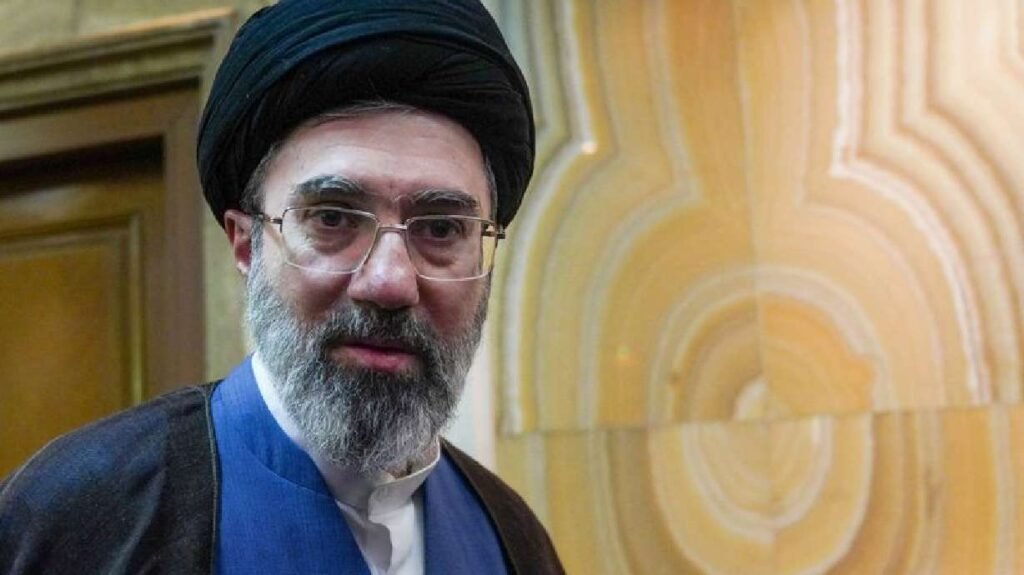
TEHRAN, March 12 – The conflict between Iran and Israel escalated further on Thursday as Iran’s newly appointed Supreme Leader, Mojtaba Khamenei, declared that Tehran would continue its confrontation with both Israel and the United States. In a defiant statement broadcast on Iranian state television, the new leader vowed that Iran would keep the strategically crucial Strait of Hormuz closed as part of its response to the ongoing war.
The comments marked Khamenei’s first public message since he assumed leadership following the death of his father, former Supreme Leader Ali Khamenei, who was reportedly killed in an Israeli strike at the beginning of the conflict. The remarks came at a time when tensions across the Middle East are intensifying, with attacks reported at sea, airstrikes in Lebanon, and rising concerns about disruptions to global oil supplies.
Iran Signals Defiance as Conflict Expands
In the televised message, which was read by a presenter rather than delivered directly by the new leader, Mojtaba Khamenei stressed that Iran would not retreat from its current position. He insisted that the country’s leadership would pursue retaliation for those killed in the war, referring to them as martyrs.
According to Iranian state television, Khamenei emphasized that Iran must continue what he described as “effective defense” against its adversaries. He also reiterated that control over the Strait of Hormuz would remain a key strategic tool. The narrow waterway, located along Iran’s southern coast, is one of the most critical shipping lanes in the world and carries roughly one fifth of global oil supplies.
Khamenei urged neighboring countries hosting American military bases to reconsider their cooperation with Washington. He warned that those installations could become targets if the conflict continues to expand. The message suggested that Iran intends to apply pressure not only through military responses but also by leveraging economic disruption.
The fact that the new leader did not appear on camera raised questions internationally. Iranian officials had previously said he sustained minor injuries during the initial wave of Israeli airstrikes on February 28. However, they have not provided further details about his condition.
Security conditions inside Iran also appear to have tightened. Residents in Tehran described a noticeable increase in the presence of security forces across the capital. A teacher identified as Majan told international media outlets by phone that patrols and checkpoints had become more visible throughout the city. While grocery stores and basic services remain open, many residents are reportedly limiting their movements due to uncertainty about the situation.
Meanwhile, Israel claims its forces have targeted positions associated with the Basij militia in Tehran. The Basij is a volunteer force linked to the Islamic Revolutionary Guard Corps and often plays a role in domestic security operations.
Global Markets and Regional Fronts React
The escalating confrontation has already begun to ripple through international markets. Oil prices surged roughly 9%, climbing close to the $100 per barrel mark after investors reacted to the possibility of a prolonged shutdown of the Strait of Hormuz. Analysts frequently note that even partial disruptions in that corridor can send energy markets into turmoil because so many oil exports from the Middle East depend on the route.
Financial markets in the United States also responded sharply. The S&P 500 index recorded its steepest three day decline in about a month, reflecting growing investor anxiety about geopolitical instability and its potential impact on global trade and inflation.
Events at sea underscored the seriousness of the situation. In Iraq’s southern port city of Basra, two oil tankers were left burning after being struck by vessels believed to be carrying explosives. Video footage circulating online and verified by international journalists showed large fireballs erupting from ships docked in the harbor, lighting up the night sky. Authorities confirmed that at least one crew member died in the incident.
Earlier the same day, three other ships were reportedly attacked in the Gulf region. Iran’s Revolutionary Guard claimed responsibility for striking at least one vessel, a Thai bulk carrier that caught fire after the assault. Another cargo ship reported being hit by an unidentified projectile near the coast of the United Arab Emirates.
The maritime incidents appear to challenge claims from both Israel and the United States that Iran’s military capabilities had already been significantly weakened during the early stages of the conflict.
On land, fighting has also intensified in Lebanon. Israeli warplanes conducted airstrikes in central Beirut, sending thick columns of smoke rising over the city skyline. The Israeli military later issued evacuation orders for additional areas in southern Lebanon as it expanded operations against Hezbollah, the Iran backed militant group.
According to Lebanese officials and humanitarian organizations, the war has already claimed more than 2000 lives across the region, including nearly 700 in Lebanon alone.
Israeli Prime Minister Benjamin Netanyahu addressed the situation in his first press conference since hostilities began. Speaking from Jerusalem, he defended Israel’s military campaign and issued a warning directed at Iran’s leadership. Netanyahu said he would not guarantee the safety of leaders connected to organizations that threaten Israel, though he declined to outline specific plans.
Across the Gulf region, reports of drones entering the airspace of several countries added another layer of uncertainty. Authorities in Kuwait, Iraq, the United Arab Emirates, Bahrain, and Oman reported sightings of unmanned aircraft believed to have originated from Iran or its allies.
Meanwhile, Donald Trump, the President of the United States, attempted to downplay concerns about rising energy prices. In a social media post, he argued that the United States benefits from higher oil prices because it is the world’s largest producer of crude oil. However, economists note that sustained price increases could still lead to higher inflation and increased costs for consumers.
U.S. Treasury Secretary Scott Bessent, speaking in an interview with Sky News, suggested that the U.S. Navy could eventually escort commercial vessels through the Strait of Hormuz if conditions allow. Such a mission would likely involve cooperation from allied nations and could become a major international security operation.
Iranian officials, however, continue to signal that their strategy may involve maintaining economic pressure for as long as necessary. A spokesperson for Iran’s military command recently warned that global oil prices could eventually reach $200 per barrel if the confrontation persists.
For now, the conflict shows little sign of easing. With attacks occurring across land, sea, and air, and major powers involved either directly or indirectly, analysts warn that the region could be entering a prolonged period of instability with global consequences.