
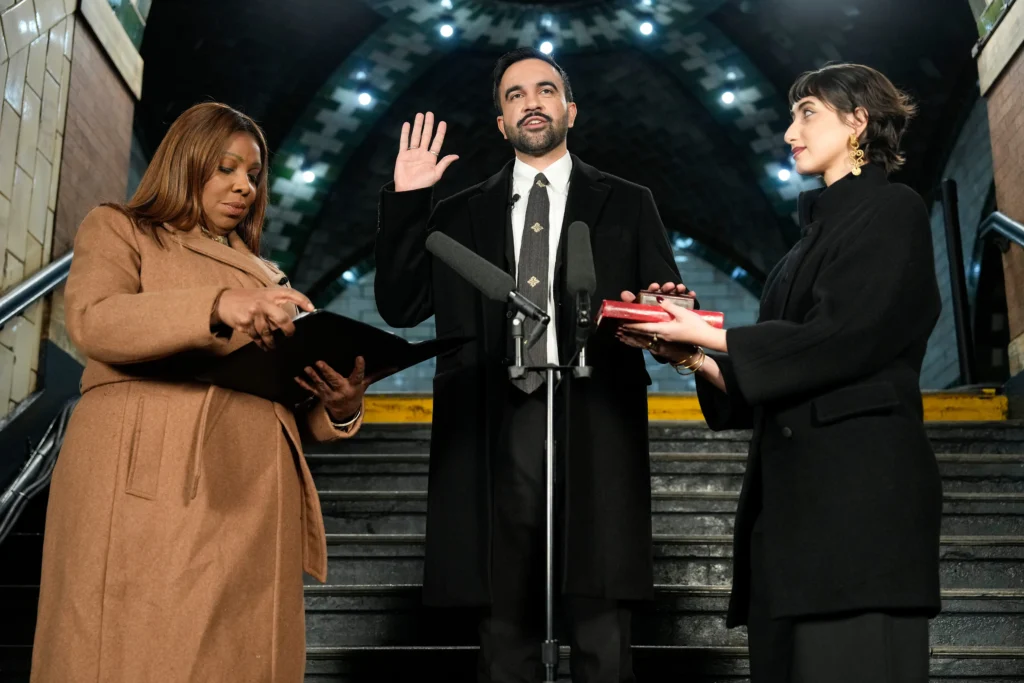
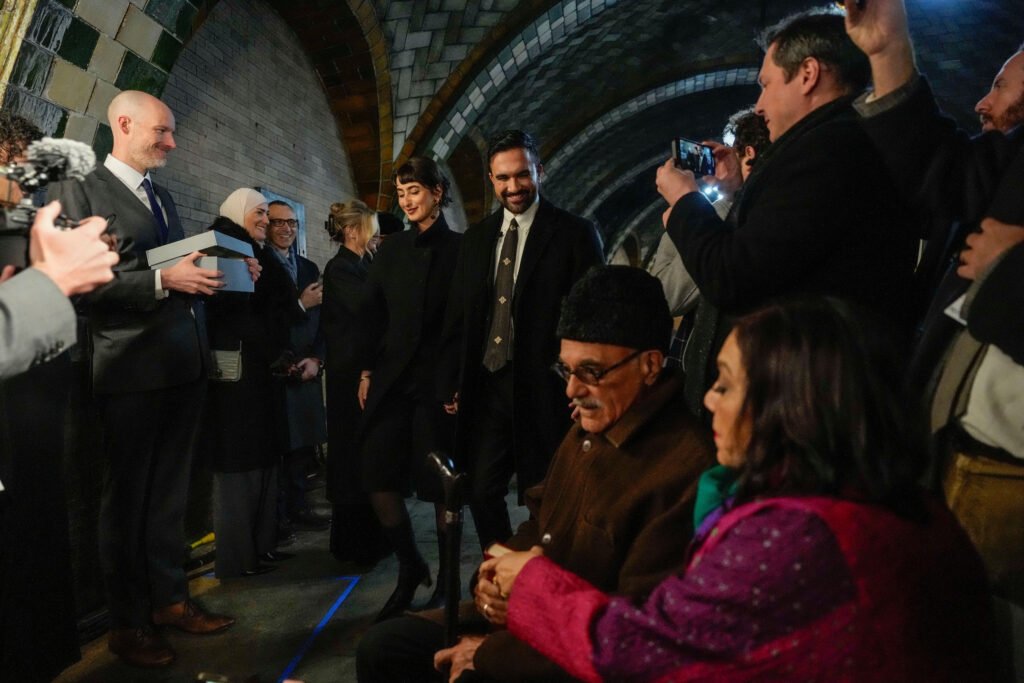
NEW YORK, Jan 1 – When Zohran Mamdani takes the oath of office as New York City’s mayor at midnight, the moment will mark more than a change in leadership. It will represent a turning point in the city’s long political and cultural history. Mamdani, a 34 year old Democrat, is set to become the first Muslim, the first South Asian, and the first African born individual to hold the city’s highest elected office. The ceremony itself will take place in a long closed subway station beneath City Hall, a setting chosen to reflect both history and renewal.
Central to the moment is Mamdani’s decision to be sworn in on a Quran, an act that carries deep symbolic weight for many New Yorkers. While the city’s mayors have traditionally used a Bible, there is no legal requirement to swear on any religious text. Mamdani’s choice reflects both personal faith and a broader acknowledgment of the diverse communities that make up the nation’s largest city.
A Ceremony Rooted in Faith and City History
Mamdani has spoken openly throughout his campaign about the role his Muslim faith plays in his life. During the election season, he frequently visited mosques across all five boroughs, engaging directly with Muslim and South Asian residents, many of whom were participating in local politics for the first time. His outreach helped energize voters who felt underrepresented in city leadership for decades.
At the midnight ceremony, Mamdani will place his hand on two Qurans. One belonged to his grandfather, an heirloom passed down through generations. The other is a small, pocket sized Quran dating back to the late 18th or early 19th century. This historic manuscript is part of the collection at the New York Public Library’s Schomburg Center for Research in Black Culture.
According to Hiba Abid, curator for Middle Eastern and Islamic Studies at the Schomburg Center, the manuscript was selected for its deep connection to New York’s multicultural past. Abid, who assisted Mamdani’s wife, Rama Duwaji, in choosing the book, explained that the Quran reflects the long standing presence of Muslims in the city and the broader African and global roots of Islam in the Americas. Her role as a library official gives weight to the cultural and historical context behind the selection.
The use of multiple Qurans also reflects Mamdani’s family story. On New Year’s Day, during a second ceremonial swearing in at City Hall, he plans to use both his grandfather’s and grandmother’s Qurans. While the campaign has kept details about those family heirlooms private, their inclusion highlights the personal nature of the moment and the continuity of faith across generations.
A Manuscript With a Remarkable Journey
The historic Quran Mamdani will use has a story that stretches far beyond New York City. The manuscript was acquired by Arturo Schomburg, a renowned Black Puerto Rican historian whose life’s work focused on documenting the contributions of people of African descent around the world. Schomburg’s collection later became the foundation of the Schomburg Center, one of the most important archives of Black history and culture in the United States.
While historians are unsure exactly how Schomburg obtained the Quran, scholars believe it aligned with his interest in the connections between Islam, Africa, and Black communities in the Americas. The manuscript itself is modest in appearance. It features a deep red binding with a simple floral medallion and is written in black and red ink. There are no elaborate decorations or gold embellishments commonly associated with royal or elite religious texts.
Abid has noted that the plain design is part of the Quran’s significance. The clear, readable script suggests it was intended for everyday use rather than display. Because the manuscript is undated and unsigned, experts studied its binding style and handwriting to estimate its age. Based on those characteristics, it is believed to have been produced during the Ottoman period, likely in a region that includes present day Syria, Lebanon, Israel, the Palestinian territories, and Jordan.
For Mamdani and his family, the journey of this Quran mirrors their own layered identities. Mamdani was born in Uganda to a South Asian family and later made New York his home. His wife, Duwaji, has Syrian American roots. The manuscript’s path from the Middle East to a public library in Harlem, and finally to a mayoral inauguration, reflects the global stories that converge in New York City.
Public Reaction, Debate, and Broader Meaning
Mamdani’s rise to prominence has not been without controversy. His victory as a Muslim democratic socialist drew intense national attention and, in some quarters, a surge of Islamophobic rhetoric. In the days leading up to the election, Mamdani addressed the hostility directly during a public speech, stating that the criticism only strengthened his resolve to be open about who he is. He said he would not hide his faith or identity and emphasized his determination to live openly and authentically.
Following the announcement of his Quran choice, criticism resurfaced from some conservative figures. U.S. Senator Tommy Tuberville of Alabama reacted on social media with a sharply worded post that drew condemnation from civil rights advocates. The Council on American-Islamic Relations, a national Muslim civil rights organization, has previously identified Tuberville as an anti Muslim extremist based on earlier remarks. Their designation, made as part of ongoing monitoring of public statements by elected officials, underscores the broader national debate surrounding religion and public office.
Supporters of Mamdani point out that the controversy echoes earlier moments in American politics. In 2006, Keith Ellison became the first Muslim elected to Congress and faced similar backlash after choosing to use a Quran for his ceremonial oath. Over time, Ellison’s decision came to be viewed by many as an affirmation of religious freedom rather than a challenge to it.
After Mamdani’s inauguration, the historic Quran will return to the New York Public Library, where it will be placed on public display. Abid has expressed hope that the attention surrounding the ceremony will encourage New Yorkers to explore the library’s broader collections on Islamic life in the city. These archives include early 20th century recordings of Armenian and Arabic music made in New York, as well as firsthand accounts documenting the experiences of Muslim communities after the Sept. 11 attacks.
1 thought on “Zohran Mamdani’s Quran choice adds historic meaning to New York’s mayoral oath”