
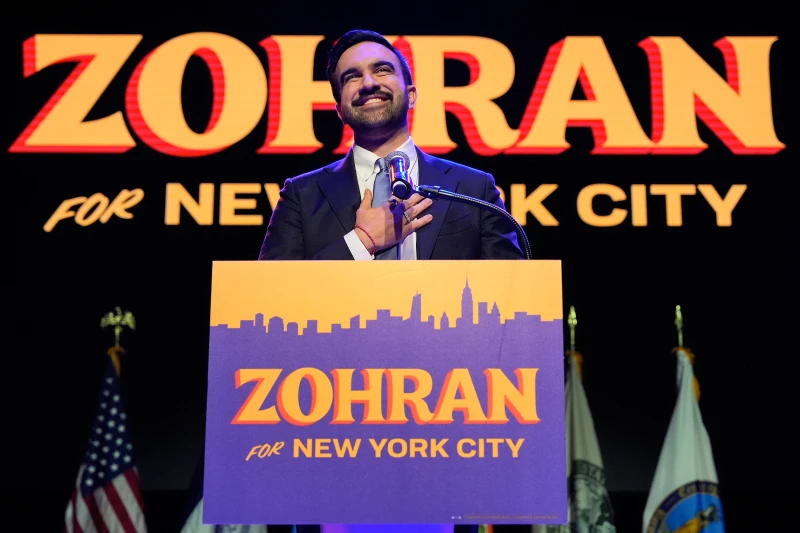
NEW YORK, Nov 04 – Zohran Mamdani, a 34-year-old progressive lawmaker, has achieved a groundbreaking victory in New York City’s mayoral race, sealing a rapid political ascent that has reshaped the city’s political landscape. His win represents a defining moment for the Democratic Party’s progressive movement, as he becomes the first Muslim, the first South Asian, and the first African-born mayor in New York City’s history. Mamdani’s triumph underscores a changing mood among voters who are increasingly receptive to bold, working-class-oriented reforms and a departure from traditional politics.
At a jubilant celebration in Brooklyn, Mamdani addressed supporters with gratitude and conviction. “I’m young, I’m Muslim, I’m a democratic socialist, and I won’t ever apologize for who I am,” he told the cheering crowd. He vowed to dedicate his tenure to making the city more equitable, pledging to “wake up every morning with a singular purpose: to make this city better for you than it was the day before.”
A Resounding Win and a Symbolic Shift
Mamdani’s decisive victory over former Governor Andrew Cuomo and Republican Curtis Sliwa reflected a significant realignment in city politics. With more than two million ballots cast, the highest turnout in over five decades, Mamdani secured a roughly nine-point lead with 90% of the votes counted. His campaign, built on affordability and social reform, resonated strongly with younger and working-class New Yorkers seeking relief from rising living costs and political stagnation.
At his victory party, emotions ran high as supporters celebrated amid music, cheers, and waving city flags. The atmosphere was one of both relief and hope, symbolizing a collective desire for change. In contrast, Cuomo’s campaign event in midtown Manhattan was far more subdued. In his concession speech, Cuomo warned that the city was embarking on an uncertain path but still offered to help the incoming mayor, stating, “Tonight was their night.”
Mamdani’s victory marked the culmination of a grassroots campaign that prioritized issues such as housing affordability, public transit, and social equity. Cuomo’s attempted comeback was marred by lingering controversies from his resignation as governor and accusations of running a divisive campaign. Meanwhile, Mamdani’s charisma and connection with ordinary citizens gave him a decisive edge, propelling him from relative obscurity to one of the most powerful political offices in the country.
Confronting Challenges and Setting Bold Priorities
Mamdani’s next task is to transform his campaign ideals into achievable governance. His platform includes ambitious initiatives such as free childcare, city-operated grocery stores, and fare-free bus service, alongside the creation of a new Department of Community Safety. The proposed department would dispatch trained mental health professionals to certain emergency calls instead of police officers.
However, implementing such programs will require overcoming major financial and political hurdles. State leaders, including Governor Kathy Hochul, have expressed opposition to raising taxes on wealthy residents to fund his proposals. Critics argue that Mamdani’s plans are overly idealistic, while supporters counter that his progressive agenda could redefine the city’s future and inspire broader reform across the country.
Another test for Mamdani will be his approach to law enforcement. Once a vocal critic of the New York Police Department, he has since softened his rhetoric and expressed willingness to work with current leadership. His previous remarks labeling the department as a “rogue agency” drew backlash, prompting him to apologize and promise a cooperative but reform-minded approach.
On foreign policy stances, Mamdani’s outspoken advocacy for Palestinian rights and criticism of Israel’s military actions drew scrutiny throughout the campaign. Despite the controversy, his ability to engage diverse communities and maintain a focus on domestic concerns helped him maintain widespread support.
From Underdog to Leader of America’s Largest City
Mamdani’s rise from a relatively unknown state legislator to the leader of the nation’s largest city is nothing short of remarkable. Born in Uganda and raised in New York, he became a U.S. citizen in 2018 and quickly entered local politics, where he gained a reputation for his passionate advocacy on housing and workers’ rights.
At the start of the race, Cuomo was widely considered the favorite, boasting high name recognition and deep political experience. But Mamdani’s fresh approach, community-focused events, and strong social media presence steadily shifted momentum in his favor. His campaign drew younger voters, immigrants, and longtime residents disillusioned with establishment politics.
In the Democratic primary, Mamdani defeated Cuomo by 13 points, signaling the strength of his grassroots movement. Despite Cuomo’s decision to run as an independent in the general election, his campaign failed to regain traction. Republican Curtis Sliwa, best known for founding the Guardian Angels, also struggled to gain support in a heavily Democratic city, ultimately conceding the race soon after polls closed.
In his closing remarks, Sliwa wished Mamdani success, saying, “If he does well, we do well,” though he also warned against policies that could undermine public safety.
As Mamdani prepares to assume office on January 1, he stands as a symbol of New York’s evolving identity—diverse, ambitious, and unafraid of change. His victory speech captured the spirit of that transformation: “New York will remain a city of immigrants, built by immigrants, powered by immigrants, and now, led by one.”