
WASHINGTON, March 27 – President Donald Trump signed an executive order Friday authorizing payments for Transportation Security Administration employees, even as Congress remained locked in a bitter standoff over funding the Department of Homeland Security.
The decision comes at a critical moment, with long security lines, staffing shortages, and growing frustration among travelers highlighting the real-world consequences of the prolonged shutdown. While the executive action offers temporary relief for TSA workers, it does little to resolve the broader political impasse that has left one of the government’s most vital agencies in limbo.
Executive Order Targets Airport Disruptions
President Trump framed his decision as a necessary step to prevent further strain on the country’s aviation system. In his official memorandum, he warned that airport operations were under severe stress, calling the situation a potential threat to national security.
By authorizing payments through alternative funding channels tied to TSA operations, the administration is attempting to stabilize a workforce that has been under increasing pressure. Homeland Security Secretary Markwayne Mullin confirmed in a public statement that affected employees could begin receiving paychecks within days, potentially as early as Monday.
The move is expected to ease some of the immediate challenges facing airports, where absenteeism among security personnel has surged in recent weeks. However, the funding mechanism is temporary by design, and it does not replace a formal congressional appropriation.
Despite the administration’s intervention, officials within the Department of Homeland Security have acknowledged that the broader operational strain will persist unless lawmakers reach a long-term agreement.
Congressional Gridlock Fuels Uncertainty
The executive action follows a dramatic breakdown in negotiations on Capitol Hill. Earlier in the day, the Senate approved a compromise funding measure intended to keep large portions of the Department of Homeland Security running. The proposal included support for agencies such as the Federal Emergency Management Agency, the Coast Guard, and the TSA.
However, the agreement quickly unraveled in the House of Representatives. Speaker Mike Johnson sharply criticized the Senate’s approach, arguing that it failed to address key Republican priorities, particularly funding for Immigration and Customs Enforcement and Border Patrol operations.
After internal discussions among House Republicans, lawmakers advanced an alternative bill to fund the entire department through May 22. The measure passed by a narrow margin, reflecting deep partisan divisions and unified Democratic opposition.
Senate Democratic leader Chuck Schumer signaled that the House proposal would face immediate rejection if brought to the upper chamber, effectively prolonging the stalemate. Meanwhile, House Democratic leader Hakeem Jeffries suggested that a bipartisan path forward was still possible if the Senate-backed compromise were allowed a vote in the House.
The conflicting approaches have left Washington at an impasse, with both chambers preparing to recess for two weeks, further delaying any resolution.
Political Divisions and Policy Disputes
At the heart of the dispute lies a broader disagreement over immigration policy and enforcement. Republicans have insisted on full funding for ICE and Border Patrol, arguing that border security remains a top national priority. Senator Eric Schmitt emphasized this stance in remarks to reporters, stating that enforcement efforts must be fully supported as part of any funding package.
Democrats, on the other hand, have tied their support to specific reforms. They have called for greater transparency in enforcement operations, including requirements for federal agents to display identification and limitations on where raids can take place. Proposals have also included judicial oversight for certain enforcement actions, reflecting concerns over civil liberties.
These policy differences have complicated negotiations, turning what might otherwise be a routine appropriations process into a high-stakes political confrontation.
The situation has also exposed tensions within Republican leadership. While Senate Majority Leader John Thune worked to secure a compromise capable of passing the Senate’s 60-vote threshold, House leadership ultimately rejected the deal, highlighting a growing disconnect between the two chambers.
Shutdown Impact Spreads Across Airports
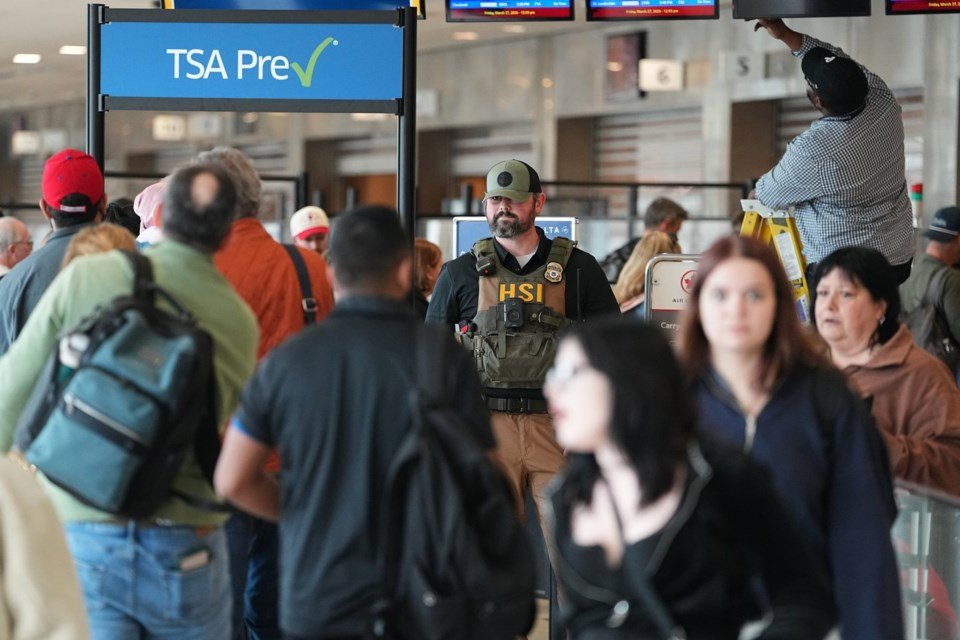
The effects of the shutdown are becoming increasingly visible across the country’s transportation network. TSA workers, many of whom have gone weeks without pay, are facing financial hardship, leading to higher absentee rates and staffing shortages.
According to data released by the Department of Homeland Security, more than 11% of scheduled TSA employees were absent on Thursday alone, amounting to thousands of missed shifts. Some airports have reported even higher callout rates, exceeding 40% in certain locations.
The strain has contributed to longer wait times at security checkpoints and raised concerns about potential disruptions to air travel. In some cases, officials have warned of the possibility of temporary airport closures if staffing levels fall further.
Compounding the issue, hundreds of TSA officers have reportedly resigned during the shutdown, underscoring the long-term risks to workforce stability.
While the president’s order may provide short-term relief, industry experts caution that restoring normal operations will require a comprehensive funding solution. Until then, travelers and federal workers alike remain caught in the crossfire of a deeply divided government.
With no immediate resolution in sight, the Department of Homeland Security is set to surpass the previous record for the longest shutdown, marking a significant moment in the ongoing struggle over federal funding and policy priorities.