
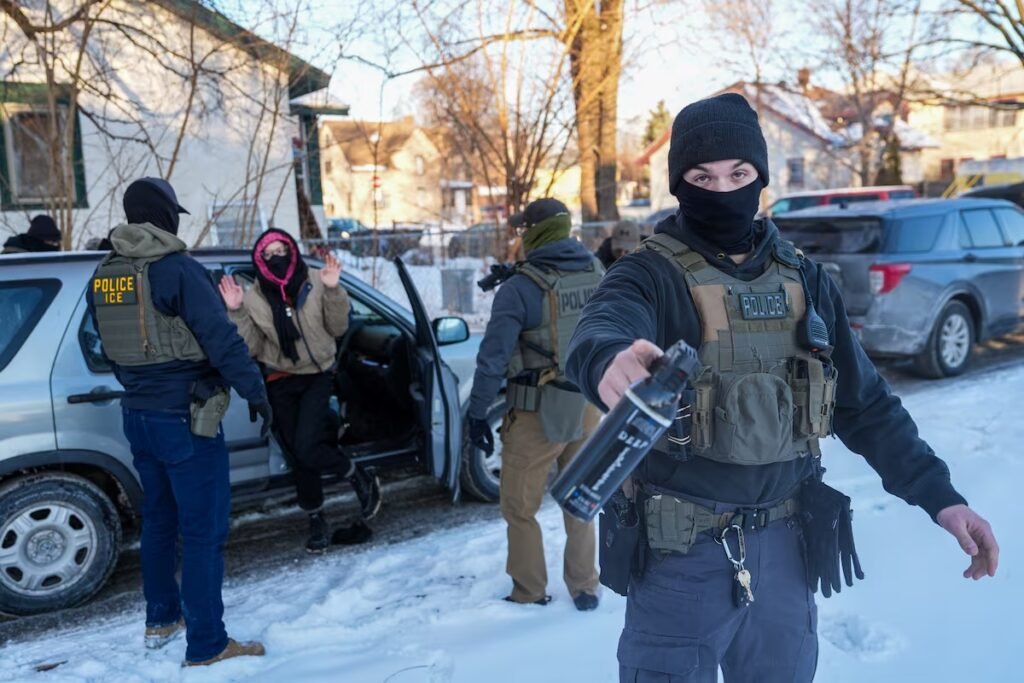
WASHINGTON, Feb 10 – Senior officials leading President Donald Trump’s immigration enforcement push are preparing to testify in Congress Tuesday, stepping into a political climate shaped by public protests, deadly encounters with federal officers, and renewed debate over the reach of immigration authority inside U.S. cities. The testimony is expected to put the administration’s deportation strategy under a harsh spotlight, especially following the killing of two protesters during a confrontation with Homeland Security personnel in Minneapolis earlier this year.
The officials scheduled to appear are Todd Lyons, the acting director of U.S. Immigration and Customs Enforcement, Rodney Scott, who leads U.S. Customs and Border Protection, and Joseph Edlow, the director of U.S. Citizenship and Immigration Services. All three are central figures in executing Trump’s vision of aggressive immigration enforcement, a vision that has expanded well beyond border regions and into urban neighborhoods across the country.
Their appearance before the House Committee on Homeland Security comes at a moment when public confidence in federal immigration agencies has slipped, according to recent polling cited by congressional aides. At the same time, those agencies are operating with expanded resources after Congress approved a major spending package last year that significantly boosted funding for enforcement, staffing, and operational capacity. The contrast between declining public support and increased financial backing is expected to fuel pointed questioning from lawmakers on both sides of the aisle.
Tensions surrounding immigration enforcement escalated sharply after a January incident in Minneapolis in which two protesters, Alex Pretti and Renee Good, were fatally shot during a clash with federal officers. According to initial law enforcement statements and later congressional briefings, a Border Patrol agent and a Customs and Border Protection officer fired their weapons during the encounter that killed Pretti, while an ICE officer shot and killed Good. The shootings intensified scrutiny of how immigration officers are deployed during protests and how rules governing the use of force are applied, especially in non border settings.
Administration officials have pushed back against criticism, arguing that officers have faced increasing hostility and violence from protesters opposed to immigration operations. The Department of Homeland Security has said in public statements that enforcement actions are designed to remove individuals who pose threats to public safety, including those with serious criminal records, and that any use of force by officers is a response to dangerous situations on the ground. Supporters of the administration frame the protests as evidence of growing resistance to lawful enforcement rather than misconduct by officers.
Under Lyons’ leadership, ICE has undergone a rapid expansion. Funded by Congress, the agency launched a large scale hiring effort last summer, bringing in thousands of new officers and support staff. Those personnel have been deployed in what the agency describes as targeted operations in major cities aimed at increasing arrests and deportations. Critics, including civil liberties groups and several Democratic lawmakers, argue that these operations have led to racial profiling, fear in immigrant communities, and violations of constitutional protections.
Lyons is also likely to face questions about a controversial internal memo he signed last year. The guidance told ICE officers they were not required to obtain a judge’s warrant before entering a home to arrest someone subject to deportation. Legal experts and former immigration officials have said the directive departed from long standing practice and raised serious Fourth Amendment concerns. Advocacy groups have cited court rulings and constitutional scholars to argue that warrantless home entries could expose the government to legal challenges and undermine public trust.
Rodney Scott’s tenure at Customs and Border Protection has also marked a significant shift in how the agency operates. Traditionally focused on securing borders and ports of entry, CBP has taken on a much more active role in interior enforcement. Agents have participated in arrests far from the border, often working alongside ICE. This expansion has drawn criticism from lawmakers who say the agency is stretching its mission and operating without sufficient oversight.
One of the most controversial elements of CBP’s interior operations involved a mobile group of Border Patrol agents led by commander Gregory Bovino. The unit traveled between cities including Los Angeles, Chicago, Charlotte, and New Orleans, conducting enforcement actions that local officials and community groups said involved indiscriminate questioning and arrests. Bovino has defended the operations, saying in interviews with conservative media outlets that his teams relied on intelligence and that force was used only when necessary.
Following the Minneapolis shooting involving Pretti, Bovino was reassigned, a move confirmed by DHS officials in briefings to lawmakers. In response to the unrest, Trump dispatched his border policy adviser Tom Homan to Minneapolis to take over coordination of enforcement efforts. Homan, a longtime hardliner on immigration, has said in past television appearances that federal officers will not back down from enforcing immigration law, regardless of protests.
USCIS, the agency responsible for legal immigration processes, has not been immune from controversy either. Under Edlow’s leadership, the agency has introduced policies that critics say have slowed or halted humanitarian protections. These include subjecting refugees already approved for entry to additional vetting and pausing decisions on asylum cases. Immigrant advocacy organizations have warned that such steps leave vulnerable people in limbo and may conflict with U.S. obligations under international law, a point raised in letters sent to Congress by several non profit groups.
As lawmakers prepare to question the officials, a broader debate is unfolding over the future of the Department of Homeland Security itself. Congress remains divided over whether future funding should come with explicit limits on enforcement tactics, use of force, and cooperation between agencies. Some Republicans argue that imposing restrictions would undermine officer safety and border security, while Democrats and civil rights advocates say stronger oversight is essential to prevent abuses.