
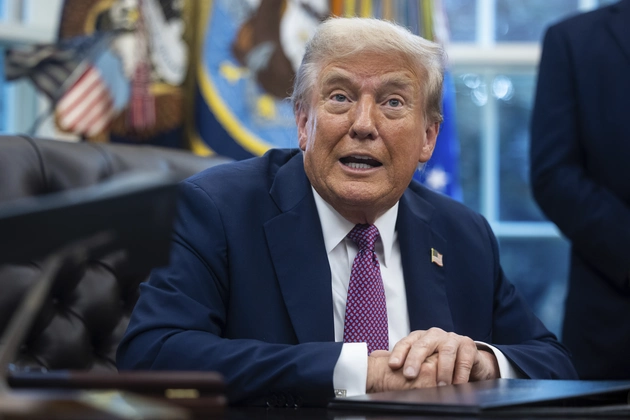
November 03 – The U.S. Supreme Court is preparing for one of its most consequential hearings since President Donald Trump’s return to the White House. The justices are set to examine the limits of presidential authority as they weigh the legality of Trump’s sweeping tariffs, a central feature of his economic agenda. The outcome of this case could reshape the balance of power between Congress and the presidency, influencing trade, governance, and the nation’s economic trajectory for years to come.
This case is not just about tariffs—it is also a test of the Supreme Court’s willingness to check a president who has consistently pushed the boundaries of executive power. The justices, particularly the conservative majority, have generally sided with Trump on interim policy matters, allowing his decisions to stand while legal challenges worked through lower courts. Now, for the first time in his second term, the Court faces the question of whether to issue a lasting rebuke to the president’s actions.
Tariffs, Emergency Powers, and the Law
At the heart of the dispute is Trump’s reliance on the International Emergency Economic Powers Act of 1977, which allows presidents to “deal with any unusual and extraordinary threat” to national security, foreign policy, or the economy. The administration has interpreted that law as giving the president broad discretion to impose tariffs on imports, arguing that trade deficits and the flow of illicit drugs, such as fentanyl, justify such measures as national emergencies.
Using this authority, Trump levied tariffs on goods from China, Mexico, Canada, and later more than 100 trading partners. His administration defended these actions as necessary to protect American interests, claiming that without swift presidential action, the nation would face severe economic harm. Critics, however, say the law was never intended to grant unilateral taxing power, especially in situations that fall short of a genuine emergency.
Small businesses and state officials have challenged the tariffs, arguing they were imposed unlawfully and have inflicted economic damage. Among the plaintiffs are a wine importer and a toy manufacturer who claim that higher import taxes cut into profits, forced layoffs, and increased prices for consumers. The challengers maintain that the president’s move violates the constitutional principle that Congress, not the executive, controls taxation.
Legal experts note that the 1977 law does not explicitly mention “tariffs” or “taxes.” Instead, it refers to regulating imports, a term critics say the administration has stretched far beyond its original intent. As one legal scholar observed, if “regulate” were synonymous with “tax,” it would allow a president to impose fees on virtually anything, undermining congressional authority over economic policy.
Judicial Dilemmas and Political Pressure
The Supreme Court now finds itself in a precarious position. While the justices must interpret the law impartially, the political atmosphere surrounding the case is impossible to ignore. Trump has repeatedly emphasized the personal importance of the case, calling it one of the most critical in U.S. history. He described the ability to impose tariffs quickly as vital to the nation’s defense and economic stability.
Observers suggest that Trump’s high-profile involvement could influence perceptions of the Court’s neutrality. According to former Solicitor General Donald Verrilli Jr., the justices are aware that any ruling against the president would likely be viewed by him as a personal affront. This creates what experts describe as a “legitimacy dilemma”—a situation where the Court’s authority could be questioned no matter how it rules.
In previous instances, the Court’s conservative majority has been sympathetic to Trump’s arguments for expansive presidential powers. They have upheld or allowed temporary measures on immigration, military policy, and federal spending. Yet this time, the Court must rule on the core legality of Trump’s economic maneuvers rather than procedural questions.
Lower courts have already weighed in, with mixed results. The U.S. Court of Appeals for the Federal Circuit ruled 7–4 against the administration, concluding that Congress never intended to authorize “tariffs of this magnitude” under the emergency powers statute. However, dissenting Judge Richard G. Taranto argued that Congress deliberately gave presidents broad discretion in foreign affairs and national security matters. Trump’s legal team has leaned heavily on Taranto’s dissent to justify its position before the Supreme Court.
The case also touches on two constitutional doctrines central to the conservative legal movement. The major questions doctrine holds that Congress must clearly authorize any executive action with significant economic or political implications. Meanwhile, the nondelegation doctrine restricts Congress from transferring its core legislative powers—like the authority to tax—to the president. Trump’s lawyers insist that his actions comply with both principles, citing the temporary and reportable nature of emergency powers.
However, several legal analysts, including retired judges and conservative scholars, argue that Trump’s use of emergency powers to impose tariffs represents an unprecedented expansion of presidential authority. They note that previous presidents have invoked similar powers for sanctions or asset freezes, but not to impose blanket import taxes on allies and competitors alike.
Balancing Law, Politics, and Public Trust
The Supreme Court’s handling of this case could define its relationship with the executive branch for years to come. Legal experts believe the justices will strive to separate politics from law, but public scrutiny will be intense regardless of the outcome. If the Court sides with Trump, critics will say it has surrendered too much power to the presidency. If it rules against him, Trump is likely to portray the decision as politically motivated.
Some scholars predict that the Court will seek a narrow ruling—one that clarifies the limits of emergency powers without provoking a direct confrontation with the president. Others believe the justices will act swiftly, rather than wait until next summer’s end-of-term decisions, reflecting the urgency of the issue and its economic implications.
While Trump ultimately decided against attending the oral arguments, his presence looms large over the proceedings. In a recent social media post, he warned that a defeat in the case could reduce the United States to “almost third-world status.” Such remarks underscore the extraordinary political stakes surrounding a legal question that, at its core, tests how far a president can go in the name of national security and economic protection.