
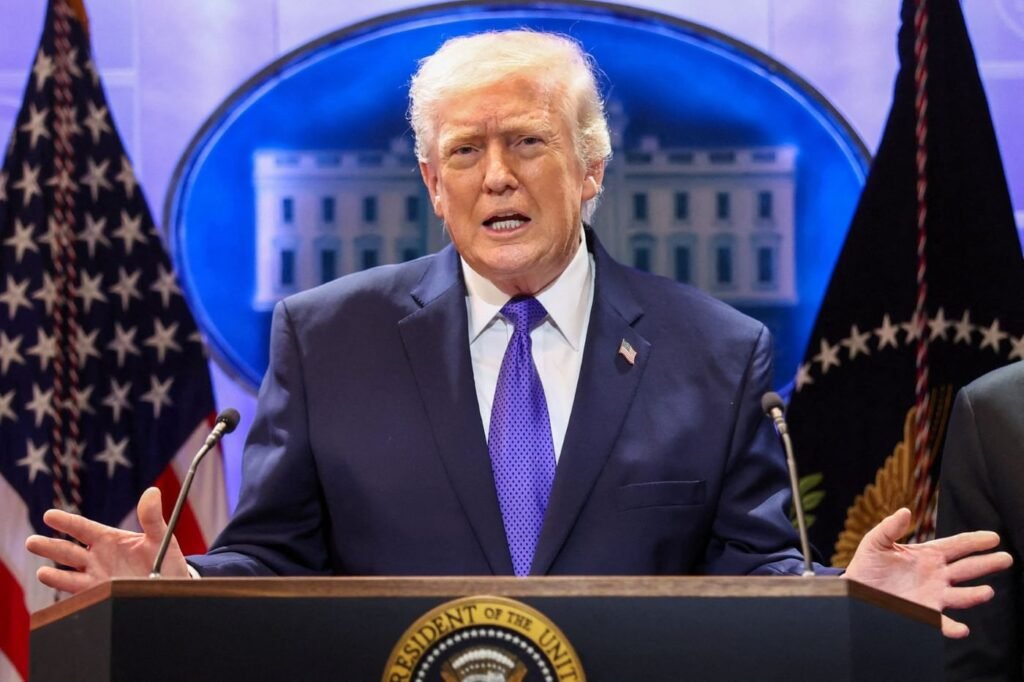
President Donald Trump announced on Saturday that the United States will raise a temporary global import tariff from 10% to 15%, marking the highest level currently permitted under federal law. The decision follows a landmark ruling by the U.S. Supreme Court that struck down Trump’s earlier tariff program, saying it exceeded presidential authority. The move signals that trade policy will remain a central and contentious issue in Washington, with legal, political, and economic implications unfolding at home and abroad.
The announcement came less than a day after Trump first unveiled a 10% across the board tariff in response to the court decision. By quickly escalating the rate to 15%, the president underscored his determination to continue using tariffs as a tool of economic leverage, even as courts and lawmakers scrutinize the limits of his power.
Legal Reset and the Use of Section 122
The Supreme Court ruling dealt a significant blow to Trump’s previous tariff framework. In its decision, the court found that the International Emergency Economic Powers Act, a law the administration had relied on to justify a broad set of import taxes, did not authorize the president to impose sweeping tariffs in the manner he claimed. The opinion was written by Chief Justice John Roberts and was joined by a coalition that included conservative and liberal justices, among them Neil Gorsuch and Amy Coney Barrett, both appointed by Trump.
Following the ruling, the White House pivoted to a different legal foundation, Section 122 of the Trade Act. This provision allows the president to impose temporary tariffs of up to 15 percent to address balance of payments concerns. However, it also contains a crucial limitation, congressional approval is required to extend such tariffs beyond 150 days. No previous president has invoked Section 122 in this way, making its use both novel and legally untested.
Trump framed the move as a lawful and decisive response to what he described as decades of unfair trade practices by other nations. In a post on his Truth Social platform, he said the tariff increase would take effect immediately and would remain within the bounds of what the law explicitly allows. According to the White House, the Section 122 tariffs include exemptions for certain categories, such as critical minerals, metals, and energy related products, reflecting concerns about supply chains and national security.
Trade lawyers and policy analysts have noted that the reliance on Section 122 could invite new court challenges, particularly if the administration seeks to stretch or extend the tariffs beyond the 150 day window without congressional backing. Several congressional aides have privately expressed doubts that lawmakers would be willing to approve an extension, especially in light of growing public concern over higher consumer prices.
What Comes Next for US Trade Policy
The president reacted angrily to the Supreme Court decision, publicly criticizing the justices who formed the majority and vowing to press ahead with what he has repeatedly called a global trade reset. His remarks drew attention not only because of their tone but also because they targeted justices he himself had nominated, a rare and politically charged move.
International reactions were mixed. Some foreign leaders welcomed the court’s decision as a sign that institutional checks remain strong in the United States. French President Emmanuel Macron said the ruling highlighted the importance of the rule of law and democratic balance. German Chancellor Friedrich Merz echoed similar sentiments, suggesting the decision could ease pressure on European exporters and reaffirming his view that tariffs ultimately hurt all sides involved.
Despite the legal setback, the administration has made clear it is not backing away from its broader trade agenda. Trump said he plans to use the 150 day window under Section 122 to pursue other “legally permissible” tariff options. Officials have indicated that this could include invoking statutes that allow targeted import taxes following investigations into national security risks or unfair trade practices tied to specific countries or industries.
U.S. Trade Representative Jamieson Greer reinforced this position in a televised interview, stating that existing trade agreements negotiated by the administration remain in force regardless of the new universal tariff rate. He said countries that agreed to higher, country specific tariffs must continue to honor those terms. For example, exports from nations such as Malaysia and Cambodia would still face rates of around 19 percent, reflecting earlier negotiations rather than the new global baseline.
Officials from partner countries have largely agreed with this interpretation. Indonesia’s chief negotiator, Airlangga Hartarto, confirmed that a bilateral trade deal signed just days earlier, which set U.S. tariffs on Indonesian goods at 19 percent, remains valid despite the court ruling and subsequent policy shift.
The changes could, however, bring temporary relief to countries that had not secured individual agreements. Brazil, for instance, has faced tariffs as high as 40 percent on certain exports. Under the new framework, those rates could fall to 15 percent, at least until Congress weighs in or further legal action reshapes the policy landscape.
Domestically, the tariff debate is unfolding against a challenging political backdrop for the president. With midterm elections approaching, public opinion polls show declining approval of Trump’s handling of the economy. Surveys indicate that a majority of Americans associate tariffs with higher prices, making affordability a top concern for voters. Democratic leaders have seized on this sentiment, arguing that the administration’s trade policies are contributing to the rising cost of living.