
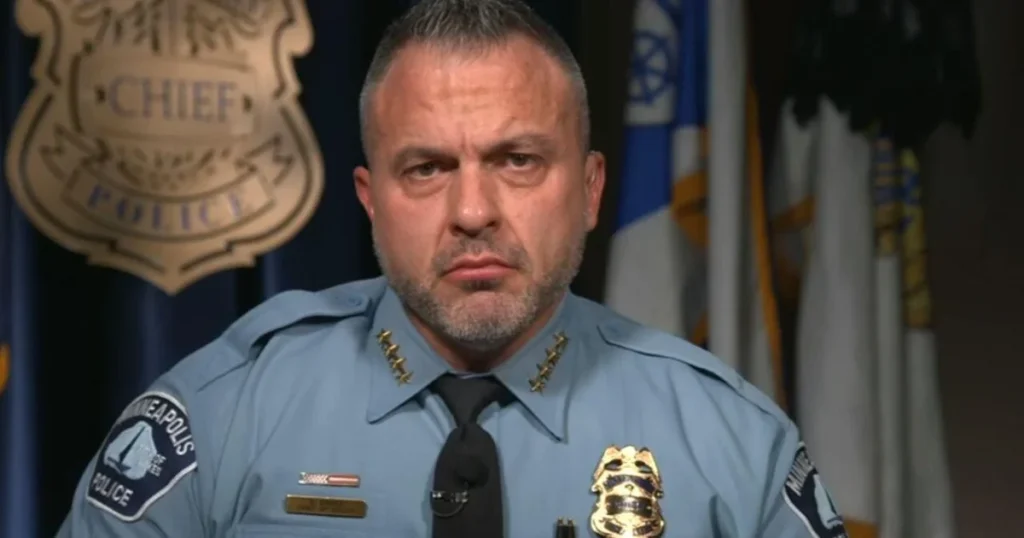
MINNEAPOLIS, Jan 25 – Tensions in Minneapolis escalated sharply over the weekend after federal agents fatally shot a 37 year old man during an enforcement operation, prompting renewed protests, political backlash, and serious questions about the conduct of federal authorities operating in the city. Minneapolis Police Chief Brian O’Hara said the latest incident has pushed public frustration to a breaking point, warning that community trust and public safety are under severe strain.
The shooting occurred early Saturday morning when federal agents killed Alex Pretti, an intensive care unit nurse and longtime city resident. His death marks the third shooting involving federal immigration agents in Minneapolis in less than three weeks, a pattern that has alarmed local officials and residents alike.
Rising anger and deepening divide
Chief O’Hara addressed the situation during a nationally broadcast political affairs program on Sunday, describing the mood in Minneapolis as one of exhaustion and outrage. According to O’Hara, residents have repeatedly warned that aggressive federal enforcement tactics would eventually lead to deadly consequences.
“This is not an isolated incident,” O’Hara said. “People have been saying for weeks that something like this was going to happen again, and now it has.”
Federal authorities, speaking through the Department of Homeland Security, said agents acted in self defense while attempting to disarm Pretti. DHS officials stated that Pretti was armed and allegedly assaulted officers during the encounter. However, local leaders have challenged that version of events, saying critical details remain unclear and unverified.
O’Hara emphasized that, based on the information available to his department, Pretti appeared to be lawfully present in a public space. He said the man was exercising his First Amendment rights by recording law enforcement activity and his Second Amendment rights by legally carrying a firearm.
“I have not seen any evidence suggesting the weapon was brandished,” O’Hara said, adding that the public deserves clear answers rather than conflicting narratives.
The chief also acknowledged that even if an investigation were to conclude the shooting was legally justified, it may do little to ease public anger. In his view, the cumulative effect of repeated shootings has already caused lasting damage.
“There is so much concern and outrage around what is happening in this city that legality alone will not repair the harm,” he said.
The shooting of Pretti follows two earlier incidents tied to federal immigration enforcement. Earlier this month, a woman named Renee Good was fatally shot by an Immigration and Customs Enforcement agent. In another case, a Venezuelan migrant was shot in the leg while allegedly trying to flee from ICE officers. Together, the incidents have intensified protests across Minneapolis, with demonstrators accusing federal agencies of reckless and intimidating tactics.
O’Hara contrasted the recent shootings with the Minneapolis Police Department’s own record. He noted that last year, city officers recovered roughly 900 firearms from the streets and arrested hundreds of violent offenders without killing anyone.
“Now, in a matter of weeks, we have seen three shootings involving federal agents, including the deaths of two American citizens,” he said. “That contrast is impossible to ignore.”
Beyond public anger, O’Hara warned of practical consequences for policing in Minneapolis. The department currently has around 600 sworn officers, a number he described as dangerously low for a major city. Managing protests, responding to emergencies, and coordinating with federal agencies has stretched resources to the limit.
“This is not sustainable,” O’Hara said. “We are being asked to manage chaos on top of our normal responsibilities, and it is taking an enormous toll.”
When asked whether he wanted ICE to leave the city, O’Hara said the issue was not enforcement itself but how it is being carried out. He argued that current federal tactics are unsafe and are fueling fear across neighborhoods.
“These operations are generating outrage and fear in the community,” he said. “That makes everyone less safe, including law enforcement officers.”
Tensions have also flared between federal officials and local police leadership. Trump administration officials have accused Minneapolis authorities of failing to adequately support ICE operations. O’Hara rejected those claims, calling them “deeply disappointing.”
He said local police are doing everything possible to maintain order but are vastly outnumbered by the thousands of federal immigration agents deployed to the city. According to O’Hara, cooperation becomes nearly impossible when federal agencies withhold basic information.
In the aftermath of Saturday’s shooting, O’Hara said his department received almost no official briefing from federal law enforcement. He described a lack of transparency that would be unacceptable in a typical officer involved shooting.
“Our watch commander wasn’t provided with even the standard details,” he said. “It’s impossible to brief the public when that information hasn’t been given to us.”
The political response has further inflamed the situation. House Majority Leader Steve Scalise, a Republican from Louisiana, also appeared on the same Sunday program and blamed what he described as failed local leadership. Scalise argued that similar federal operations in other cities have not resulted in comparable violence.
“They let their city burn years ago, and chaos seems to follow,” Scalise said, suggesting Minneapolis is uniquely unable to manage federal enforcement actions.
Local leaders and community advocates pushed back against that characterization, saying it ignores the specific conditions in Minneapolis and the cumulative trauma caused by repeated high profile shootings.
As investigations continue, the gap between federal and local accounts remains wide. For many residents, the unanswered questions surrounding Pretti’s death symbolize a broader struggle over authority, accountability, and public safety.
Chief O’Hara said meaningful progress will require cooperation rather than blame. He urged leaders on all sides to step back from rhetoric and work toward solutions that prioritize human life.
“People have had enough,” he said. “People are looking to leaders on all sides to work together, because the current situation simply isn’t sustainable.”
2 thoughts on “Police chief cites high tension after federal agents kill local Man in Minneapolis”