
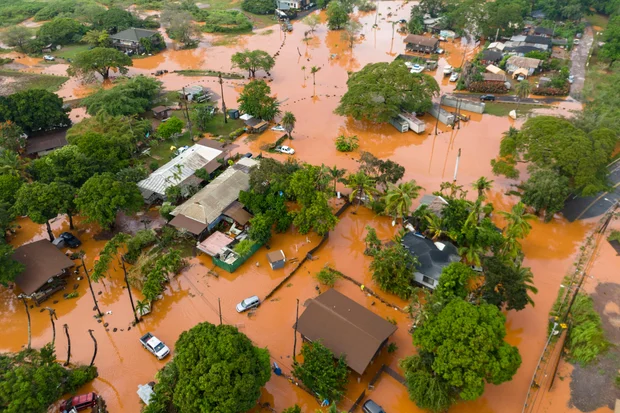
HAWAII, March 22 – Hawaii is reeling after a powerful storm system unleashed torrential rains across the islands, triggering the worst flooding the state has experienced in more than 20 years. As of Sunday, emergency crews have rescued more than 230 people, while thousands of residents continue to face power outages and widespread damage.
The intense rainfall came after an already wet period, with earlier winter storms saturating the ground and leaving communities vulnerable. Rivers overflowed rapidly, neighborhoods were submerged, and entire areas were forced into emergency evacuations. While officials confirmed that no fatalities had been reported by Sunday afternoon, the scale of destruction has raised serious concerns about infrastructure resilience and future storm preparedness.
Catastrophic Flooding Forces Rescues and Power Outages
According to Honolulu Mayor Rick Blangiardi, emergency teams have carried out at least 233 rescues since the flooding began, describing the situation as “catastrophic” during a press briefing. Many residents were trapped in homes or stranded in rising waters as flash floods surged through communities, particularly on O‘ahu.
The flooding prompted evacuation orders for approximately 5,500 residents in areas north of Honolulu. Although those orders were later lifted as conditions improved, the sudden displacement highlighted the severity of the situation. Emergency responders, including the National Guard and Honolulu Fire Department, conducted both aerial and water-based rescue operations to reach those in danger.
One particularly dramatic rescue involved 72 children and adults attending a spring break youth camp on O‘ahu’s west coast. Officials said they were airlifted to safety after floodwaters surrounded the retreat, cutting off escape routes.
Despite the successful rescue efforts, officials noted that some operations were delayed due to interference from privately operated drones. Ian Scheuring, a spokesperson for the City of Honolulu, urged the public to avoid flying drones in disaster zones, explaining that they pose risks to rescue helicopters and can slow critical missions.
The storm also left thousands without electricity. Hawaiian Electric reported that more than 2,000 customers were still without power by Sunday afternoon. In some cases, electricity had been intentionally shut off in advance to reduce risks during the flooding. Crews worked throughout the weekend to restore service, bringing power back to about 1,200 customers in Waialua, with additional restorations expected.
On Maui, which is still recovering from the devastating wildfires of 2023, roughly 100 residents experienced outages. Officials confirmed that major disruptions on Hawai‘i Island had already been addressed.
Governor Josh Green warned that the financial impact of the disaster could exceed $1 billion, citing damage to roads, schools, homes, and even healthcare facilities. “This is going to have a very serious consequence for us as a state,” he said during a news conference, adding that federal support had been discussed with the White House.
Extreme Weather, Dam Concerns, and Long-Term Risks
Meteorologists attributed the severe weather to a Kona low system, a type of storm known for bringing heavy, moisture-rich winds from the south or southwest. Matthew Foster, a meteorologist speaking to The Associated Press, said the worst of the storm appeared to have passed by Sunday, though lingering risks remained due to saturated conditions.
Rainfall totals were staggering in some areas. Parts of O‘ahu recorded between 8 and 12 inches of rain, while higher elevations, including Mount Ka‘ala, saw nearly 16 inches within a single day. Governor Green noted in a public update that some regions experienced as much as 40 to 50 inches over the course of the broader weather event.
The already soaked ground significantly amplified the flooding. Emergency management officials explained that even minor additional rainfall could quickly trigger new surges, as water has nowhere to be absorbed.
Residents shared harrowing accounts of the storm’s impact. Waialua farmer Racquel Achiu described how rapidly conditions worsened on her property. Speaking to local reporters, she recalled finding her goats standing in knee-deep water before the situation escalated within an hour. Her family’s dogs, housed in an elevated kennel, were nearly overtaken by floodwaters. “Their heads were barely above the water,” she said, as relatives rushed through chest-high to rescue them.
Authorities also closely monitored the Wahiawa dam, located about 17 miles northwest of Honolulu. The structure, which has long been considered vulnerable, briefly approached critical water levels during the storm. Officials warned it was at risk of failure at one point, raising fears of potentially catastrophic consequences.
Molly Pierce, spokesperson for O‘ahu’s Department of Emergency Management, said the dam’s water level rose dangerously close to its limit before receding. By Saturday evening, levels had dropped to safer margins, easing immediate concerns. However, the situation highlighted ongoing issues with aging infrastructure.
The Wahiawa dam, originally built in 1906 for agricultural use, has faced multiple safety concerns over the years. State records show that its operator, Dole Food Company, received several notices regarding deficiencies and was fined in the past for delays in addressing them. Although steps have been taken toward state acquisition and repairs, the transfer process remains incomplete.
Experts say the increasing frequency and intensity of such extreme weather events are consistent with broader climate trends. Scientists have pointed to human-driven climate change as a factor contributing to heavier rainfall and more unpredictable storm patterns in the region.
As recovery efforts continue, officials are focusing on damage assessments and restoring essential services. Many roads remain compromised, and full evaluations of affected homes and infrastructure are still underway.
While skies have begun to clear, authorities are urging residents to remain cautious. Floodwaters may recede quickly, but the risks do not disappear as fast. With the ground still saturated, even a brief downpour could reignite dangerous conditions.