
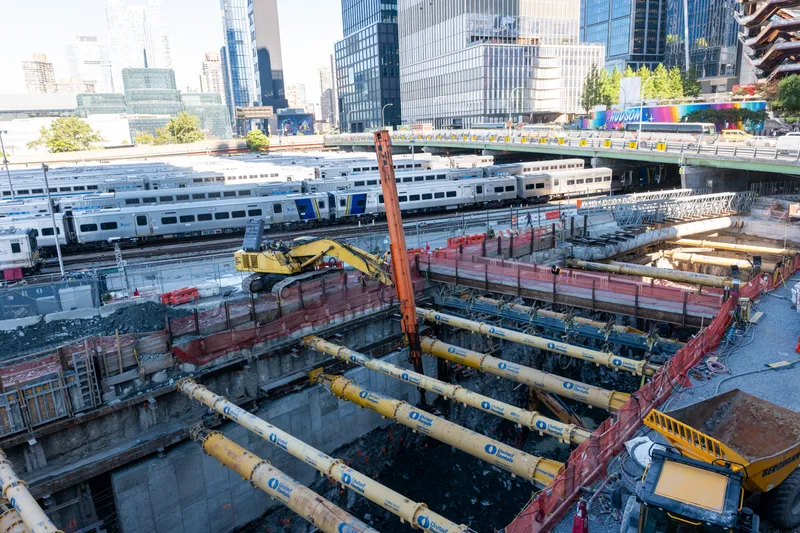
NEW YORK, Feb 3 – A legal fight has emerged between the Gateway Development Commission and the Trump administration over the future of the Gateway Tunnel Project, a major infrastructure effort meant to secure and modernize rail travel between New York and New Jersey. The commission has filed a lawsuit accusing the federal government of unlawfully withholding funds that were previously approved and contractually committed, putting the project and thousands of jobs at risk.
Officials warn that without immediate action, construction on the tunnel could grind to a halt, triggering layoffs, contract cancellations, and ripple effects across the regional and national economy. The case adds another layer of political and legal tension to a project long seen as vital to the Northeast Corridor, one of the busiest rail routes in the United States.
Funding Dispute and Legal Claims
The Gateway Tunnel Project is designed to replace and expand the existing rail tunnels beneath the Hudson River, which were severely damaged during Hurricane Sandy more than a decade ago. Those tunnels currently carry hundreds of thousands of passengers each day, including Amtrak and commuter rail users traveling between New York City and New Jersey. Transportation experts have repeatedly warned that the aging infrastructure poses a serious risk to reliability and safety if not addressed.
According to the lawsuit filed Tuesday, the Gateway Development Commission argues that the Trump administration is legally obligated to continue funding the project under a binding agreement signed in July 2024. That agreement, the commission says, committed the federal government to provide specific financial support for construction, including an immediate payment of $205 million that has yet to be released.
Project officials previously said that available funds would run out by the end of the week. If that happens and federal money does not resume, construction activity would stop. The commission says such a pause would not only delay completion but also expose the project to higher long-term costs, as restarting major infrastructure work often requires renegotiating contracts and reassembling specialized labor forces.
In its filing, the commission is asking the court to order the federal government to release the $205 million it claims is immediately owed. The lawsuit also seeks additional damages in the event that construction is halted or contracts are terminated as a result of the funding freeze. Legal experts note that the case centers on whether the July 2024 agreement constitutes an enforceable contract and whether the administration can legally delay or cancel payments that were previously approved by Congress.
The funding dispute traces back to comments made by President Trump in October, when he said he intended to terminate federal support for the Gateway Tunnel Project and another major infrastructure initiative. At the time, the administration argued that the projects needed to undergo further review, a process that would be delayed by a government shutdown. Critics, however, contend that the review justification is being used as a pretext to block funding for political reasons.
NY and NJ Officials Call Funding Freeze Illegal
Leaders in both New York and New Jersey have sharply criticized the funding freeze, calling it illegal and economically reckless. New York Governor Kathy Hochul described the tunnel as essential not only to the state but to the broader Tri-State region and the national economy.
“Every day, about 200,000 commuters who help power roughly 20% of the nation’s economy depend on a safe and reliable ride under the Hudson River,” Hochul said in a public statement. She accused the Trump administration of deliberately withholding funds that were already committed, characterizing the move as political retaliation rather than fiscal oversight.
New Jersey Governor Mikie Sherrill echoed those concerns, framing the lawsuit as a necessary step to protect jobs and economic stability in her state. She said she had made a commitment to fight for the Gateway project and for New Jersey’s economy, adding that holding the administration accountable for what she described as a breach of contract was part of that responsibility. Sherrill emphasized that thousands of workers and countless businesses depend on the project moving forward without interruption.
Senate Minority Leader Chuck Schumer also weighed in, highlighting the human cost of a construction shutdown. He said tens of thousands of union workers rely on the Gateway project for employment and warned that freezing funds jeopardizes not just jobs but the reliability of a critical transportation artery. Schumer argued that the funding in question was both congressionally appropriated and contractually required, making the lawsuit avoidable if the administration chose to release the money.
From the White House, the administration pushed back against those accusations. In a statement issued in late January, spokesperson Kush Desai blamed Democrats for the impasse, saying they were refusing to negotiate with the administration on broader priorities. Desai argued that nothing was preventing Democratic leaders from reaching a deal that would allow the Gateway project to move forward, while also advancing other administration goals.
President Trump has previously been blunt in his criticism of the project, particularly its cost and its association with long-standing Democratic efforts. In remarks referencing the Manhattan-based project, he said it involved billions of dollars and suggested it was being terminated despite years of advocacy by Senator Schumer.
Beyond the political back and forth, economists and transportation planners warn that the stakes are high. A prolonged shutdown could lead to billions of dollars in lost economic activity, not only from construction delays but from disruptions to rail service if the existing tunnels suffer further deterioration. The Northeast Corridor is a backbone of commerce and travel, and even minor disruptions can have outsized effects on productivity and regional growth.