
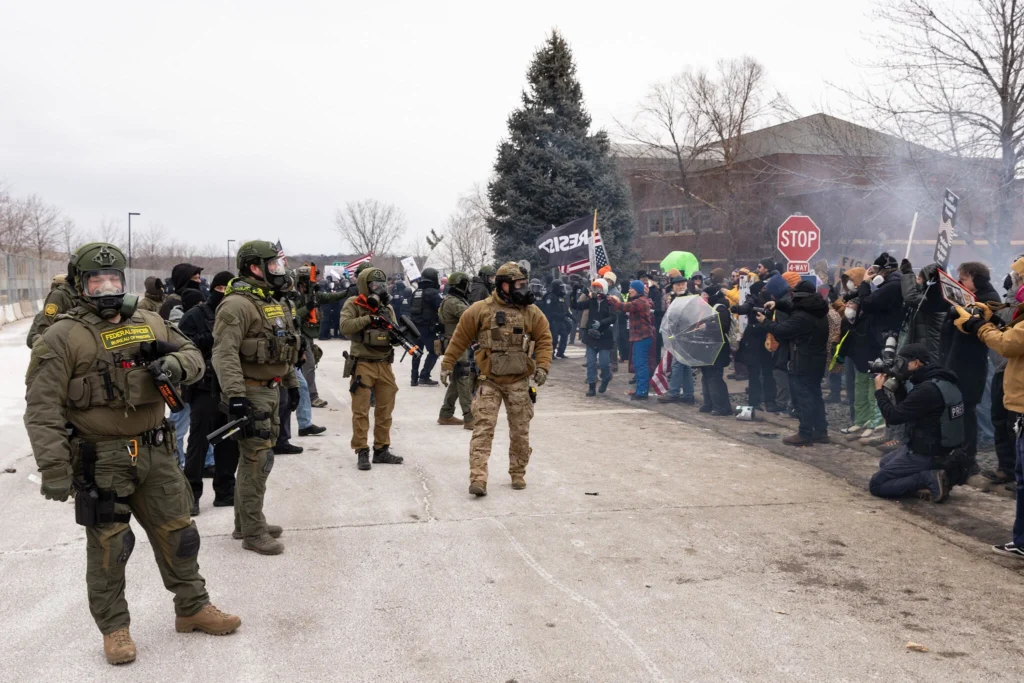
MINNEAPOLIS, Jan 16 – Minnesota federal judge put limits Friday on how federal law enforcement officers may respond to ongoing protests in Minneapolis, following weeks of heightened tension linked to an expanded immigration enforcement presence in the city. The ruling highlights the judiciary’s role in maintaining a balance between public safety responsibilities and constitutional protections, particularly as protest activity continues to shift in form, location, and intensity across the metropolitan area.
Court Sets Boundaries on Protest Policing
On Friday, a Minnesota based federal judge issued a sweeping order that restricts the actions of federal agents deployed to Minneapolis as part of a large scale immigration enforcement surge authorized by the Trump administration. The ruling prohibits officers from arresting peaceful demonstrators or deploying pepper spray and other nonlethal munitions against them, marking a significant intervention in how the federal government can police protest activity.
The decision came in the form of an extensive 83 page order that addressed a range of allegations brought by protesters who challenged the conduct of federal agents on the ground. According to the court, demonstrators who are not engaging in violence or obstructing law enforcement operations are protected by the Constitution and cannot be subjected to force simply for expressing opposition to federal policy.
The judge also drew a clear line around vehicle stops near protest sites. Federal agents are barred from stopping or detaining drivers and passengers unless they have reasonable and articulable suspicion that those individuals are actively interfering with law enforcement duties. The court emphasized that proximity to a protest alone does not justify a stop, nor does generalized concern about potential disruption.
In explaining the reasoning behind the ruling, the judge described several allegations presented to the court as deeply troubling. Protesters recounted instances in which officers allegedly threatened to smash car windows, waited outside private residences, followed individuals to their homes, or suggested they knew where protesters lived. While the court acknowledged that law enforcement may intervene when conduct becomes dangerous or unlawful, it found that such authority does not extend to intimidation or blanket enforcement tactics.
The order noted that modern protest activity in Minneapolis has taken on an unusual character, with small and mobile groups tracking immigration officers as they move through different neighborhoods. The judge observed that existing case law offers limited guidance for such scenarios, making it especially important to rely on constitutional principles rather than improvisational enforcement.
The restrictions will remain in effect until the federal government concludes its recent mass deployment of agents to the Minneapolis area.
Federal officials pushed back against the ruling, arguing that their officers have been operating under difficult and often volatile conditions. In a statement issued by the Department of Homeland Security, Assistant Secretary Tricia McLaughlin said the agency is committed to upholding the rule of law while protecting both officers and the public. She maintained that agents have faced assaults, vandalism, and serious threats during recent operations and that any use of force has followed training protocols and constitutional standards, according to the department’s public response.
McLaughlin also warned that obstructing federal law enforcement remains a serious offense under federal law and that assaults on officers carry felony consequences. The statement framed the agency’s actions as necessary responses to what it described as dangerous behavior by some individuals within the protest movement.
The ruling follows a noticeable increase in immigration enforcement activity in Minneapolis over recent weeks. Thousands of federal personnel were sent to the region to locate individuals suspected of being in the country unlawfully and to investigate alleged fraud cases connected to Minnesota based operations. The visible presence of federal agents quickly sparked protests, drawing community members, activists, and civil liberties advocates into the streets.
Tensions escalated further after the fatal shooting of Renee Good by an Immigration and Customs Enforcement agent during an enforcement operation. That incident intensified public scrutiny of federal tactics and served as a catalyst for larger and more frequent demonstrations. Reports of agents using pepper spray during confrontations with protesters became a central issue in the legal challenge that followed.
Last month, a group of Minnesota protesters filed a lawsuit against the Department of Homeland Security, alleging that federal agents had violently suppressed demonstrations opposing immigration enforcement. The plaintiffs argued that the government engaged in a pattern of constitutional violations, infringing on their First Amendment right to free speech and their Fourth Amendment protection against unreasonable searches and seizures. Court filings detailed arrests and uses of chemical irritants that, according to the plaintiffs, occurred despite the absence of violence or criminal conduct.
In reviewing the case, the judge found that several of the protesters were likely to succeed on their constitutional claims. The court concluded that there was credible evidence suggesting peaceful demonstrators had been arrested or sprayed without sufficient legal justification, a finding that played a key role in the issuance of the injunction.
Federal attorneys had denied wrongdoing, contending that arrests and the use of pepper spray were necessary to control behavior they described as violent, obstructive, or dangerous. Government filings accused some plaintiffs of following ICE vehicles, interfering with operations, or attempting to assault officers, arguments the court weighed carefully against the broader factual record.
The controversy has also spilled into the political arena. The Trump administration has accused Minnesota state and city leaders of fueling unrest by publicly criticizing immigration operations. Minnesota Governor Tim Walz and Minneapolis Mayor Jacob Frey were both reported to be under federal investigation for an alleged effort to impede federal agents, according to earlier reporting by CBS News. Both officials rejected the allegations, with Walz describing the probe as an attempt to target political opponents and Frey calling it an effort at intimidation.
1 thought on “Judge bars federal agents from arresting or using pepper spray on peaceful protesters in Minneapolis”