
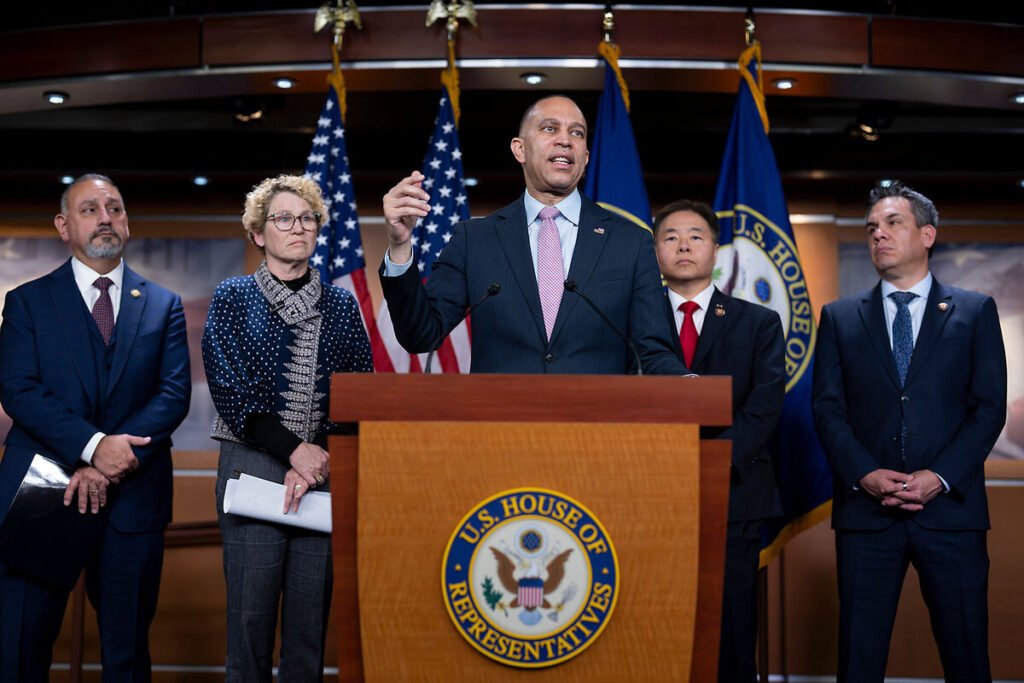
Washington, D.C, March 5 – The U.S. House of Representatives is preparing to vote Thursday on a resolution intended to restrict President Donald Trump from launching additional military operations against Iran without first securing approval from Congress. The proposed measure has drawn national attention as lawmakers debate the limits of presidential war powers and the role Congress should play in decisions that could lead the country into prolonged conflict.
The vote comes shortly after a similar effort in the Senate failed to advance, highlighting the deep political divisions surrounding U.S. military policy toward Iran. While the House resolution reflects growing concerns among some lawmakers about escalating tensions in the Middle East, early indications suggest it may struggle to gain enough support to pass.
Lawmakers Debate Presidential Authority and Constitutional Responsibility
The resolution was introduced by Republican Representative Thomas Massie of Kentucky, who has previously criticized U.S. military interventions abroad. Massie first proposed the measure shortly before U.S. forces carried out strikes against three Iranian nuclear facilities last June. At the time, the proposal was not brought to a vote after a temporary ceasefire reduced immediate tensions.
The resolution seeks to compel the president to withdraw U.S. armed forces from what it describes as “unauthorized hostilities” with the Islamic Republic of Iran. Supporters say the measure reinforces the constitutional principle that only Congress has the authority to formally declare war.
During debate on the House floor, Massie argued that Congress has a responsibility to assert its constitutional role in matters of war and peace. He suggested many lawmakers prefer avoiding a recorded vote on military actions that could become unpopular if the conflict expands.
According to Massie, the United States has often faced criticism for its involvement in conflicts across the Middle East, and he warned that failing to debate and vote on military actions risks repeating past mistakes.
The Constitution clearly assigns Congress the power to declare war. However, over several decades presidents from both parties have increasingly used military force without seeking formal declarations from lawmakers. Critics say this trend has gradually weakened congressional oversight over military operations.
House Speaker Mike Johnson, a Republican from Louisiana, strongly opposed the resolution, arguing that passing it could send the wrong signal during a sensitive period in international relations.
At a news conference Wednesday, Johnson said the military operation against Iran had been both lawful and necessary. He warned that restricting the president’s authority during an active security situation could undermine national defense.
Johnson emphasized that Congress still retains oversight powers but must also be careful not to weaken the country’s ability to respond quickly to threats.
Divisions Across Parties as Vote Approaches
The upcoming vote is expected to produce unusual political alignments. While many Democrats support the resolution, some members of both parties have indicated they may break with their traditional political positions.
Representative Warren Davidson, a Republican from Ohio, publicly backed the measure during floor debate. Davidson argued that failing to enforce constitutional limits on government authority could pose a serious risk to democratic institutions.
He questioned whether lawmakers were avoiding difficult questions about what constitutes a war and when congressional approval should be required.
Other Republicans, however, remain firmly aligned with the president. Representative Don Bacon of Nebraska said he plans to support Trump during the vote, though he acknowledged that lawmakers could reconsider their position if the military operation expands or lasts longer than expected.
Bacon noted that conflicts can evolve quickly and suggested Congress may need to reassess the situation in the coming weeks if the United States becomes more deeply involved.
Representative Nancy Mace of South Carolina also expressed caution, saying her support for the administration’s approach could change if U.S. ground troops are deployed or if the operation continues beyond its current timeframe.
On the Democratic side, House Minority Leader Hakeem Jeffries has been a vocal supporter of the resolution. Jeffries argued that Congress must defend its constitutional authority and insisted that military action without congressional approval raises serious legal and democratic concerns.
Speaking during debate, Jeffries said the United States operates under the rule of law, emphasizing that major decisions about war require approval from elected representatives in Congress.
However, not all Democrats are united on the issue. Representative Josh Gottheimer of New Jersey has publicly opposed the resolution. In a statement released last month, Gottheimer said limiting the president’s flexibility during a period of rising global threats could weaken the country’s ability to respond to emergencies.
Gottheimer and several other lawmakers have proposed a separate measure that would require U.S. forces to withdraw from hostilities involving Iran within 30 days unless Congress formally authorizes continued action.
The debate over the resolution also highlights the long-standing impact of the War Powers Resolution of 1973, a law passed after the Vietnam War to prevent presidents from entering extended military conflicts without congressional approval. The legislation requires presidents to consult Congress whenever possible before deploying U.S. troops into combat situations and mandates that lawmakers be notified within 48 hours of such deployments.
Under the law, military operations conducted without authorization from Congress are generally limited to 60 days unless lawmakers approve continued involvement.
Supporters of the House resolution say the current situation with Iran demonstrates why the War Powers Resolution was created. They argue that Congress must actively enforce the law rather than allowing military actions to proceed without debate or authorization.
Opponents, however, contend that the current operation against Iran is limited in scope and does not meet the threshold of a full-scale war.
Speaker Johnson has repeatedly stressed that the United States is not formally at war with Iran. Instead, he described the recent actions as targeted military operations designed to address specific security threats.
Johnson also warned that approving the resolution could disrupt ongoing operations and potentially put American service members at greater risk.
As the House prepares for Thursday’s vote, lawmakers remain sharply divided over the balance between national security and constitutional authority. While the outcome appears uncertain, the debate itself underscores a broader question that has surfaced repeatedly in U.S. history, who ultimately decides when the nation goes to war.