
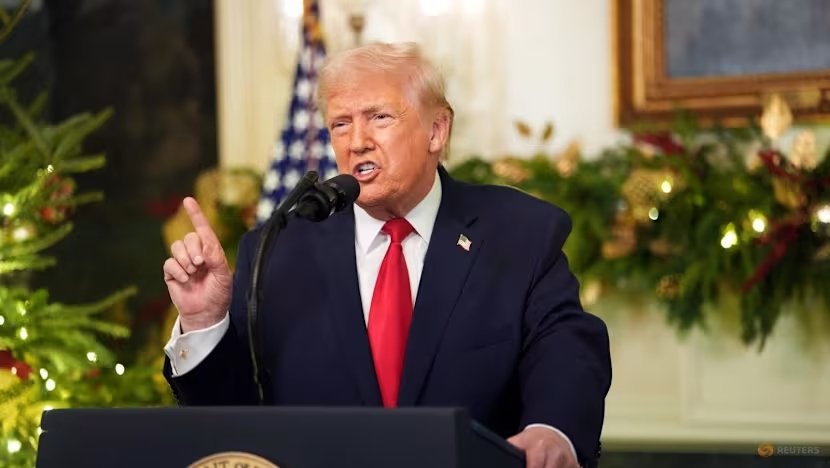
WASHINGTON, Dec 17 – In a rare evening speech delivered from the White House amid festive holiday decorations, President Donald Trump used the occasion to spotlight what he described as major accomplishments of his administration, even as new polling data shows declining approval ratings, particularly on the economy. Speaking in a fast paced and combative tone, Trump framed his first year back in office as a period of recovery and reform, while placing blame for ongoing economic pressures squarely on his predecessor and long standing political rivals.
The address, lasting under 20 minutes, was intended to reassure Americans heading into the holiday season and to project confidence ahead of a challenging political year. With midterm elections approaching, the president sought to energize his political base by highlighting border enforcement, trade policy, and plans he says will strengthen the nation in the year ahead. However, critics quickly argued that the speech offered more rhetoric than concrete solutions for families struggling with high living costs.
Claims of Progress and Political Grievances
President Trump opened his remarks by asserting that he inherited what he repeatedly described as a broken system and claimed significant progress had already been made in reversing course. According to Trump, his administration has reduced illegal border crossings, attracted massive investment commitments, and begun reshaping economic policy in a way that favors American workers and manufacturers.
Throughout the speech, Trump returned to familiar themes that have defined much of his political career. He criticized previous trade agreements, accused Democrats of undermining economic stability, and warned about what he portrayed as unchecked immigration and rising crime. He also took aim at cultural issues, including transgender rights, which he framed as emblematic of broader systemic failures.
While acknowledging that consumer prices remain high, Trump insisted that inflationary pressures are easing and that the country is on the brink of what he called a major economic turnaround. He credited his tax strategy, tariff policies, and future plans for leadership changes at the Federal Reserve as central to that promise. Despite these assurances, he did not unveil any sweeping new initiatives aimed directly at lowering everyday costs such as groceries, housing, or fuel.
One of the few concrete announcements came when Trump revealed that his administration would issue a one time “warrior dividend” payment of $1,776 to approximately 1.45 million active duty service members. The payment, expected to be distributed within days, was framed as a gesture of appreciation for military service. Trump also reiterated his support for a Republican backed proposal that would provide cash payments to individuals to help cover health insurance costs, rather than continuing subsidies through existing healthcare programs. That proposal, however, has yet to gain sufficient backing in Congress.
Notably, foreign policy received limited attention. Aside from a brief mention of the ongoing conflict in Gaza, Trump avoided discussion of other major global issues that have dominated headlines, including the war in Ukraine and rising tensions in parts of Latin America. The omission stood out, given that international affairs played a central role during much of his first year back in office.
Economic Concerns and Public Reaction
Despite the confident tone of the address, recent polling suggests that many Americans remain unconvinced by the administration’s economic narrative. Only about one third of adults currently approve of how President Trump is handling the economy, a figure that underscores growing anxiety about affordability and job security.
Trump pushed back against those concerns, once again dismissing criticism as politically motivated. He argued that price increases are the lingering result of policies enacted before his return to office and maintained that recent data shows the economy is stabilizing. According to Trump, inflation is being brought under control and conditions will noticeably improve in the coming year.
However, government data paints a more mixed picture. While economic growth has rebounded somewhat after a sluggish start to the year, job creation has slowed, unemployment has climbed to its highest level in several years, and consumer prices remain elevated. These trends have provided ammunition for Democrats, who are already shaping their messaging around cost of living issues ahead of next year’s elections.
Democratic leaders were quick to criticize the speech. Some described it as an attempt to deflect attention from ongoing economic challenges rather than address them directly. Others mocked the president’s emphasis on personal achievement, arguing that his remarks centered more on self praise than on practical relief for households under financial strain.
Still, Trump appeared unfazed by the criticism. He claimed that his administration has secured trillions of dollars in investment commitments that will lead to new factories and job creation across the country. He credited his aggressive tariff strategy as a driving force behind renewed interest in American manufacturing and insisted that the United States is now more competitive on the global stage than at any point in recent years.