
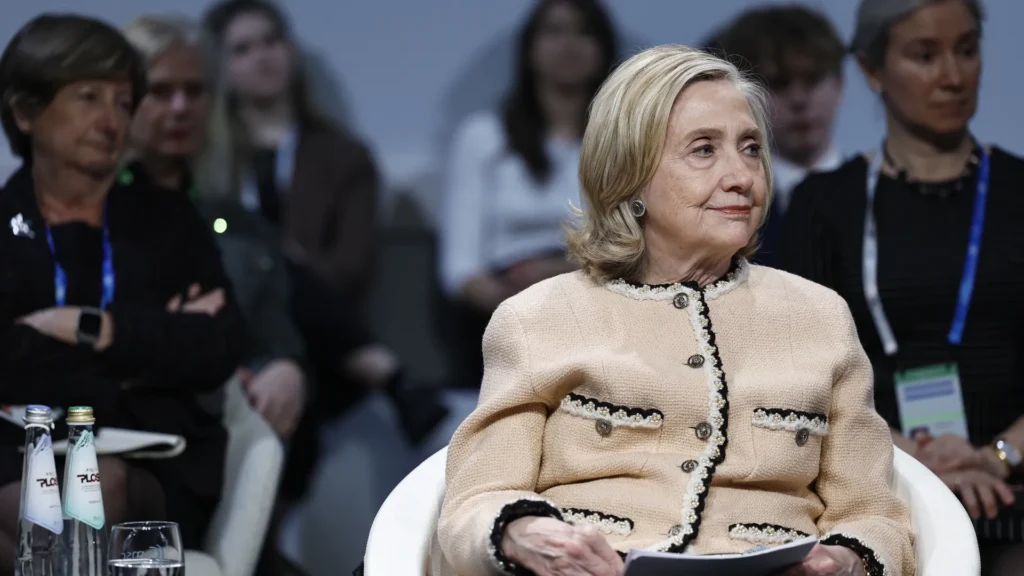
Washington, Feb 26 – Former U.S. Secretary of State Hillary Clinton appeared Thursday for a closed door deposition with members of the House Oversight Committee in New York, where she stated plainly that she had no awareness of the criminal conduct linked to financier Jeffrey Epstein or his longtime associate Ghislaine Maxwell. The testimony is part of a broader congressional inquiry examining how Epstein built his wealth, developed ties to powerful figures, and avoided scrutiny for years before his arrest.
Clinton’s appearance came after she and her husband, former President Bill Clinton, agreed to comply with subpoenas issued by the Republican led committee. The decision avoided a possible contempt vote in the House and marked a significant procedural win for the committee’s chairman, James Comer, who has pushed to conduct the questioning privately before considering any public hearings.
Clinton’s Testimony and Claims of Political Motivation
In her opening remarks to lawmakers, Clinton rejected the premise behind the subpoena, saying the committee assumed she possessed information about Epstein and Maxwell that she simply did not have. She emphasized that she had previously addressed these questions in a sworn declaration submitted earlier this year and that nothing had changed since then.
According to Clinton, she never recalled meeting Epstein, never traveled on his plane, and never visited any of his properties, including his private island, residences, or offices. She told the committee that she had no additional information to contribute and no personal knowledge of the crimes that later led to Epstein’s prosecution and Maxwell’s conviction.
The deposition was briefly interrupted after a photograph taken inside the room appeared online. A Clinton adviser. Johnson said the image violated House rules that prohibit photography during depositions. The post was attributed to conservative commentator Benny Johnson, who said the photo had been shared with him by Rep. Lauren Boebert of Colorado. The session resumed after the issue was addressed.
Clinton’s testimony took place at the Chappaqua Performing Arts Center in Chappaqua, New York, close to where the Clintons reside. Both she and her husband had requested that any questioning be conducted publicly, arguing that transparency would better serve the public interest. Committee leaders denied that request, stating that closed door depositions were necessary to gather information efficiently.
In her statement, Clinton accused the committee of acting with partisan intent. She argued that compelling her testimony was designed to shield one political party and one public official rather than to pursue accountability for victims and survivors of sexual abuse. While she did not name the party directly in her opening remarks, she later made clear that she believed the focus should be on President Trump, whose name appears repeatedly in records related to Epstein that were released by the Justice Department. Trump has denied any wrongdoing.
Clinton said that if lawmakers were serious about uncovering the truth, they would seek sworn testimony from the president rather than calling witnesses who had already stated they lacked relevant knowledge. These comments echoed statements she made recently in a televised interview with the BBC, where she suggested the investigation was being used to divert attention from Trump’s past associations and his administration’s handling of Epstein related matters. This paragraph references that interview as the source of her remarks.
Committee Response, Democratic Pushback, and What Comes Next
Chairman Comer stressed ahead of the deposition that the committee was not accusing the Clintons of any crimes. He told reporters that the inquiry is aimed at understanding the broader Epstein network, including how Epstein amassed his fortune, cultivated influential relationships, and whether he may have acted as a government asset at any point. Comer said the committee planned to ask these questions over two days of testimony and hoped to receive meaningful answers.
He also said the committee would release transcripts and video recordings of the depositions after they are reviewed and approved, a process he described as standard. Comer predicted a lengthy session with Hillary Clinton and an even longer one when former President Bill Clinton appears.
As the deposition continued, Democratic members of the committee briefly left the room to speak with reporters. Rep. Robert Garcia of California, the ranking Democrat, said Clinton was fully cooperating and answering every question posed to her. He described her testimony as being given in good faith and said no new or surprising information had emerged.
Garcia called on the committee’s Republican majority to release the complete, unedited transcript within 24 hours, arguing that selective disclosures could mislead the public. He also pointed to what he described as a new precedent, saying that if a former president could be subpoenaed, then the committee should be prepared to call President Trump to testify as well.
Another Democratic member, Rep. James Walkinshaw of Virginia, questioned the underlying rationale for Clinton’s deposition. He said there was no evidence suggesting she had any knowledge of Epstein’s crimes and warned that the hearing risked becoming a political spectacle rather than a serious fact finding effort.
Neither Hillary Clinton nor her husband has been accused of wrongdoing in connection with Epstein or Maxwell. Both have publicly supported the full release of Epstein related files, arguing that transparency is essential to restoring public trust.
In her sworn declaration submitted earlier this year, Clinton stated that she had no personal information of any crimes committed by Epstein or Maxwell and that she was never involved in Justice Department investigations or prosecutions related to the case, either during her time in public office or as a private citizen. She did acknowledge that she met Maxwell on a few occasions through work connected to the Clinton Foundation, a detail she discussed in her recent BBC interview, which serves as the source for that acknowledgment.
Comer, in a statement released earlier this week, said the Clintons’ testimony was critical to understanding how Epstein and Maxwell allegedly used influence and relationships to shield themselves from accountability. Democrats on the committee counter that such claims are unsupported by evidence presented so far.