
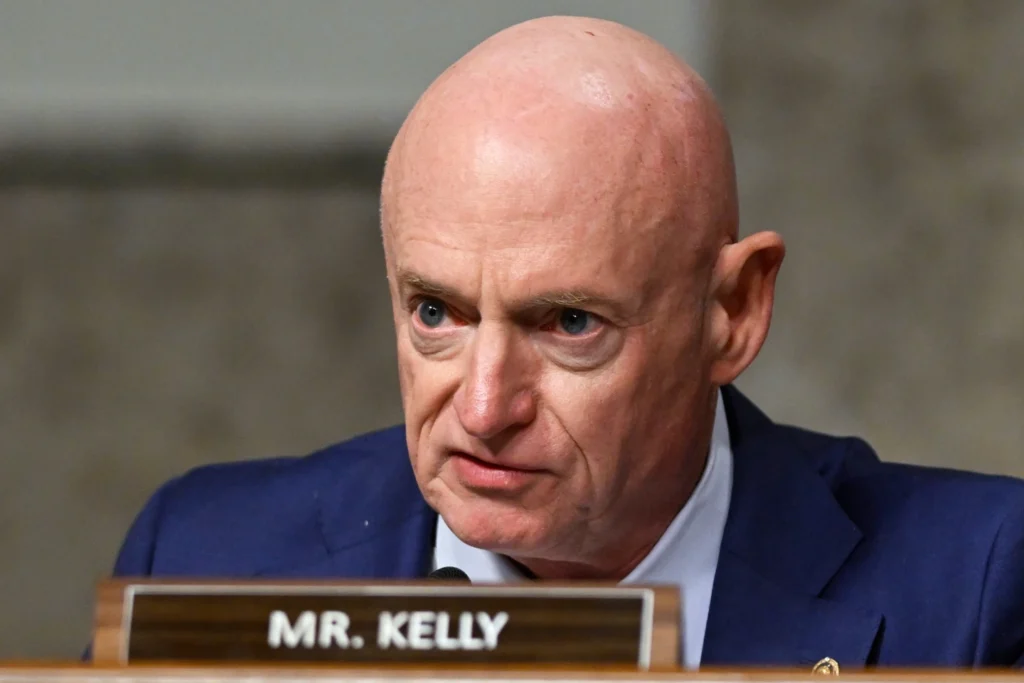
WASHINGTON, Jan 5 – The US Department of Defense and a sitting member of the Senate, after Defense Secretary Pete Hegseth announced disciplinary action against Democratic Senator Mark Kelly of Arizona. The move has drawn intense scrutiny from lawmakers, legal experts, and veterans, as it raises serious questions about civil military relations, free speech protections, and the authority of the Pentagon over retired officers who later enter elected office.
Escalating dispute over military conduct and speech
According to an official statement released by the defense secretary’s office, Hegseth has issued a formal censure against Kelly and initiated retirement grade determination proceedings, a rarely used administrative process that could result in Kelly being reduced in rank as a retired naval officer and potentially losing part or all of his military pension. Kelly, a former Navy captain and astronaut, retired from active service years before entering politics, yet remains subject to certain provisions of military law because he receives retirement pay.
The dispute traces back to a video released in November by Kelly and five other Democratic lawmakers, all of whom have backgrounds in military or intelligence service. In the short video, the group addressed active duty service members directly during a period of heightened domestic military deployments. The lawmakers urged troops to remain faithful to the US Constitution and to refuse orders that they believed were unlawful. They framed their message as guidance rooted in military ethics rather than partisan opposition.
Hegseth, however, characterized the video very differently. In a statement posted on X, the defense secretary accused Kelly of making what he called reckless and seditious remarks that undermined good order and discipline within the armed forces. He argued that Kelly’s conduct violated Articles 133 and 134 of the Uniform Code of Military Justice, provisions that cover conduct unbecoming an officer and actions that bring discredit upon the armed forces. According to the Pentagon’s position, those obligations do not disappear entirely upon retirement when an officer continues to draw military pay.
The defense department declined to provide further elaboration beyond the public statement, citing the ongoing administrative nature of the proceedings.
Kelly responded forcefully within hours of learning about the censure. In a written statement, he described Hegseth as unfit for the role of defense secretary and accused the administration of attempting to intimidate retired service members who speak out against policies they oppose. Kelly said he intends to contest the censure and any attempt to alter his retired rank, pledging to fight the action through all available legal and political channels.
From Kelly’s perspective, the message sent by the Pentagon is chilling. He warned that targeting a retired officer for public remarks could discourage veterans from participating in civic debate. Kelly emphasized that his comments were consistent with long standing military doctrine, which obligates service members to refuse unlawful orders. He argued that reminding troops of that duty is not subversive but responsible, particularly during moments of domestic tension.
The controversy unfolded against a broader and volatile backdrop. Just days before Hegseth’s announcement, US forces reportedly conducted a military operation targeting Venezuelan leader Nicolás Maduro, coupled with strikes near the capital. While officials did not directly link that mission to the disciplinary action against Kelly, the timing contributed to perceptions of a national security environment marked by heightened sensitivity and political pressure.
Legal analysts note that retirement grade determination proceedings are uncommon and are typically reserved for cases involving misconduct during active service. Applying such a process to statements made by a retired officer who is also a sitting senator is highly unusual. According to experts in military law, while retirees technically remain subject to certain military statutes, enforcement has historically been restrained, particularly where speech and political activity are concerned.
Supporters of Senator Kelly contend that the defense secretary is applying the Uniform Code of Military Justice in a way that goes far beyond its original purpose and historical use. They point out that federal courts have previously ruled that some domestic military deployments violated the Posse Comitatus Act, lending weight to Kelly’s argument that concerns about unlawful orders were not hypothetical. From this perspective, the senator’s warning aligned with constitutional safeguards rather than defiance of lawful authority.
The video at the center of the controversy featured remarks from Senator Elissa Slotkin and Representatives Jason Crow, Chris Deluzio, Maggie Goodlander, and Chrissy Houlahan. Slotkin acknowledged the immense strain faced by service members during the period in question, highlighting uncertainty and pressure under the administration’s security policies. The video did not call for mutiny or disobedience in general terms, but rather emphasized constitutional limits on military power, a principle taught in officer training programs.
Nevertheless, the reaction from political leadership was swift and severe. Shortly after the video’s release, President Donald Trump publicly accused the lawmakers of sedition in a social media post, language that escalated tensions and framed the debate in extreme terms. While no legal action followed those remarks at the time, they set the stage for the current confrontation.
Under the Pentagon’s directive, Kelly has been given 30 days to submit a formal response to the censure, which will be permanently added to his military personnel file. The secretary of the Navy has been instructed to complete the rank review within 45 days, after which a final determination will be made.
Hegseth’s statement made clear that Kelly’s position as a US senator does not shield him from potential consequences under military regulations. He also warned that additional actions could follow if further violations are found.