
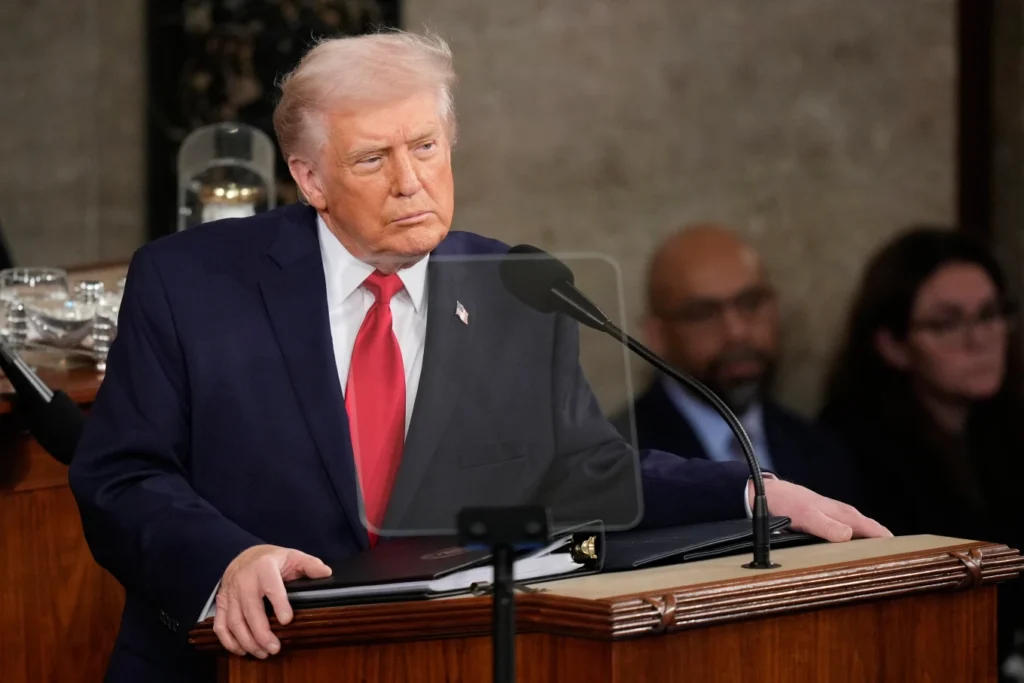
WASHINGTON, Feb. 24 – President Donald Trump delivered his State of the Union address to a joint session of U.S. Congress on Tuesday, using the nationally televised moment to reinforce his case to voters ahead of November’s midterm elections. The speech came as Americans continue to express frustration over everyday costs and as global tensions, particularly involving Iran, weigh on the administration’s agenda.
While the address followed the familiar script of policy promises and partisan contrasts, it also revealed subtle shifts in priorities and tone, offering insight into how the White House sees the political landscape heading into a consequential election season.
The Economy as the Central Message
Economic issues dominated the address, reflecting the administration’s belief that voters ultimately judge presidents on their wallets. Trump touched on a wide range of household concerns, from housing affordability and healthcare costs to energy bills, crime, and retirement security. The emphasis suggested a conscious effort to bring so-called kitchen table issues to the forefront after criticism from allies that economic messaging had been too diffuse.
The president painted a broadly optimistic picture, arguing that inflation, mortgage rates, and gasoline prices are easing while investment, energy production, and job creation are on the rise. He presented proposals aimed at lowering prescription drug prices and restructuring certain federal payments, describing them as fiscally responsible and beneficial to ordinary Americans.
However, the speech largely avoided direct acknowledgment of the strain many families still feel from elevated food and housing costs. Publicly available government statistics indicate that inflation has not fallen as sharply as the White House claims, and labor data shows mixed results in manufacturing and overall job growth. Independent polling organizations have also reported that a majority of voters remain uneasy about the economy and skeptical of the administration’s performance.
By stressing positive indicators and minimizing setbacks, Trump appeared intent on reframing the economic debate rather than engaging with its more uncomfortable realities. Political strategists from both parties note that whether this approach resonates could play a decisive role in determining control of Congress later this year.
A Carefully Staged Political Spectacle
Despite moments of restraint, the address leaned heavily on visual and emotional elements designed for television. Trump recognized military veterans, honored athletes, and highlighted invited guests whose stories underscored his broader themes of patriotism, national strength, and public safety.
These moments reinforced how the State of the Union has evolved into a form of political theater, where symbolism often carries as much weight as policy detail. The president’s background as a media figure was evident in the pacing and presentation, with applause lines and dramatic pauses calibrated to energize supporters and draw sharp contrasts with political opponents.
Such staging is not new, but critics argue it can overshadow substantive debate. Supporters counter that these gestures humanize policy and connect abstract issues to real lives. Either way, the address reflected an understanding that modern political communication extends well beyond the written text of a speech.
Foreign Policy and the Question of Conflict
One of the most anticipated aspects of the address was how Trump would address escalating tensions in the Middle East, particularly regarding Iran. The president delayed any substantive reference to the issue until well into the speech, and when he did, he relied on familiar rhetoric about preventing nuclear proliferation and countering regional instability.
What was notably absent was a detailed explanation of why military action might be necessary now or what specific objectives the United States would pursue. Observers had expected a more comprehensive case, given recent troop movements and diplomatic activity. Instead, the remarks left room for interpretation, suggesting that internal deliberations are ongoing.
Other international issues received limited attention. Ongoing conflicts involving major world powers were mentioned only briefly, and some previously emphasized ambitions, such as territorial acquisitions or major diplomatic confrontations, were omitted entirely. Analysts suggest this restraint may reflect a strategic decision to keep the focus on domestic concerns as the midterms approach.
Immigration, Crime, and Shifting Emphasis
Immigration returned as a central theme, though in a more selective form than in past speeches. Trump highlighted violent crimes committed by immigrants and framed the issue as a failure of Democratic leadership, while avoiding discussion of the operational details of his administration’s enforcement policies.
Notably absent were references to U.S. Border Patrol and Immigration and Customs Enforcement, agencies that have been highly visible during recent crackdowns. By focusing on outcomes rather than methods, the president appeared to be recalibrating his message in response to public unease about aggressive enforcement tactics.
This approach marked a partial return to campaign themes that previously resonated with voters, emphasizing security and order while downplaying controversy. Whether the shift will rebuild broader support remains uncertain, particularly as immigration continues to divide the electorate.
Partisan Appeals and Changing Priorities
The address also offered clues about evolving priorities within the administration. Several topics that featured prominently in last year’s remarks were missing, including confrontational language toward China and praise for high-profile efficiency initiatives linked to Elon Musk. Instead, Trump announced a new effort focused on combating fraud, to be chaired by Vice President JD Vance.
At the same time, the president sharpened his attacks on Democrats, portraying them as obstructive and out of touch with national interests. The chamber’s reaction underscored the deep partisan divide, with Republicans offering frequent standing ovations and Democrats largely remaining seated, occasionally voicing objections.
Beyond policy, the rhetoric was aimed squarely at motivating voters to deliver unified control of government to Republicans. Trump framed the upcoming midterms as a referendum not just on legislation, but on competing visions of the country’s future.
As the speech concluded, it was clear that the State of the Union served less as a policy roadmap than as a campaign argument. With economic anxiety lingering and global uncertainty unresolved, the effectiveness of that argument will be tested in the months ahead.