
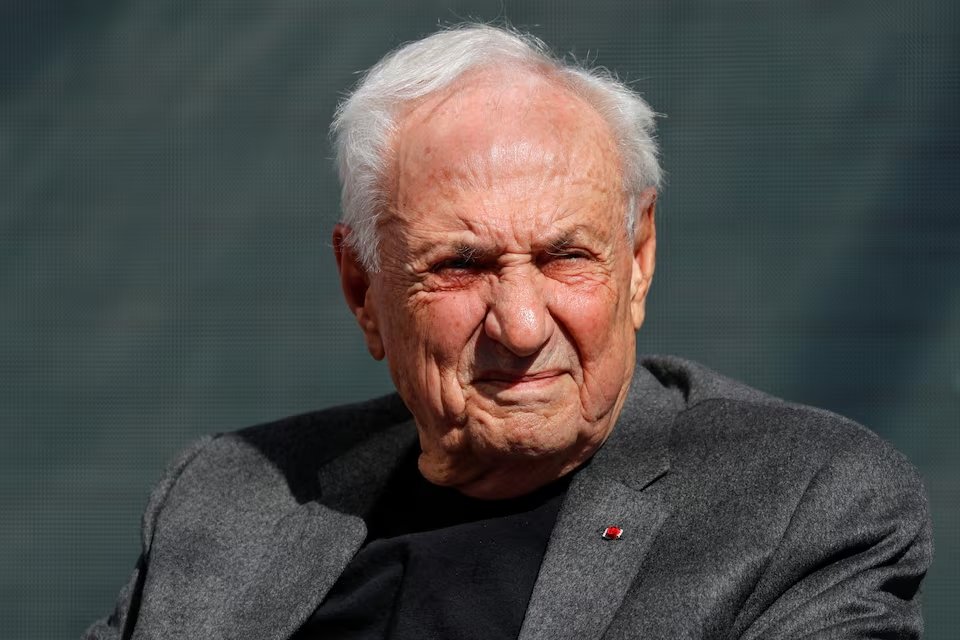
December 5 – Frank Gehry, long celebrated for reimagining how buildings could move, shine, twist, and speak, has passed away at the age of 96. Known for imaginative structures that turned cities into galleries of form and motion, Gehry shaped skylines across the world with confidence, curiosity, and playful rebellion. His career spanned decades of experimentation, and he used metal, glass, and sweeping curves to push architecture into new territory. His passing marks the end of an era for a figure who transformed modern design with bold ideas and a willingness to challenge the ordinary.
Iconic Buildings and Global Recognition
Gehry’s architectural voice emerged most powerfully through the buildings that made him a household name. Among these was the Guggenheim Museum in Bilbao in Spain, a structure defined by its shimmering titanium curves and fluid forms. This museum became a symbol of his style, which often appeared as if the building itself had been caught in motion, folding and unfolding like layers of sculpted metal. This celebrated work helped transform Bilbao into an international destination for art lovers and architecture enthusiasts.
His creative reach extended into France with the Fondation Louis Vuitton museum in Paris, a project that showcased glass structures shaped like billowing sails. In California, Gehry left his mark on the Facebook campus in Menlo Park. Although he was known for dramatic and adventurous shapes, this project came with a request to avoid excessive boldness so that the new spaces would fit comfortably into the campus environment. Even with such guidelines, the design still carried his signature blend of material expression and structural movement.
Gehry’s influence also touched numerous other cities. The Walt Disney Concert Hall in Los Angeles became one of the most recognizable cultural landmarks in the United States, while the Dancing House in Prague added a sense of rhythmic motion to the city’s historic streets. He also designed the Experience Music Project in Seattle, along with the 8 Spruce Street tower in New York, a residential building with a rippling metallic exterior that redefined the surrounding skyline. Through these projects, Gehry proved that buildings could become characters in their own stories, speaking through shapes, shadows, and surprising contours.
Gehry’s work did not always escape criticism. Some argued that his attention to form overshadowed practicality, calling certain structures extravagant or chaotic. His Disney Hall, for instance, was criticized by some commentators with colorful descriptions comparing it to broken dishes or discarded objects. Yet Gehry understood that innovation invited debate. In interviews, he often noted that at least people were paying attention, suggesting that he valued conversation over conformity.
Bold Personality, Strong Opinions, and a Drive to Disrupt
Gehry carried an outspoken spirit throughout his career. He believed many contemporary buildings lacked imagination, and he made no effort to hide his opinions. During an event in Spain in 2014, when asked about criticism of his style, he responded with a blunt gesture and a sharp remark about the state of modern design. His confidence, humor, and willingness to defy expectations shaped both his work and his public persona.
Early Life and the Search for Creative Direction
Born Frank Owen Goldberg in Toronto on February 28, 1929, Gehry was the son of Polish Jewish parents. As a child, he spent hours building imaginative structures out of wood scraps, a memory he later described as the spark that led him toward architecture. He found early inspiration in the idea that creativity could have a place in everyday work, and that grown adults could still play while building something meaningful.
After graduating from the University of Southern California, Gehry went through several formative experiences. He worked for architecture firms in Los Angeles, briefly attended the Harvard Graduate School of Design, served in the United States Army, and lived for a period in Paris. During this time, he explored new environments and drew inspiration from European art and design. Upon returning to Los Angeles in the early 1960s, he changed his last name to Gehry, following his wife’s suggestion, as a way to navigate cultural biases more comfortably.
Breakthrough Projects and Worldwide Impact
Gehry’s rise to prominence began with his reconstruction of his own home in Santa Monica in 1978. He transformed a simple pink Dutch colonial house using industrial materials such as chain link fencing, corrugated metal, and raw plywood. The result was a bold statement about what architecture could be, sending a clear message that Gehry intended to break rules rather than follow them.
By the mid 1980s, Gehry was gaining international recognition for projects that bent metal into graceful arcs and dramatic folds. His talent reached a new milestone in 1989 when he received the Pritzker Prize, the most esteemed award in architecture. This honor placed him among the greatest creative minds in his field.
His work reached new heights with the completion of the Guggenheim Museum in Bilbao in 1997. The project used advanced computer design tools to achieve shapes that would have been nearly impossible to construct in earlier decades. The museum’s opening was met with worldwide admiration, and many experts regarded it as one of the most influential architectural works of its time.
Beyond buildings, Gehry ventured into designing furniture, jewelry, watches, and even a sculptural hat for the singer Lady Gaga. These collaborations demonstrated his belief that design could flow beyond structures and into objects that people use and wear.