
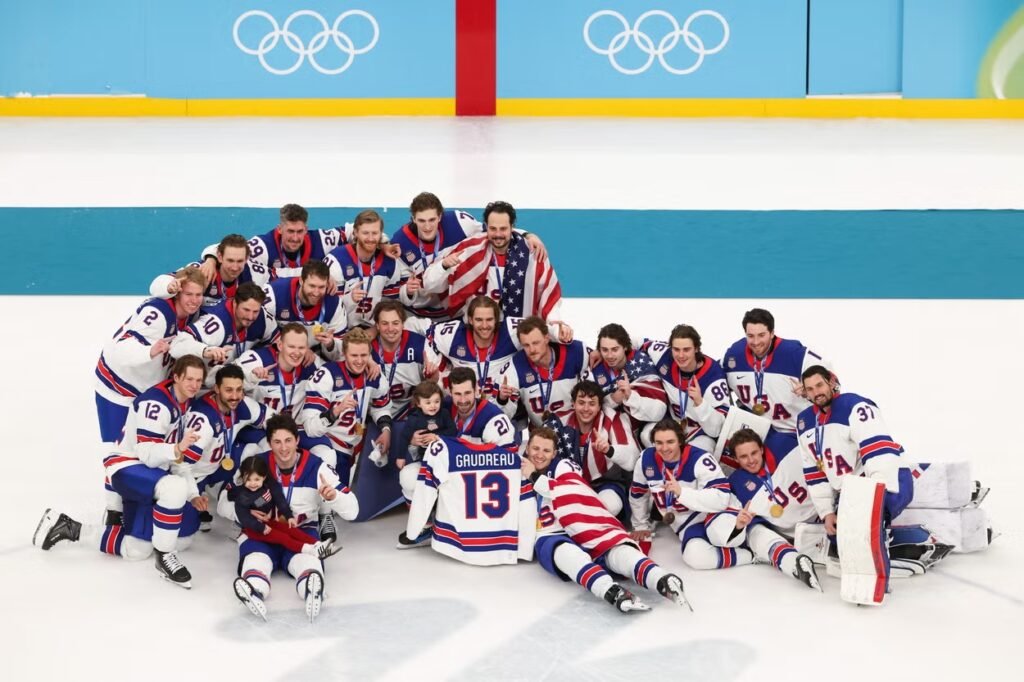
MILAN, Feb 22 – The United States men’s hockey team delivered a moment that will be remembered for generations, defeating Canada 2–1 in overtime to claim Olympic gold in a dramatic final that blended history, heartbreak, and high drama. Played exactly 46 years after the Americans last stood atop the Olympic podium, the victory echoed the spirit of past triumphs while firmly establishing this team’s own legacy on the global stage.
The game, contested before a packed and emotionally charged crowd, lived up to its billing as the sport’s fiercest rivalry. Every shift carried tension, every save drew gasps, and when overtime arrived, it felt inevitable that one unforgettable moment would decide it all.
A Rivalry Renewed and an Overtime for the Ages
The decisive moment came just 1 minute and 41 seconds into three-on-three overtime, when Jack Hughes found open ice and buried the game-winning goal. Despite having lost teeth earlier in the contest due to a high stick, Hughes showed remarkable composure, converting a precise feed from Zach Werenski and sending the American bench into a frenzy. Canada’s players could only watch from across the ice as the celebration unfolded.
Hughes later described the moment as surreal, emphasizing the magnitude of a USA-Canada Olympic final and the resilience of his teammates. He acknowledged that the Americans entered the game as underdogs but believed the team had the depth and belief to match Canada shift for shift. His words reflected both disbelief and pride, sentiments shared throughout the locker room.
The path to overtime was anything but simple. The United States struck first when Matt Boldy opened the scoring six minutes into the game. After receiving a pass from Auston Matthews, Boldy showed quick hands and confidence, batting the puck forward to split two Canadian defensemen before slipping a backhand shot past goaltender Jordan Binnington. The early goal gave the Americans momentum, but Canada responded with patience and pressure.
It took nearly two periods for Canada to break through. Late in the second, Cale Makar tied the game with a well-placed shot, assisted by Devon Toews. From that point on, the contest tightened into a defensive battle, with both teams trading chances and goaltenders taking center stage.
Special teams added another layer of drama. The United States enjoyed extended power play time in the third period after a high stick by Sam Bennett, only for Hughes to be penalized moments later, leveling the manpower situation. Each missed opportunity heightened the tension as regulation time ticked away.
If one player defined the American effort, it was Connor Hellebuyck. The goaltender turned aside 41 of 42 shots and delivered what many called the save of the tournament, deflecting a dangerous third-period attempt from Toews with his stick. Minutes later, he denied Macklin Celebrini on a breakaway, preserving the tie and setting the stage for overtime heroics. Teammates openly credited Hellebuyck as the backbone of the gold medal run.
History, Heart, and Meaning Beyond the Medal
This victory carried significance beyond the scoreboard. It marked the 3rd time the United States and Canada have met in an Olympic gold medal game, reinforcing the rivalry as one of the sport’s defining narratives. Unlike the underdog squad that stunned the world in 1980 at Lake Placid, this American team arrived with a roster filled with NHL talent and expectations to match. Still, the weight of history was impossible to ignore.
Former U.S. captain Mike Eruzione, who scored the iconic goal against the Soviet Union in 1980, was in attendance to witness the new generation’s achievement. His presence served as a living bridge between eras, reminding fans and players alike of what Olympic hockey has meant to the country.
The emotional depth of the night was further underscored by a tribute to the late Johnny Gaudreau. Werenski and Matthew Tkachuk carried Gaudreau’s No. 13 jersey around the ice following the final horn. Gaudreau had been killed along with his brother in 2024 after being struck by a driver, a loss that deeply affected the hockey community. His parents, widow Meredith, and their children were present, including his youngest on his 2nd birthday. The gesture transformed the celebration into a moment of shared remembrance and respect.
Reaction to the win extended well beyond the arena. Donald Trump publicly congratulated the team, calling the victory remarkable and later speaking to the players via video call in the locker room. According to head coach Mike Sullivan, the message focused on pride, unity, and appreciation for the players’ effort, a reflection of the national attention the game commanded.
For many on the roster, the gold medal represented the fulfillment of lifelong dreams. Players spoke openly about growing up watching Olympic highlights and imagining themselves in similar moments. Forward Vincent Trocheck described the win as the culmination of childhood aspirations, shaped by memories of the Miracle on Ice and years of sacrifice.
Brady Tkachuk echoed that sentiment before the final, saying the opportunity to win gold meant everything, not just for the players, but for the generations who came before them and the country they represented. That perspective seemed to fuel the team’s performance, especially in moments when momentum swung dangerously toward Canada.