
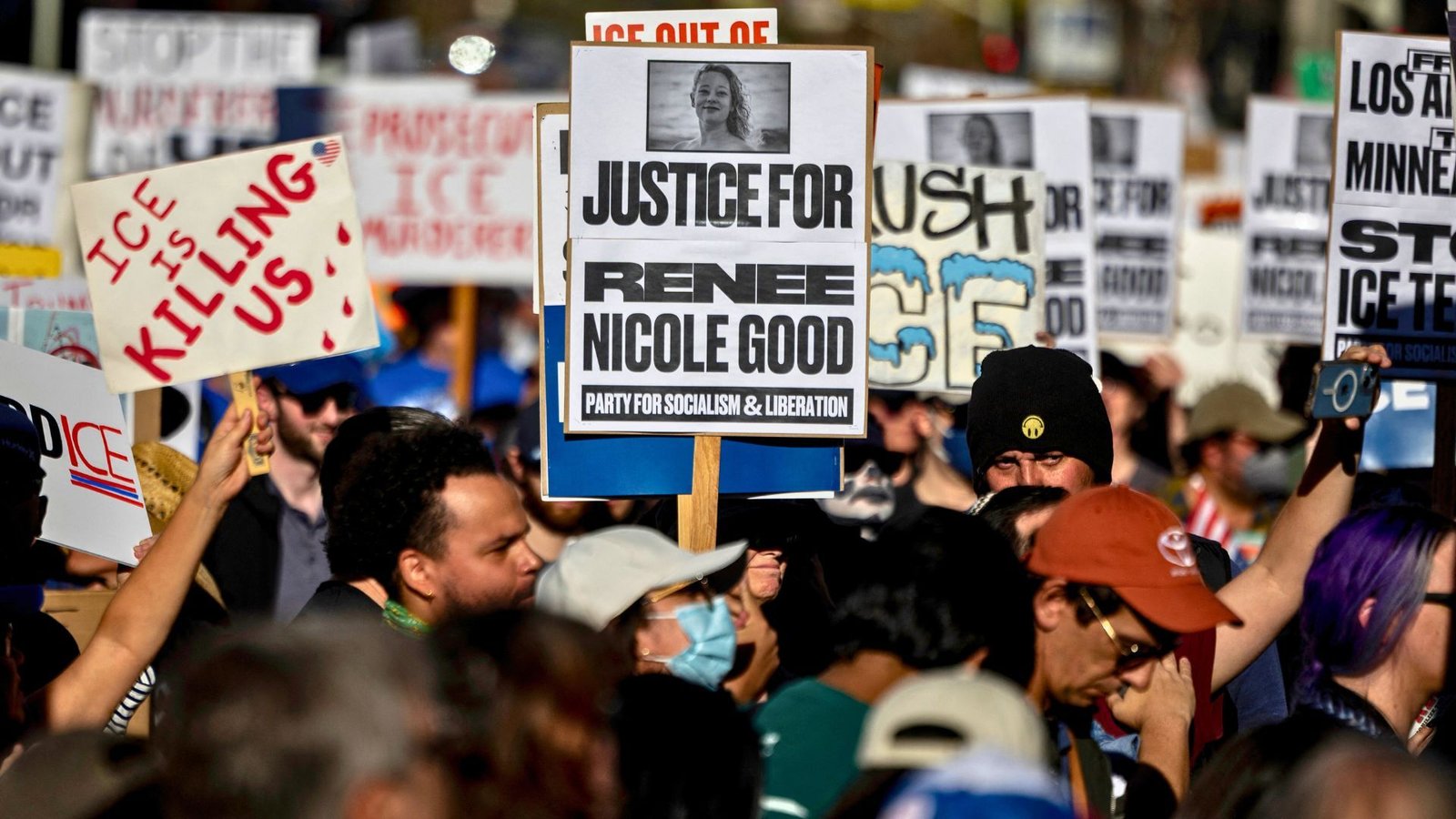
MINNEAPOLIS, Jan 11 – The fatal shooting of Renee Nicole Good, a Minneapolis resident and US citizen, by an Immigration and Customs Enforcement officer has ignited a national debate over the expanding use of the term “domestic terrorism” by federal officials. At the center of the controversy is US Homeland Security Secretary Kristi Noem’s public statement labeling Good’s actions as “domestic terrorism,” a description that legal experts, civil liberties advocates, and Minnesota officials say is misleading, legally unsupported, and potentially dangerous for democratic norms.
Good, a mother of three known in her community as a poet and caregiver, was killed after an encounter with ICE officers near her neighborhood shortly after she dropped her young son at school. Within hours of the incident, the federal government framed the shooting as a response to what it described as a terrorist act. That framing, critics argue, risks reshaping public understanding of terrorism and blurring the line between criminal conduct, protest, and lawful dissent.
Understanding ‘Domestic Terrorism’ in US Law
In US law, “domestic terrorism” has a specific and narrow meaning, even though it is often used loosely in political rhetoric. Federal agencies such as the FBI and the Department of Homeland Security rely on statutory definitions drawn from the US Code. These definitions generally describe domestic terrorism as acts that are dangerous to human life, violate criminal laws, and are intended to intimidate civilians or coerce government policy through violence or threats.
However, unlike foreign terrorism, there is no standalone federal crime labeled “domestic terrorism.” This distinction has been emphasized repeatedly by legal scholars and government research bodies, including the nonpartisan Congressional Research Service. Individuals can be charged under existing criminal statutes that fall within the broader terrorism framework, but no legal mechanism exists to formally designate a US citizen as a “domestic terrorist” in the way foreign terrorist organizations are designated.
Former federal law enforcement officials and legal analysts have long warned that conflating rhetoric with law creates confusion and opens the door to abuse. Michael German, a former FBI agent and later a fellow at a major civil liberties institute, has previously noted that government officials have no legal authority to label individuals as domestic terrorists absent a judicial process. According to him, such labels are inherently prejudicial and carry no legal weight, even though they can heavily influence public perception.
In the case of Renee Good, Minnesota officials quickly challenged the federal account. Video footage reviewed by major US media outlets showed Good attempting to drive away from ICE officers, rather than deliberately attempting to strike them. Minnesota Attorney General Keith Ellison, speaking publicly on CNN, described the use of the term “domestic terrorism” as an abuse of language that undermines its seriousness and meaning.
Experts say intent is central to any terrorism analysis. While a vehicle can be used as a weapon in certain contexts, the available evidence in this case suggests an effort to flee, not to intimidate or coerce the government for political ends. Without clear evidence of political motive or intent to cause mass harm, legal experts argue that the terrorism label does not apply.
A Broader Pattern and Growing Legal Concerns
The controversy surrounding Good’s death does not exist in isolation. In recent months, the Trump administration has increasingly invoked the language of domestic terrorism in the context of immigration enforcement and political unrest. A September memo circulated within federal law enforcement agencies urged officials to prioritize threats described as violent efforts to obstruct immigration operations. Critics said the memo blurred the line between violence and protected speech, raising serious First Amendment concerns.
A similar incident occurred during a high profile immigration crackdown in Chicago known as “Operation Midway Blitz.” In that case, a US citizen named Marimar Martinez was shot multiple times by a Border Patrol agent and later described by DHS in a public release as a domestic terrorist. Prosecutors ultimately moved to dismiss the federal charges, and a judge approved the request. Legal analyst Joey Jackson later told CNN that the case raised significant doubts about the accuracy of the officers’ initial accounts.
Beyond immigration enforcement, the administration has expanded its rhetoric to encompass a wide range of politically motivated activities. Following the murder of conservative activist Charlie Kirk, President Trump issued a memo directing the attorney general to broaden domestic terrorism priorities to include activities such as organized doxing, swatting, and civil disorder. Days earlier, Trump had signed an executive order designating antifa, a loosely organized left wing movement, as a domestic terrorist organization, a move widely criticized by constitutional scholars.
Attorney General Pam Bondi subsequently instructed federal agencies to compile lists of groups that might be engaged in acts constituting domestic terrorism. Civil liberties experts warned that such directives risk criminalizing dissent and selectively targeting ideological opponents. Faiza Patel of the Brennan Center for Justice wrote that these measures lack grounding in law and fact and could chill free expression by threatening investigations based on political views.
Critics have also noted the apparent imbalance in enforcement priorities. The administration’s directives have focused heavily on left leaning activism while making little reference to acts of violence associated with other ideological movements. Thomas E Brzozowski, a former Justice Department counsel specializing in domestic terrorism, argued in a public commentary that policies singling out one ideological group undermine any claim of neutrality.
In Good’s case, legal experts expressed particular concern about the speed with which the terrorism label was applied. Brzozowski told PolitiFact that issuing such a designation before the completion of any investigation strips the term of its meaning and transforms it into a political tool. Stanford Law School professor Shirin Sinnar echoed that concern, stating that while vehicle attacks can constitute terrorism in certain contexts, the Minneapolis footage does not support that conclusion here.
For many observers, the central issue is not only the tragic loss of life but also the precedent being set. When senior government officials publicly label a deceased civilian as a domestic terrorist without legal findings, it risks normalizing a practice that bypasses due process. As German noted in his comments, there is no public evidence that Good engaged in conduct prosecutable under federal terrorism statutes. In that light, the label functions not as a legal assessment but as a narrative device, one that can shape public opinion and justify the use of lethal force.
1 thought on “Federal use of ‘domestic terrorism’ questioned after ICE agent kills Minneapolis mother”