

HOUSTON, April 11 – The four astronauts of NASA’s Artemis II mission received an emotional and celebratory welcome in Houston after completing a groundbreaking journey around the moon, marking a major milestone in modern space exploration. Their return not only symbolizes a technological achievement but also signals a renewed commitment to human spaceflight beyond Earth’s orbit for the first time in more than a half century ago.
Commander Reid Wiseman, along with Victor Glover, Christina Koch, and Canadian astronaut Jeremy Hansen, concluded their 10-day mission with a safe splashdown in the Pacific Ocean near Southern California. Within hours, they were transported back to Texas, where families, colleagues, and hundreds of NASA personnel gathered to greet them with applause and visible pride.

A Mission That Revives Lunar Exploration
The Artemis II mission stands as a historic moment in spaceflight, being the first crewed journey to circle the moon and return safely since the Apollo era ended in the early 1970s. Launching on April 1 from Kennedy Space Center, the astronauts traveled aboard the Orion spacecraft, powered by the Space Launch System, currently the most powerful operational rocket in the world.
After entering Earth’s orbit, the crew conducted extensive checks of onboard systems before initiating a precise engine burn that sent them toward the moon. Over the following days, they traveled deep into space, eventually entering the moon’s gravitational influence and flying around its far side, an area rarely seen directly by human eyes.

During the mission, the crew reached a record-breaking distance of more than 252,000 miles from Earth, surpassing the farthest distance previously achieved by astronauts during the Apollo 13 mission. This milestone highlighted both the technical capabilities of modern spacecraft and the expanding boundaries of human exploration.
Throughout their journey, the astronauts documented their experiences with photos, video recordings, and personal observations. These materials are expected to provide valuable insights for scientists and engineers, particularly regarding how humans perceive and respond to deep space environments.
One of the most unforgettable moments came when the crew witnessed a solar eclipse from space. As the moon passed in front of the sun, it created a glowing halo effect, a sight described by Victor Glover during a transmission to mission control. According to NASA communications, the crew expressed awe at the visual contrast between the bright Earth, the shadowed moon, and the vast darkness surrounding them.

NASA Administrator Jared Isaacman, speaking at the welcome ceremony in Houston, emphasized the importance of the mission. He noted that after decades without crewed lunar missions, the agency has successfully demonstrated its ability to send astronauts to the moon and bring them back safely. His remarks underscored the broader goal of establishing a sustained human presence on the lunar surface.
Emotional Reflections and a Vision for the Future
Following their return, each astronaut shared deeply personal reflections about the journey, revealing the emotional and philosophical impact of seeing Earth from such a distant vantage point.
Commander Reid Wiseman described the transition from spaceflight back to Earth as surreal. He spoke candidly about the contrast between traveling at extreme speeds in space and suddenly being back home among loved ones. His comments highlighted the emotional pull of family and the unique perspective gained from leaving the planet behind.
Victor Glover, known for his strong faith, expressed gratitude both before and after the mission. He publicly thanked God for the opportunity and reflected on the overwhelming sense of appreciation he felt for the experience, his crewmates, and the view of Earth from space. His remarks added a spiritual dimension to the mission’s significance.
Christina Koch focused on the profound visual impact of seeing Earth suspended in the darkness of space. She described the planet as a fragile, isolated lifeboat surrounded by an immense void. Her words carried a message of unity, suggesting that humanity shares a collective responsibility for the planet.
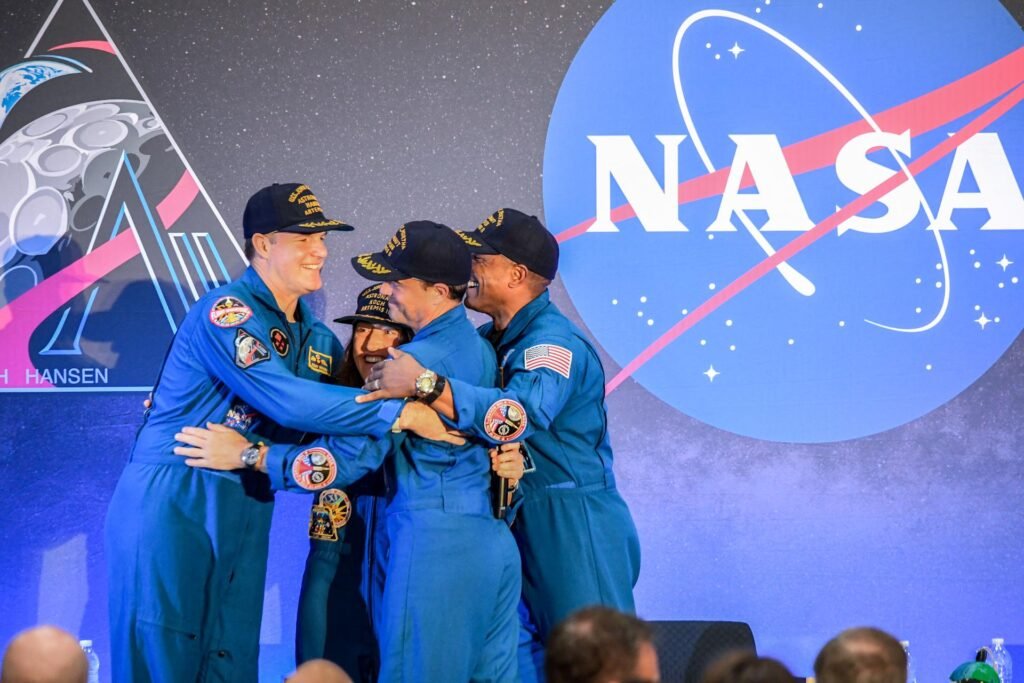
Jeremy Hansen, representing Canada, delivered a heartfelt message during the welcome event. He spoke about the importance of gratitude, shared joy, and love as the foundation of a successful mission. In a symbolic gesture, he gathered his fellow crew members for a group embrace, emphasizing the human connection behind the technical achievement.
The mission also included meaningful tributes. The crew proposed names for newly identified lunar features, including one named after a loved one connected to the team. This gesture added a personal legacy to their scientific accomplishments.
The significance of Artemis II extends beyond its immediate success. According to statements relayed during the mission, including remarks from U.S. leadership, the journey is part of a broader strategy to return humans to the moon permanently and eventually prepare for missions to Mars. The Artemis program aims to establish a sustainable presence near the lunar south pole, where future astronauts may live and work.
As the astronauts settle back into life on Earth, their journey continues to resonate across the global space community. Their mission not only demonstrated advanced capabilities but also reignited a sense of wonder and possibility that had been largely dormant since the Apollo era.
The return of Artemis II marks the beginning of a new chapter in human exploration, one defined not just by technological progress, but by the shared ambition to reach farther into the cosmos while gaining a deeper appreciation for the planet we call home.