
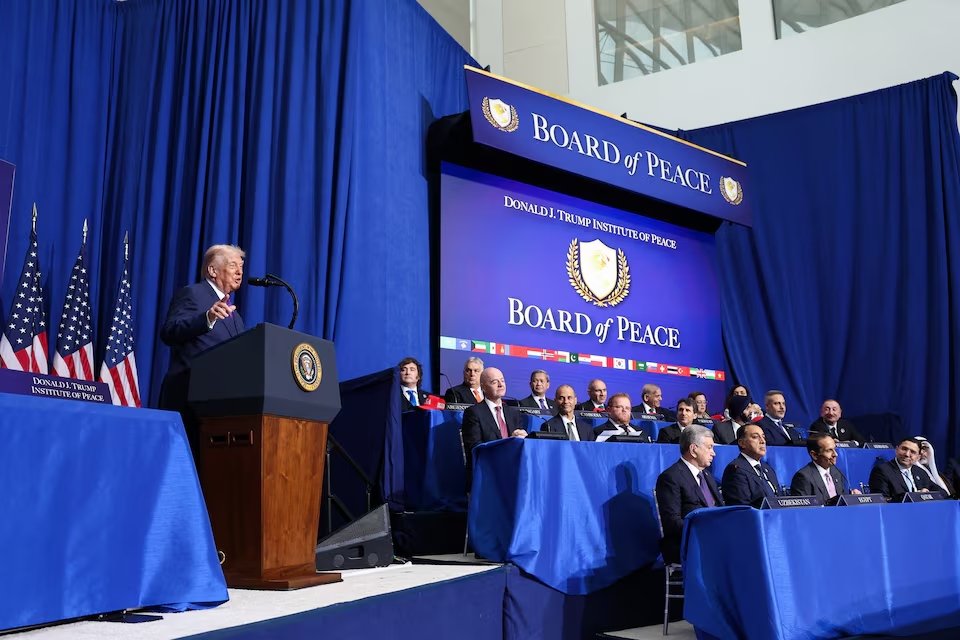
WASHINGTON, Feb 19 – U.S. President Donald Trump on Thursday unveiled sweeping financial and diplomatic commitments at the inaugural meeting of his newly formed Board of Peace, presenting the initiative as a cornerstone of his broader ambition to be remembered as a global peacemaker. Central to the announcement was a multibillion dollar reconstruction plan for Gaza, tied to the still uncertain disarmament of Hamas and the stabilization of the war battered enclave after two years of devastating conflict.
Meeting in Washington with representatives from dozens of countries, Trump framed the gathering as a historic first step toward rebuilding Gaza and preventing a return to war. Yet beneath the optimism, the initiative faces formidable political, military, and humanitarian obstacles, including the absence of Palestinian representatives, unresolved questions over funding sources, and deep skepticism about whether armed groups in Gaza will relinquish their weapons.
Global Funding Pledges and the Shape of the Board of Peace
In a lengthy and at times rambling address, Donald Trump announced that participating nations had collectively pledged $7 billion to a Gaza reconstruction fund. He described the sum as an initial down payment rather than a final figure, acknowledging that rebuilding Gaza, much of which has been reduced to rubble, could ultimately cost ten times that amount. Independent estimates by international development experts have placed total reconstruction needs as high as $70 billion, given the scale of destruction to housing, infrastructure, health facilities, and basic services.
Trump also declared that the United States would commit an additional $10 billion to support the Board of Peace itself, although he did not clarify whether the funding would require congressional approval or how it would be financed. Senior administration officials later indicated that discussions with lawmakers had not yet taken place, leaving open questions about the political viability of such a pledge.
The Board of Peace is composed largely of Middle Eastern countries, along with a smaller number of states from Central Asia and beyond. Trump listed contributors including Azerbaijan, Kazakhstan the United Arab Emirates, Qatar, Bahrain, Saudi Arabia, Morocco, Uzbekistan, and Kuwait. Several diplomats attending the meeting privately suggested that some governments saw participation as a way to strengthen ties with Washington at a time when U.S. foreign policy is increasingly transactional.
Notably absent from the board are Palestinian representatives. Israel is included as a member, but Palestinian political factions and civil society figures were not invited to the founding meeting. Critics argue that this omission undermines the board’s credibility and risks alienating the very population whose future it seeks to shape. Trump sought to deflect such criticism by insisting that Palestinian interests would be represented indirectly through technocratic mechanisms and humanitarian programs.
International organizations were also name checked during the event. Trump said FIFA would raise $75 million for sports related projects aimed at youth in Gaza, while the United Nations was expected to provide $2 billion in humanitarian assistance. While both institutions have long been active in Gaza, officials familiar with the matter cautioned that formal agreements had yet to be finalized.
Trump emphasized that the Board of Peace would not be limited to Gaza alone. He reiterated that its mandate could expand to other global conflict zones, a statement that has unsettled some U.S. allies who fear the initiative could sideline established multilateral forums. Norway, which Trump mentioned as a future host of a board related event, later clarified through its foreign ministry that it was not joining the board itself.
Security, Hamas Disarmament, and the Risk of a Fragile Peace
The most contentious issue surrounding the Board of Peace remains security, particularly the fate of Hamas’ armed wing. Trump tied large scale reconstruction directly to the disarmament of Hamas, describing it as a prerequisite for lasting peace. While he expressed hope that force would not be necessary, he acknowledged that the path ahead was uncertain.
Hamas has so far been reluctant to hand over its weapons, citing fears of Israeli reprisals and a lack of guarantees for Gaza’s future. The group’s leaders have argued that disarmament without a clear political horizon would leave Palestinians vulnerable. In Israel, Benjamin Netanyahu adopted a far more uncompromising tone, warning that Hamas would be disarmed either voluntarily or through military means.
To address security during a potential transition period, Trump announced plans for an International Stabilization Force. According to details outlined at the meeting, several countries are preparing to deploy thousands of troops once conditions allow. Indonesian President Prabowo Subianto said his country could contribute up to 8,000 soldiers, one of the largest contingents discussed so far.
The proposed force would initially operate in areas currently controlled by Israeli troops, beginning in Rafah, a southern Gaza city that was largely depopulated and demolished during the war. Led by a U.S. general with an Indonesian deputy, the mission aims to train approximately 12,000 Palestinian police officers and eventually field up to 20,000 international troops. Defense officials familiar with the plan described it as ambitious and logistically complex, particularly given the absence of a final political settlement.
Trump’s peace focused rhetoric was delivered against a backdrop of heightened tensions with Iran. During the same event, he warned that he would know within 10 days whether a “meaningful deal” could be reached with Tehran over its nuclear program. The remarks underscored the contradiction critics see in Trump’s approach, promoting diplomacy in Gaza while threatening military action elsewhere in the region.
Inside Gaza, Hamas spokesperson Hazem Qassem issued a statement saying the true test of the Board of Peace would be its ability to pressure Israel to uphold the ceasefire, ease restrictions, and allow reconstruction to begin. Hamas has said it is prepared to transfer administrative control to a U.S. backed committee of Palestinian technocrats, reportedly led by Ali Shaath, but claims Israel has blocked the group from entering the territory. Israeli authorities have not publicly responded to those claims.
The Washington event itself had the atmosphere of a political rally, complete with music from Trump’s personal playlist and red campaign style hats distributed to participants. Still, some speakers struck a sober note. Nickolay Mladenov, a senior board official and former UN envoy, said thousands of Palestinians had already applied to join a new transitional police force, highlighting both urgency and fragility.
The urgency of the mission was underscored by U.S. Secretary of State Marco Rubio, who warned the gathered diplomats of the consequences of failure. “We have to get this right,” Rubio stated. “There is no Plan B for Gaza. Plan B is going back to war. No one here wants that.”