
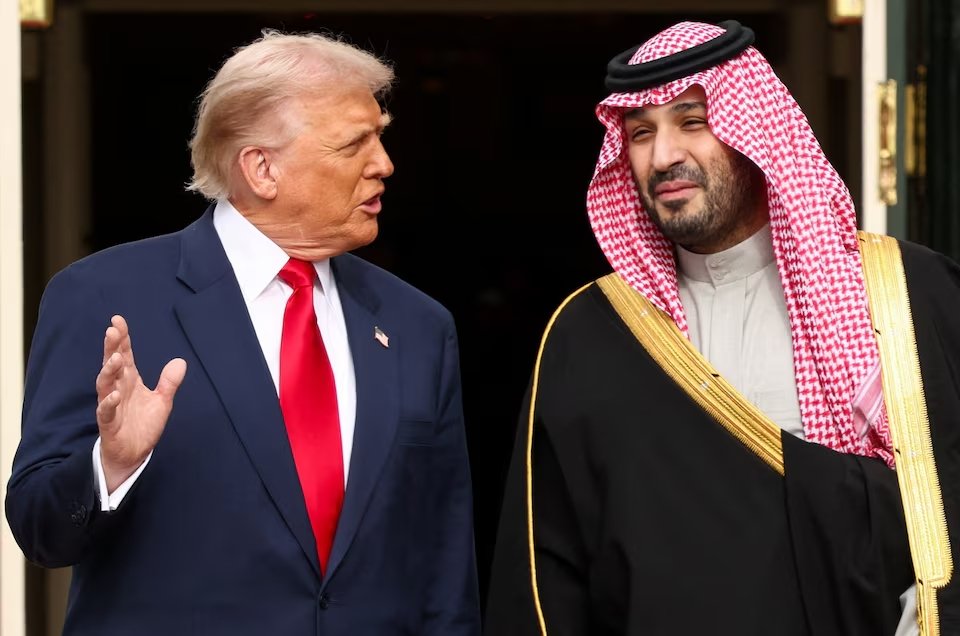
WASHINGTON, Nov 18 – President Donald Trump offered a vigorous defense of Saudi Crown Prince Mohammed bin Salman during the prince’s high profile visit to Washington, firmly insisting that the Saudi leader had no knowledge of the 2018 killing of journalist Jamal Khashoggi. The remarks, delivered in the Oval Office, directly conflicted with the long standing conclusions of United States intelligence agencies, setting off a renewed wave of controversy surrounding one of the most scrutinized episodes in recent diplomatic history.
The crown prince, making his first appearance at the White House in over seven years, arrived seeking to reinforce ties with Washington at a moment when global attention on the Khashoggi case had gradually quieted. Trump, seated beside him, repeatedly emphasized that the Saudi leader was not responsible for the killing, which took place at the Saudi consulate in Istanbul.
Washington Meeting Highlights Strategic Realignment
During their discussions, Trump announced that he was designating Saudi Arabia as a Major Non NATO Ally, a symbolic status that expands access to certain military and economic advantages. The decision marked a significant elevation of Saudi Arabia’s position within United States foreign policy, underscoring the importance Trump has placed on the partnership with the oil rich kingdom.
Alongside this designation, both governments revealed a series of agreements that included advanced weapons sales, cooperation on civil nuclear energy, artificial intelligence initiatives and deeper coordination on critical minerals. Trump also confirmed that the United States had approved future deliveries of F-35 fighter jets to the kingdom, a move that would break with past policy and potentially shift the military balance in the Middle East. Saudi Arabia has long sought access to the advanced aircraft, which until now had only been provided to Israel within the region.
United States intelligence agencies have previously concluded that the crown prince approved actions that led to the killing of Khashoggi, who was living in the United States and writing columns critical of the Saudi government. The crown prince has consistently denied directing the operation, although he has accepted overarching responsibility in his role as the country’s de facto ruler.
Clashing Narratives Around Khashoggi’s Death
When reporters raised the question of Khashoggi during the meeting, Trump pushed back sharply, saying that the Saudi leader had no advance knowledge of what occurred. He added that many people held strong opinions about the journalist, and that it was best to leave the matter where it stood. The tone of his response drew criticism from human rights advocates who have long argued that the killing was part of a wider pattern of crackdowns on dissent inside Saudi Arabia.
The crown prince acknowledged again that the killing was a painful episode and described it as a severe mistake. He said his government had carried out proper investigations and strengthened internal systems to prevent such an incident from ever happening again. According to him, the kingdom had taken corrective steps and learned from the tragedy.
Trump also complimented the prince on what he described as improvements in human rights, although he did not clarify what specific progress he was referencing. His warm tone contrasted sharply with criticism from the widow of Jamal Khashoggi, who said that no personal controversy could ever justify such a violent crime. She expressed disappointment over Trump’s remarks and said she wished the president would meet her so she could describe who her late husband truly was.
Human rights organizations have frequently condemned the crown prince both for the Khashoggi killing and for wider efforts to silence critics within the kingdom. At the same time, he has overseen sweeping social changes that have eased long standing restrictions and opened new opportunities, particularly for women and young people.
Foreign Policy, Defense Deals and Investment Promises
The meeting served as a reminder of the strategic importance the United States places on its relationship with Saudi Arabia, the top global oil exporter and a key economic partner. Trump noted that he had received encouraging feedback from Saudi leaders regarding the potential for the kingdom to join future agreements to normalize relations with Israel. The crown prince reiterated that while he remains interested in such a step, he still insists that Israel must outline a clear path toward a Palestinian state before any deal can be finalized.
Later in the evening, during a formal dinner at the White House, Trump emphasized that designating Saudi Arabia as a Major Non NATO Ally would strengthen military collaboration in the region. He pointed to recent United States strikes on Iranian nuclear facilities earlier in the year, saying they had contributed to improved security for Saudi Arabia.
In addition to the defense agreements, the White House released details of a Strategic Defense Agreement aimed at enhancing deterrence throughout the Middle East. The arrangement would facilitate the operation of United States defense firms inside Saudi Arabia and secure new financial contributions from the kingdom to help offset United States operational expenses. While the deal marked a significant step, it fell short of the fully ratified treaty Saudi Arabia had previously hoped to achieve.
Trump also confirmed that Saudi Arabia had agreed to purchase hundreds of American made tanks, further expanding the defense partnership.
Another major announcement involved the conclusion of negotiations over a civil nuclear cooperation plan. The framework would establish the legal foundation for long term collaboration on nuclear energy, a field Saudi Arabia has been eager to advance. However, past talks had struggled due to United States requirements that prohibited enrichment or processing activities, both of which can be associated with weapons development.
Economic Vision and Future Investment
As part of the visit, the crown prince reiterated his pledge to increase Saudi investment in the United States to one trillion dollars, raising the figure from a previously stated commitment of $600 billion. Although he shared no timeline, he indicated that the kingdom aims to expand its economic footprint while pursuing its own domestic transformation plan, Vision 2030. Analysts have noted that such a vast investment would be challenging given the scale of ongoing Saudi megaprojects, many of which have exceeded their budgets.
The two governments also announced agreements on artificial intelligence and critical minerals, both of which play a central role in future technological and energy landscapes.
During the bilateral discussions, Trump insisted that he had no involvement in his family’s business interests, saying that he stepped away entirely when entering office. He added that any business activity conducted by his children or extended family was separate from his political role.
The crown prince is expected to continue his outreach in Washington by attending a major investment conference at the John F. Kennedy Center for the Performing Arts, where he plans to promote his economic diversification agenda and court additional corporate partnerships.