
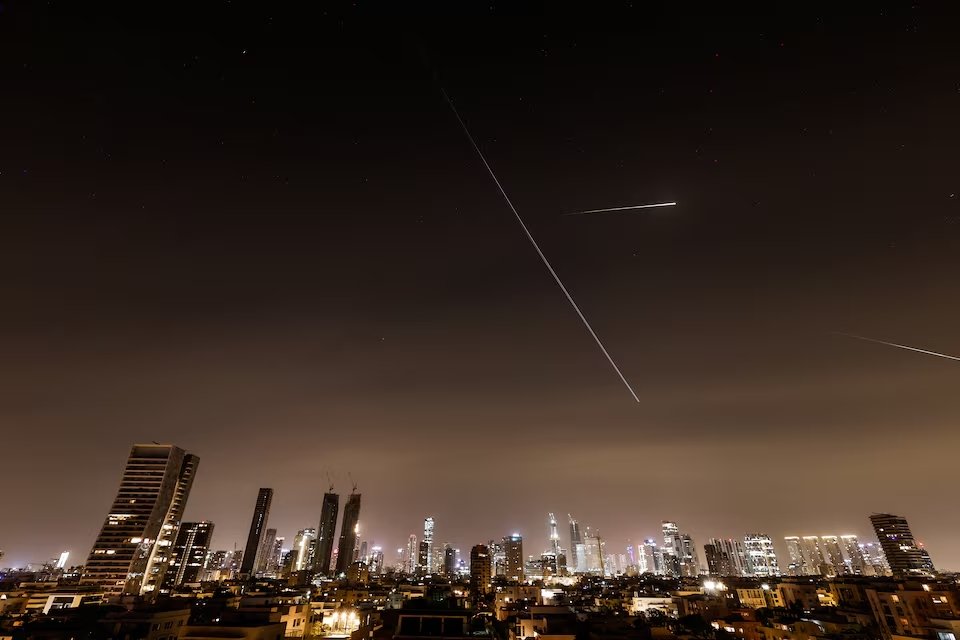
TEL AVIV/WASHINGTON, March 21 – Tensions in the Middle East reached a dangerous new phase on Saturday, as Iran expanded the scope of its military operations, launching long-range missiles for the first time since the US and Israel began attacking Iran on February 28. Israeli officials confirmed that the attacks marked a significant escalation, both in terms of distance and strategic intent, raising alarm across global capitals already grappling with the economic and security fallout of the war.
The latest developments underscore how rapidly the conflict has evolved beyond a regional confrontation into a crisis with global implications, affecting energy markets, military alliances, and geopolitical stability.
Long-Range Missile Use Signals Strategic Shift
According to Israeli military chief Eyal Zamir, Iran deployed ballistic missiles capable of traveling up to 4,000 kilometers, targeting the joint U.S.-UK military base at Diego Garcia in the Indian Ocean. Speaking through an official military statement, Zamir emphasized that this was the first time Iran had used such long-range capabilities in the ongoing war.
“These missiles are not intended solely for Israel,” Zamir stated, warning that their range could extend to major European cities such as Berlin, Paris, and Rome. His remarks highlighted growing fears that the conflict could broaden far beyond its current geography.
A source within the British defense establishment, speaking to international media, indicated that the strike occurred before formal authorization had been granted for U.S. operations from British-controlled bases. This detail points to the fast-moving and, at times, unpredictable nature of the military escalation.
The use of long-range weaponry reflects a calculated move by Tehran to demonstrate its extended reach and deterrence capability. Military analysts suggest that this shift could redefine the balance of power in the region, while simultaneously increasing pressure on Western nations to respond more decisively.
Strikes Near Dimona Raise Nuclear Concerns
Later the same day, Iranian missiles struck southern Israel, hitting areas near the cities of Dimona and Arad. Israeli emergency services reported that dozens of civilians were injured, including children, in the attacks. The strikes occurred close to one of Israel’s most sensitive sites, its nuclear reactor facility located approximately 13 kilometers from Dimona.
Iran’s Revolutionary Guards, in a statement carried by state media, claimed responsibility for targeting what they described as “military installations and security centers” in southern Israel. However, the proximity of the strikes to the nuclear site has intensified concerns about the potential risks of further escalation.
Israeli army spokesperson Brigadier General Effie Defrin acknowledged in a public update on X that air defense systems were operational but failed to intercept the incoming missiles. “We will investigate the incident and draw necessary lessons,” he said, signaling a review of Israel’s defensive preparedness.
Prime Minister Benjamin Netanyahu addressed the nation following the strikes, calling it “a very difficult evening” and reaffirming Israel’s commitment to continue military operations. His office released a statement emphasizing that the country would persist in confronting threats “on all fronts.”
Meanwhile, Iranian media reported that U.S. and Israeli forces had targeted the Natanz nuclear enrichment facility earlier that day. Officials cited technical assessments indicating no radiation leaks, though the International Atomic Energy Agency confirmed it was reviewing the situation. Israel has not officially confirmed involvement in that particular strike.
Global Impact Deepens as Energy Markets React
Beyond the battlefield, the economic consequences of the conflict are becoming increasingly severe. Oil prices have surged by as much as 50% since the war began, placing significant strain on the global economy. Analysts warn that prolonged disruption could fuel inflation and slow growth worldwide.
The Strait of Hormuz, a critical shipping route responsible for transporting roughly one-fifth of global oil and gas supplies, has been effectively restricted. This has triggered widespread among energy-dependent nations.
European gas prices have also risen sharply, climbing up to 35% during the week, according to financial reports. The European Union has responded by urging member states to manage reserves more cautiously and reduce immediate demand.
In Asia, countries heavily reliant on energy imports are navigating a delicate diplomatic balance. Indian officials confirmed ongoing coordination with Tehran to allow limited passage of liquefied petroleum gas shipments through the strait. Japanese media outlet Kyodo reported that Iran may extend similar allowances to vessels linked to Japan, which depends on the route for the majority of its oil imports.
At the same time, the United States appears to be reassessing its military involvement. President Trump, in a message posted on Truth Social, indicated that Washington was “very close” to achieving its objectives and was considering reducing its military footprint. However, he also called on other nations to take responsibility for securing key maritime routes, a proposal that has received mixed reactions from allies.
Diplomatic tensions are rising alongside military actions. Saudi Arabia has expelled several Iranian diplomats, while Israel has expanded operations to include strikes in Lebanon, targeting Hezbollah positions. Iranian reports also pointed to drone activity aimed at U.S. bases in the Gulf region.