
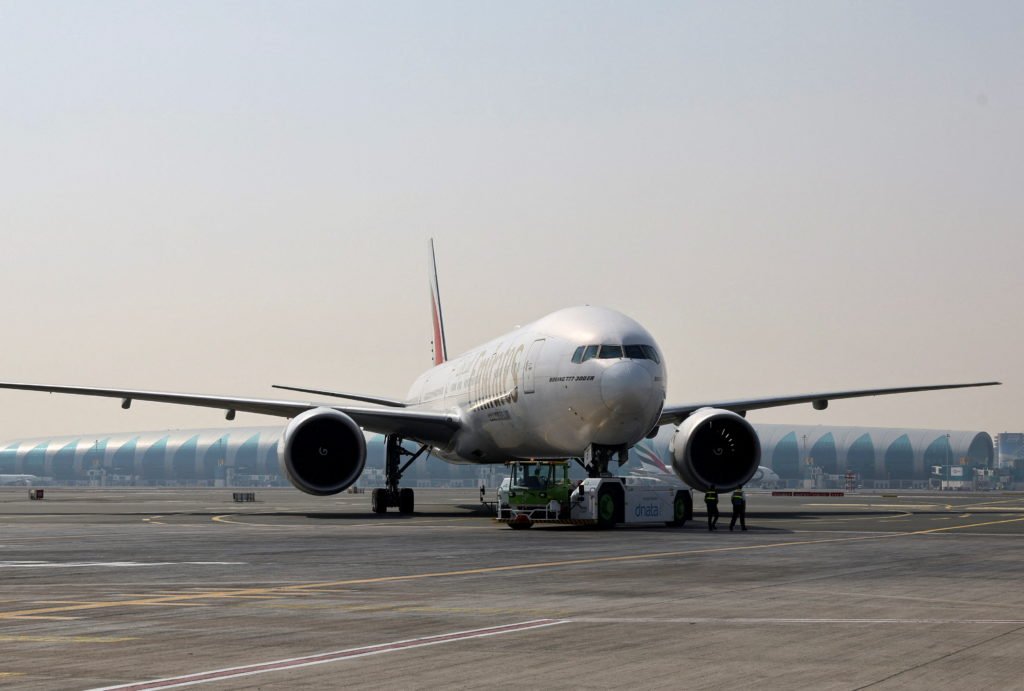
ABU DHABI, FEBRUARY 28 – Commercial aviation across the Middle East and far beyond was thrown into turmoil on Saturday after military strikes involving the United States and Israel targeted Iran, triggering widespread airspace closures and grounding flights across one of the world’s most important aviation corridors. The sudden escalation left tens of thousands of passengers stranded, disrupted global airline schedules, and created ripple effects reaching Europe, Asia, and North America.
As governments moved quickly to secure their skies, travelers found themselves facing canceled departures, unexpected diversions, and growing uncertainty over when normal flight operations might resume. Aviation analysts warned that even if tensions ease quickly, the consequences for airlines and passengers could linger for days.
Regional Airspace Closures Send Shockwaves Through Global Aviation
The immediate response to the strikes was a rapid shutdown of airspace across several Middle Eastern countries. Israel, Iran, Qatar, Iraq, Kuwait, Bahrain, and Syria all announced closures or severe restrictions, while Oman temporarily shut down operations at Muscat International Airport. Authorities in the United Arab Emirates imposed tight controls on flights transiting their airspace, significantly limiting movement through a region that normally serves as a vital bridge between East and West.
Flight tracking data from FlightRadar24 showed aircraft already in the air diverting away from destinations such as Tel Aviv and Dubai, with many rerouted to European hubs including Athens, Istanbul, and Rome. Other flights were forced to turn back to their departure airports, adding to congestion and confusion.
The closures dealt a heavy blow to Middle Eastern carriers with extensive global networks. Airlines such as Emirates, Qatar Airways, and Etihad Airways canceled hundreds of flights within hours. Cirium said, at least 850 flights operated by regional airlines were scrapped on Saturday alone, a figure expected to rise as restrictions continued.
Dubai International Airport and Zayed International Airport, both among the busiest hubs for international travel, together saw more than 1,000 inbound and outbound flights canceled. Aviation authorities in India further intensified the disruption by designating large portions of Middle Eastern airspace, including routes above Jordan, Saudi Arabia, and Lebanon, as high risk zones at all altitudes. This prompted additional cancellations by carriers operating long haul services between Asia and Europe.
Airlines outside the region were also forced to react. Air India suspended all services to Middle Eastern destinations, while Turkish Airlines halted flights to Lebanon, Syria, Iraq, Iran, and Jordan, and paused services to several Gulf states through the weekend. European carriers, including Lufthansa, Air France, and KLM, either canceled or extended suspensions on routes into affected areas.
Passengers Stranded as Airlines Warn of Ongoing Delays
For travelers, the impact was immediate and deeply personal. Airports across Europe reported crowds of passengers trying to rebook or gather information as flights disappeared from departure boards. Airlines urged customers to check their flight status online before heading to airports, noting that schedules were changing by the hour.
Some carriers introduced flexible travel waivers, allowing passengers to rebook without penalty. Still, the sheer scale of the disruption made reaccommodation difficult. Cirium estimated that roughly 90,000 passengers pass through Dubai, Doha, or Abu Dhabi each day on just three major airlines, highlighting how quickly delays can cascade across the global network.
Airline & travel industry analyst Henry Harteveldt, president of Atmosphere Research Group, said the situation offered little comfort for those affected. He noted that travelers should expect delays and cancellations for several days, adding that even passengers not flying directly to the Middle East could be impacted due to aircraft and crew being out of position. His comments were shared widely by airline industry observers and cited by multiple aviation focused media outlets covering the unfolding crisis.
The human cost of the disruption was visible in stories like that of Jonathan Escott, who arrived at Newcastle Airport in England expecting to board a direct Emirates flight to Dubai. Instead, he learned the service had been canceled, leaving him and fellow passengers stranded. Escott returned to stay with family while awaiting updates but said there was little clarity about when travel might resume. His account, shared with local British media, reflected a broader sense of uncertainty among travelers caught in the upheaval.
Beyond cancellations, rerouting added hours to journeys that did go ahead. Virgin Atlantic announced it would avoid Iraqi airspace, meaning flights to India, the Maldives, and Riyadh would take longer. The airline said it was carrying extra fuel to allow for sudden changes, a precaution echoed by several other carriers already steering clear of Iranian skies.
U.S. airlines were not immune. Delta Air Lines and United Airlines suspended flights to Tel Aviv through the weekend, while American Airlines halted services from Philadelphia to Doha. British Airways extended suspensions on flights to Tel Aviv and Bahrain and canceled services to Amman for Saturday, citing safety concerns.
Aviation experts warned that even if hostilities ease quickly, the recovery would not be immediate. Aircraft stranded at diversion airports, crew duty time limits, and ongoing security assessments could continue to disrupt schedules well into the following week. As Harteveldt put it, travelers attempting to return home may need to be creative, piecing together alternative routes through unaffected hubs or waiting for seats to open on later flights.