
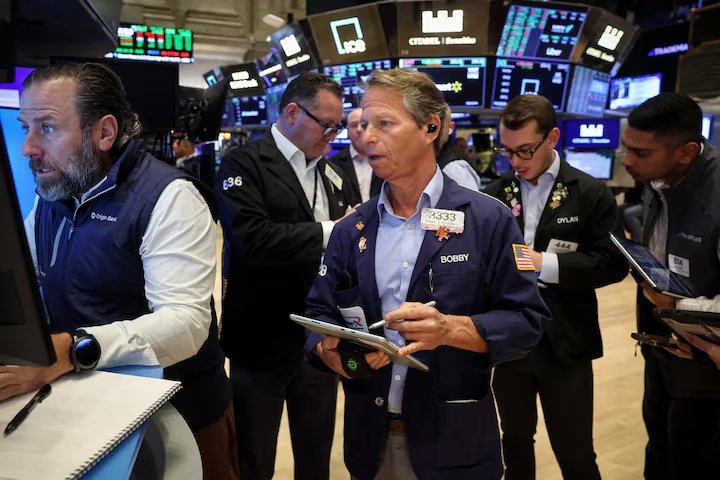
NEW YORK, Oct 31 – U.S. stock markets enter a packed week of corporate earnings with investors balancing optimism over resilient gains against caution over artificial intelligence-driven rallies and uncertainty around Federal Reserve interest rate policy.
The S&P 500 (.SPX) finished October with a 2.3% gain, marking its sixth consecutive month of growth, even as the index wavered in recent sessions following mixed earnings from major technology companies. The market’s momentum has been supported by strong corporate results, but investors are reassessing expectations for further interest rate cuts after the Federal Reserve’s recent decision to raise rates modestly by a quarter point.
Fed Chair Jerome Powell emphasized after the October policy meeting that a rate reduction at the December meeting is “not a foregone conclusion,” surprising investors who had largely anticipated a near-certain cut. Market participants are now watching closely for any economic signals that could influence the Fed’s next steps.
Corporate earnings have generally surpassed expectations this quarter. According to LSEG IBES, third-quarter S&P 500 profits are projected to rise about 13.8% compared with the same period last year. The coming week alone will see earnings reports from over 130 index companies, making it a critical period for the broader market’s trajectory.
However, the recent stock rally has pushed the S&P 500’s forward price-to-earnings multiple above 23, a level reminiscent of valuations during the dot-com era 25 years ago. Analysts warn that lofty multiples may require strong earnings to sustain upward momentum.
“If we are approaching the upper limits of what investors are willing to pay, earnings will need to do most of the heavy lifting to support further returns,” said Angelo Kourkafas, senior global investment strategist at Edward Jones.
Historically, November and December tend to be favorable months for equities. Since 1950, November has ranked as the best-performing month for the S&P 500, with an average gain of 1.87%, while December follows with an average rise of 1.43%. Some investors are wary that strong gains earlier in 2025—16% year-to-date for the S&P 500 and about 23% for the Nasdaq Composite—may have pulled some year-end upside forward. Still, historical trends suggest that stocks could continue climbing through year-end. Truist Advisory Services notes that in 21 instances since 1950 where the S&P 500 had risen at least 15% in the first 10 months of the year, the index continued higher in the final two months in all but one case.
As of Wednesday, 44% of S&P 500 companies had reported third-quarter results, with 83% exceeding earnings expectations. This would represent the sixth-highest beat rate on record if the trend continues, according to analysts at Ned Davis Research.
Not every company has impressed investors, however. Shares of Meta Platforms (META.O) and Microsoft (MSFT.O) dipped after announcing higher-than-expected spending to accelerate artificial intelligence initiatives. Alphabet (GOOGL.O), despite raising its projected capital expenditures, saw its stock rise, reflecting investor confidence in the company’s ability to fund growth internally. Amazon shares jumped after its cloud business showed strong momentum, easing concerns about falling behind in the AI race.
The artificial intelligence boom has been a major driver of equity gains, propelling the S&P 500 up approximately 90% since the bull market began more than three years ago. Yet investors are becoming more cautious about excessive enthusiasm surrounding AI. “Investors want clarity on growth prospects, spending, and the potential return on these AI investments,” said Eric Kuby, chief investment officer at North Star Investment Management.
Next week will see earnings reports from several high-profile tech names, including Advanced Micro Devices, Qualcomm, and Palantir Technologies. AMD and Palantir have more than doubled their stock prices this year, while Qualcomm shares have risen roughly 18%. Other companies reporting include McDonald’s and Uber, which are closely watched for insights on consumer spending and corporate cost strategies.
Concerns about the U.S. labor market have heightened due to a prolonged government shutdown, which has delayed official economic data releases. Investors are increasingly turning to private sources such as the ADP employment report and the University of Michigan consumer sentiment index to gauge the economy. Amazon recently announced a reduction of approximately 14,000 corporate positions globally, with additional layoffs expected in 2026, reinforcing worries about labor market softness.
“Without timely government data and with news of layoffs, it’s understandable for investors to be cautious,” said Robert Pavlik, senior portfolio manager at Dakota Wealth Management. The current government shutdown, which began on October 1, is now the second-longest in U.S. history, trailing only the 2018-2019 shutdown of 35 days. The delay of monthly jobs data, initially scheduled for November 7, further elevates the importance of alternative economic indicators.