
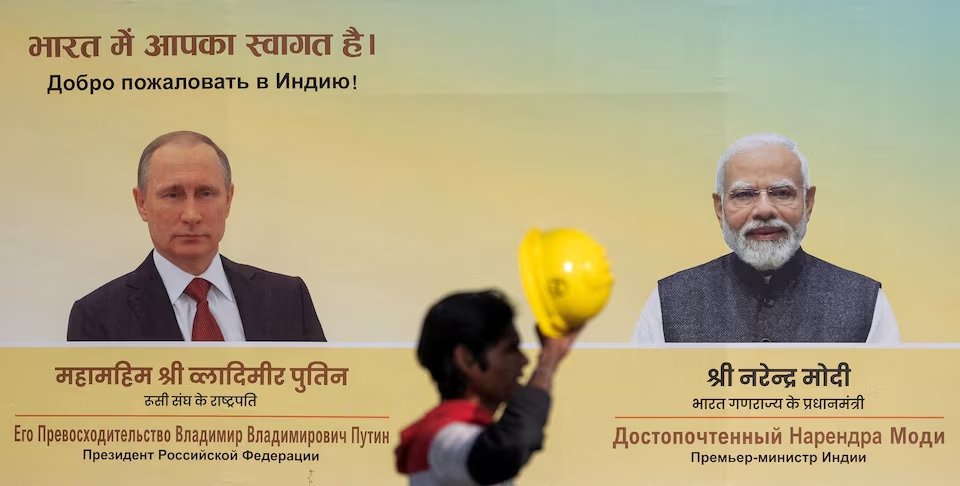
NEW DELHI, Dec 4 – Russian President Vladimir Putin arrived in New Delhi on Thursday for a two day state visit that many analysts see as a significant moment for the long standing partnership between Russia and India. His arrival marks his first trip to India in four years and comes at a time when both nations are trying to reshape their trade relationship, increase economic cooperation, and reduce dependence on a narrow set of goods. Indian Prime Minister Narendra Modi personally welcomed him at the airport, a rare gesture reserved for leaders with whom India shares particularly warm ties.
The two leaders greeted each other with a close embrace before boarding the same vehicle, a symbolic sign of the comfort and trust that has developed between them over the years. Modi will host a private dinner for Putin on Thursday evening and the two leaders are scheduled to meet for formal summit talks on Friday. Senior ministers from Russia and a large business delegation are also in the capital as both sides seek practical opportunities to strengthen their economic engagement.
Rising Trade Ambitions
India and Russia have set an ambitious target to lift their bilateral trade to $100 billion by the year 2030. Their commercial relationship has grown swiftly in recent years, rising from about $13 billion in 2021 to nearly $69 billion in the 2024 to 2025 period. Much of this jump came from India’s increased purchasing of Russian energy. However, trade fell to $28.25 billion between April and August 2025. The decline was partly due to reduced crude oil imports and partly due to the impact of new American tariffs placed on Indian goods under the administration of President Donald Trump.
These tariffs, which included a sharp 50% duty on several Indian exports, have pushed India to look for fresh global markets. Indian officials say half of the tariff penalty was tied to New Delhi’s continued imports of Russian oil, something Washington argues helps fund Moscow’s military actions. Despite these pressures, India has maintained its position that its energy imports are driven by national interest and the need for stable, affordable supplies.
Russian officials have also made it clear that they want to adjust the current trade imbalance. At present, Russian exports to India are dominated by energy, creating an uneven structure that Moscow hopes to correct. Maxim Oreshkin, Deputy Chief of Staff in the Kremlin, spoke at a business gathering in Delhi and emphasized that his delegation arrived with a clear purpose. According to Oreshkin, Russia wants to expand its purchases of Indian goods and broaden the variety of items entering its market. He explained that India currently accounts for only about two percent of Russian imports and that Moscow sees this as an opportunity to build a more stable and mutually beneficial commercial relationship. He described this shift as a long term strategy rather than a temporary response to current economic pressures.
New Opportunities for Indian Exports
Piyush Goyal, India’s Trade Minister, used the same conference to outline India’s goals. He explained that India wants to increase and diversify its exports to Russia, especially in areas such as automobiles, electronics, data processing equipment, heavy machinery, industrial components, textiles, and various food products. Goyal noted that Russia presents a large and underexplored market for Indian producers, with demand spanning multiple sectors.
According to Goyal, both countries need to bring more balance and variety to their trade. He argued that a broader economic relationship will benefit businesses in both nations and make their partnership more resilient. His remarks highlighted a shared awareness that the current structure, heavily reliant on crude oil deliveries, does not reflect the full potential of the India Russia relationship.
Russian officials echoed India’s interest in growing agricultural and food related exchanges. Oksana Lut, Russia’s Agriculture Minister, stated that Moscow is prepared to raise imports of shrimp, rice, and tropical fruits from India. She also noted interest from Russian companies in purchasing Indian food processing equipment, something that Indian manufacturers have been trying to promote in new global markets.
India remains the world’s leading exporter of shrimp, but its shipments to the United States have recently taken a significant hit due to the tariffs imposed by the Trump administration. This has forced Indian seafood exporters to search for alternative destinations. Lut mentioned that India currently supplies about twenty percent of Russia’s shrimp imports and said there is room to expand this share in the coming years.