
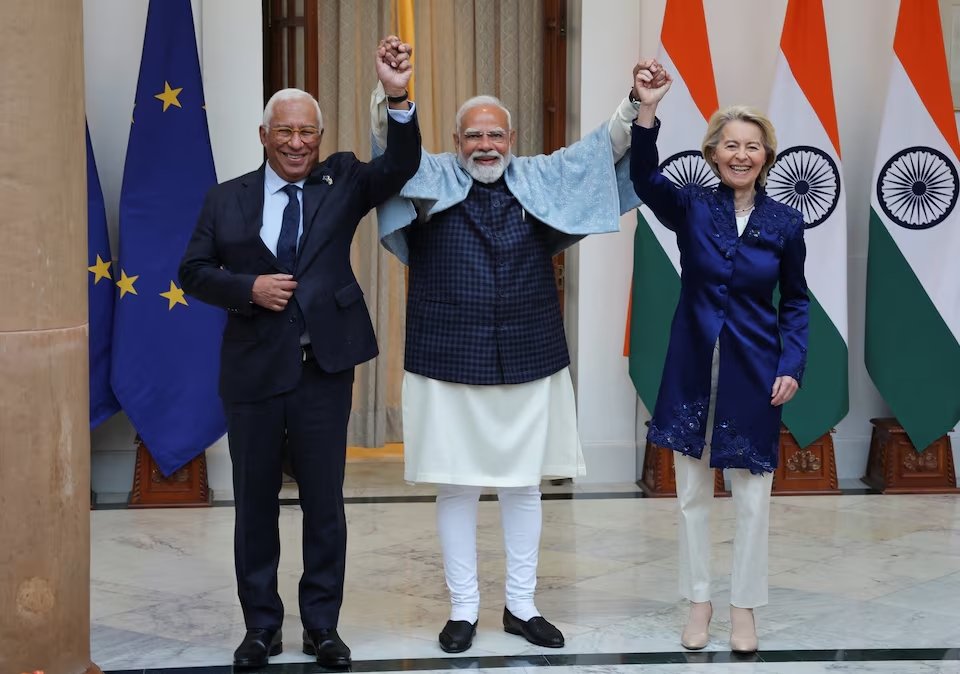
NEW DELHI, Jan 27 – India and the European Union have reached a long awaited trade agreement that both sides are calling historic in scale and ambition. Indian Prime Minister Narendra Modi described the pact as the “mother of all deals,” highlighting its vast economic reach and its importance at a time when global trade alliances are being reshaped. According to Modi, the agreement covers economies that together account for roughly a quarter of global gross domestic product and nearly one third of worldwide trade, making it one of the most consequential trade arrangements of recent decades.
The deal marks the conclusion of nearly 20 years of negotiations that frequently stalled due to political differences, regulatory concerns, and disputes over market access. With this breakthrough, India has agreed to gradually open parts of its tightly protected domestic market to freer trade with the 27 member states of the European Union. The EU is already India’s largest trading partner, and officials on both sides believe the agreement will significantly expand commercial ties in goods, services, and investment.
Speaking publicly a day after the agreement was finalized, Modi emphasized the broader impact of the deal. He said it would unlock major opportunities for India’s population of about 1.4 billion people as well as millions across Europe. Senior Indian officials echoed this view, framing the agreement as a long term growth engine rather than a short term political gesture.
European Commission President Ursula von der Leyen and Prime Minister Modi are expected to formally present the details of the agreement at an India–EU summit in New Delhi. Officials familiar with the planning of the summit say the joint announcement is meant to signal unity and strategic alignment at a time when traditional trade relationships are under strain.
Trade flows between India and the European Union have already been substantial. Government trade data from New Delhi shows that bilateral trade reached approximately $136.5 billion during the fiscal year ending in March 2025. Supporters of the deal argue that these figures represent only a fraction of the potential, particularly if barriers related to tariffs, standards, and market access are gradually reduced.
The agreement also reflects a wider pattern of intensified trade diplomacy across the globe. In recent days, the European Union finalized a major trade pact with the South American bloc Mercosur. Over the past year, Brussels has also concluded agreements with countries including Indonesia, Mexico, and Switzerland, according to statements from EU trade officials. These moves suggest a deliberate effort by Europe to diversify its economic partnerships and reduce overreliance on any single market.
India has been pursuing a similar strategy. New Delhi recently completed trade agreements with the United Kingdom, New Zealand, and Oman. Indian commerce ministry officials have described this push as part of a broader plan to integrate India more deeply into global supply chains while still protecting key domestic interests. The EU deal is widely seen as the most significant of these agreements due to its scale and the economic weight of the partners involved.
Analysts say the timing of the India–EU agreement is closely tied to shifting relations with the United States. Under President Donald Trump, Washington has adopted a more confrontational approach to trade, including aggressive tariff policies and unpredictable diplomatic moves. Trump’s public interest in acquiring Greenland and repeated tariff threats toward European nations have strained relations with long standing allies.
India has also faced direct economic pressure from Washington. The United States has imposed tariffs as high as 50% on certain Indian goods, according to Indian trade officials. Efforts to conclude a bilateral trade deal between New Delhi and Washington collapsed last year following what both sides privately described as a breakdown in communication. While officials avoided assigning blame publicly, the failure underscored the fragility of the relationship.
Against this backdrop, the India–EU trade deal is being interpreted by many observers as a form of economic insurance. By deepening ties with Europe, India reduces its vulnerability to sudden policy shifts in the United States. Similarly, the EU gains a stronger foothold in one of the world’s fastest growing major economies at a time when transatlantic trade relations are increasingly uncertain.
Despite the political agreement, the deal is not expected to take effect immediately. An Indian government official familiar with the process said the text must undergo detailed legal review and vetting, a procedure likely to take five to six months. Following that, the agreement will need to be formally signed and, on the European side, ratified according to EU procedures.
“We expect the deal to be implemented within a year,” the official said, speaking on condition of anonymity because the process is still ongoing. He added that both sides are keen to move quickly but want to ensure the legal language is precise to avoid disputes later.
Business groups in both India and Europe have largely welcomed the announcement, though some industry associations have urged caution. Indian manufacturers in sensitive sectors have raised concerns about increased competition from European firms, while European farmers and labor groups are seeking assurances that standards and protections will be upheld.
Even with these challenges, the overall tone from policymakers has been optimistic. The agreement is being framed not only as a trade deal but as a strategic partnership that reflects a changing global order. As one senior European official put it during background discussions, the pact is about “building reliable partnerships in an unpredictable world.”