
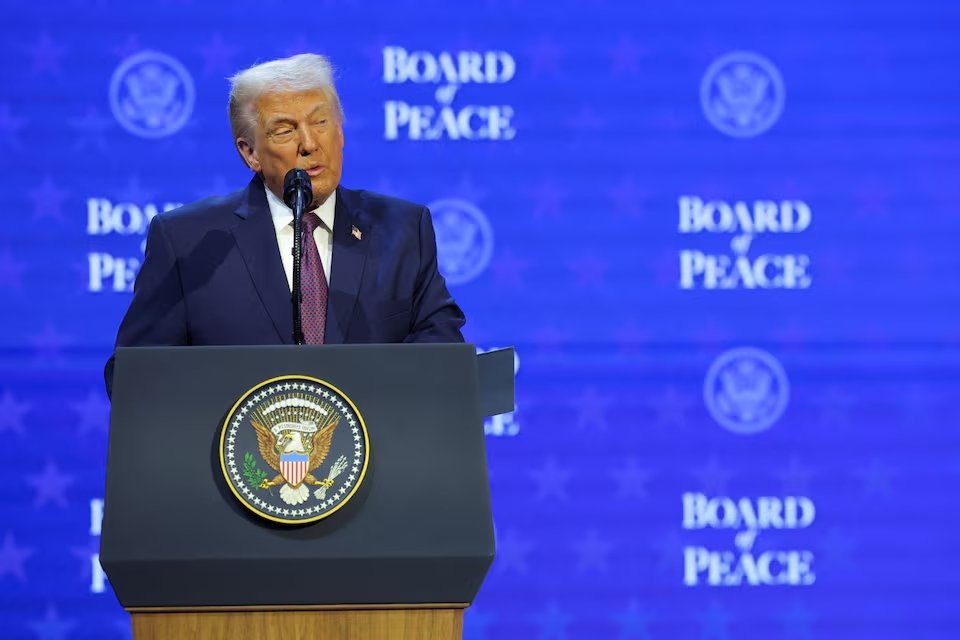
DAVOS, Switzerland, Jan 22 – U.S. President Donald Trump has formally unveiled a new international body called the Board of Peace, a move that has immediately triggered global discussion, cautious reactions from key allies, and questions about how it may reshape existing systems of diplomacy. While the initiative was initially framed around stabilizing the fragile ceasefire in Gaza, Trump has made it clear that he envisions a far broader mandate, one that could eventually extend to conflicts and political challenges across the world.
Speaking at a high profile gathering of political and business leaders in Davos, Switzerland, Trump emphasized that the Board of Peace is not intended to replace the United Nations, even as critics and diplomats express concern that it could dilute the authority of long established international institutions. According to Trump, the board is meant to complement existing structures, not compete with them, and he argued that cooperation with the United Nations would remain central to its work.
Despite these assurances, the initiative has already exposed divisions among global powers and U.S. allies, with some countries signing on enthusiastically and others choosing to stay on the sidelines for now.
Global Scope
Trump has positioned himself as chair of the Board of Peace and has personally invited dozens of world leaders to participate. He described the body as a flexible platform capable of responding quickly to crises, contrasting it with what he has often portrayed as the slow and bureaucratic nature of multilateral institutions. In public remarks, he suggested that once the board is fully formed, it could play a role in addressing a wide range of global disputes, not limited to the Middle East.
The original concept of the board is closely tied to the Gaza ceasefire, an agreement reached late last year after months of violence. U.S. officials involved in the negotiations have said the board’s immediate task is to ensure that commitments made by all parties are upheld, including humanitarian access and steps toward longer term stability. Secretary of State Marco Rubio noted that the Gaza plan is the first real test of whether the board can deliver tangible results, adding that success there could offer a model for other conflict zones.
So far, around 35 countries have agreed to participate, including Israel, Saudi Arabia, Turkey, Argentina, Pakistan and Indonesia. Several Middle Eastern states view the board as an opportunity to maintain momentum in Gaza and avoid a return to large scale fighting. Emerging economies have also shown interest, seeing the forum as a chance to have a more direct voice in global peace initiatives.
However, the absence of many traditional Western allies has been notable. France has declined to join, Britain has said it is not participating at this stage, and China has not publicly committed. None of the other permanent members of the U.N. Security Council have formally signed on so far. Diplomats from these countries have privately expressed concerns about the board’s undefined long term role and the requirement that permanent members contribute substantial funding.
Trump has stated that permanent members would be expected to provide payments of around $1 billion each to support the board’s operations and peace initiatives. This financial expectation has added another layer of hesitation, particularly among governments that already contribute heavily to existing international organizations.
Russia has taken a more ambiguous stance. President Vladimir Putin said Moscow was reviewing the proposal and signaled a willingness to contribute funds, potentially using frozen U.S. assets, which he said could be directed toward supporting the Palestinian people. Russian officials have framed their interest as conditional and tied to how the board ultimately operates.
Gaza Focus
At the heart of the Board of Peace’s early agenda is the fragile ceasefire in Gaza, which has repeatedly come under strain. Although fighting has decreased since the truce was agreed, both Israel and Hamas have accused each other of violations. Israeli officials have said delays in returning hostages and remains have undermined trust, while Palestinian representatives argue that restrictions on aid continue despite severe humanitarian needs.
Jared Kushner, who played a central role in shaping the Gaza plan and now serves as one of the board’s key figures, said the next phase would focus on reconstruction funding and security arrangements. He acknowledged that the issue of Hamas disarmament remains one of the most difficult obstacles. According to Kushner, without progress on demilitarization, the broader peace framework risks stalling.
Humanitarian access remains another urgent concern. Ali Shaath, head of a Palestinian technocratic committee tasked with administrative responsibilities, announced that the Rafah border crossing between Gaza and Egypt is expected to reopen soon. This crossing is seen as vital for the movement of aid and people, and its reopening has been welcomed by international relief organizations.
Israeli Prime Minister Benjamin Netanyahu has accepted an invitation to join the board, according to his office, while Palestinian factions have also voiced support for the overall plan. They have backed the creation of a transitional Palestinian committee to oversee Gaza’s administration under the board’s supervision, a proposal that supporters say could provide a bridge toward more stable governance.
Even with these developments, major challenges loom. The next stage of the ceasefire must tackle long standing issues that have derailed previous peace efforts, including who controls security in Gaza, the timeline for any Israeli withdrawal, and the political future of the territory. Analysts note that without clear enforcement mechanisms and broad international buy in, the Board of Peace could struggle to move beyond symbolic gestures.
Trump, who has often criticized the United Nations in the past, struck a more conciliatory tone when discussing its potential partnership with the board. He argued that the U.N. still holds enormous potential if paired with what he described as fresh leadership and unconventional thinking. Figures such as former British Prime Minister Tony Blair and senior U.S. negotiators are also part of the board, lending it a mix of political experience and controversy.