
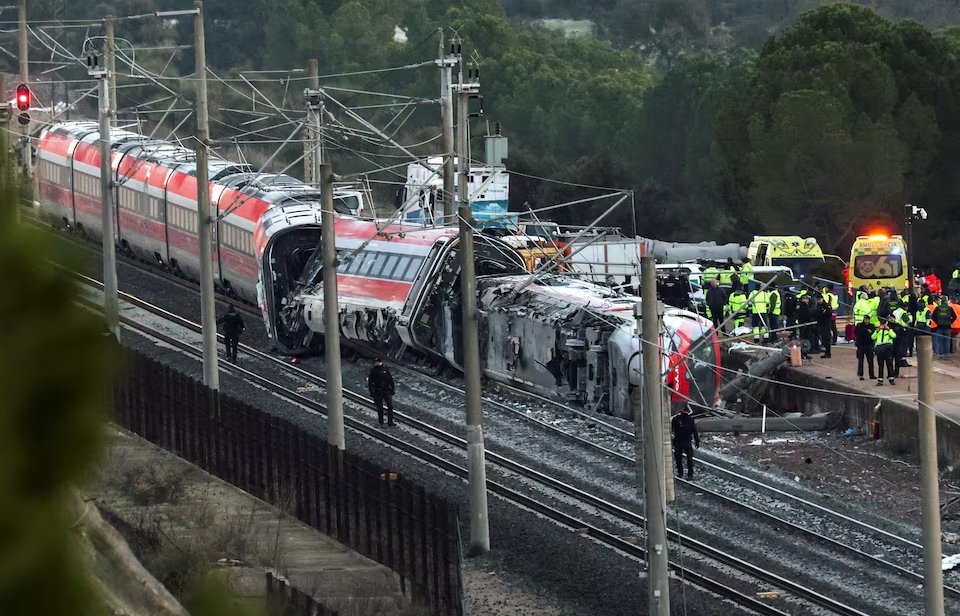
ADAMUZ, Jan 18 – Spain is grappling with one of its deadliest rail disasters in decades after a high speed train collision in the southern region of Andalusia claimed at least 39 lives. Authorities warned that the toll could still rise as rescue teams continue to search through the wreckage, where twisted carriages and debris remain piled along the tracks. The accident, which occurred on Sunday evening near the town of Adamuz in the province of Cordoba, has left the nation in mourning and raised urgent questions about rail safety on one of Europe’s most advanced train networks.
Emergency responders worked through the night and into Monday morning, pulling survivors from shattered carriages and recovering the bodies of victims scattered across the crash site. Some passengers were thrown from the trains during the violent impact, and officials said several bodies were found hundreds of meters away, underscoring the force of the collision.
Deadly collision shocks the nation
According to information released by Spanish authorities, the crash happened at around 7:45 p.m. when the rear section of a high speed passenger train traveling from Malaga to Madrid suddenly derailed. Moments later, it collided with another train heading in the opposite direction from Madrid to Huelva. The first train was carrying close to 300 passengers, while the second had nearly 200 people on board.
The head of the oncoming train absorbed most of the impact. Its first two carriages were ripped from the tracks and plunged down a slope of around four meters. Officials from the transport ministry stated that these carriages accounted for the majority of the fatalities, as passengers seated there had little chance to escape the initial force of the crash.
Rescue workers described scenes of devastation. Mangled metal, broken seats, and torn luggage were strewn across the area. Video footage released by security forces showed train cars split open like tin cans, some lying on their sides, others wrapped around concrete structures near the tracks. Survivors recounted smashing windows with emergency hammers and crawling through narrow gaps to escape, many helping fellow passengers despite their own injuries.
By Monday afternoon, authorities confirmed that all survivors had been removed from the site. More than 150 people were injured, with dozens requiring hospitalization. At least a dozen victims remained in intensive care, while many others were treated for fractures, head injuries, and shock before being discharged. A local sports complex in Adamuz was converted into a temporary medical and assistance center to cope with the influx of wounded passengers and distraught relatives.
Spain’s prime minister visited the area and announced three days of national mourning, calling the disaster a moment of profound pain for the entire country. Flags were lowered to half staff at government buildings, and moments of silence were observed across several regions.
Investigation and unanswered questions
As the nation mourns, attention has turned to the cause of the crash. Transport officials described the incident as unusual, noting that it occurred on a flat section of track that had undergone renovation just months earlier. Both trains involved were reportedly operating well below the maximum speed limit for that line, which has complicated early assessments of what went wrong.
Initial statements from railway authorities suggested that human error was unlikely, though investigators cautioned that it was too early to rule out any possibility. A full inquiry has been launched and could take several weeks to complete. Specialists are examining the trains’ mechanical systems, track infrastructure, and signaling equipment to determine whether a technical failure or infrastructure issue played a role.
The train that derailed belonged to a private operator that entered Spain’s high speed rail market in recent years, while the other was operated by the country’s public rail company. Representatives from both companies said the trains had passed recent safety inspections. One operator noted that the derailed train was manufactured only a few years ago and had undergone routine checks earlier this year.
Authorities have also focused on identifying the victims, a process complicated by the severity of the crash. Family members from across Spain gathered at information centers set up in Cordoba, Madrid, Malaga, Huelva, and Seville. Police requested DNA samples from relatives to assist with identification, acknowledging that some victims were difficult to recognize due to the condition of the remains.
Emergency personnel involved in the rescue spoke of harrowing choices made in the immediate aftermath. Firefighters said there were moments when bodies had to be moved to reach trapped survivors, highlighting the chaos and urgency at the scene. Local officials praised residents of nearby towns who rushed to help, offering water, blankets, and comfort to injured passengers as ambulances struggled to keep pace.
The crash has disrupted transport across southern Spain. Rail services between Madrid and several Andalusian cities were suspended, stranding thousands of travelers. Airlines added extra flights, and bus companies reinforced routes to help passengers reach their destinations.
Spain has long taken pride in its high speed rail system, which is among the largest and most modern in Europe. Millions rely on it each year as a fast and affordable alternative to air travel. Until now, the network had an enviable safety record, with no fatal accidents involving high speed trains since its launch in the early 1990s. The last major rail tragedy in the country occurred more than a decade ago on a conventional line, not a high speed route.
Messages of condolence poured in from across Europe and beyond. Religious leaders, European officials, and members of Spain’s royal family expressed sympathy for the victims and their families, emphasizing solidarity with those affected. The king said he understood the desperation felt by relatives waiting for news and praised the efforts of emergency workers.