
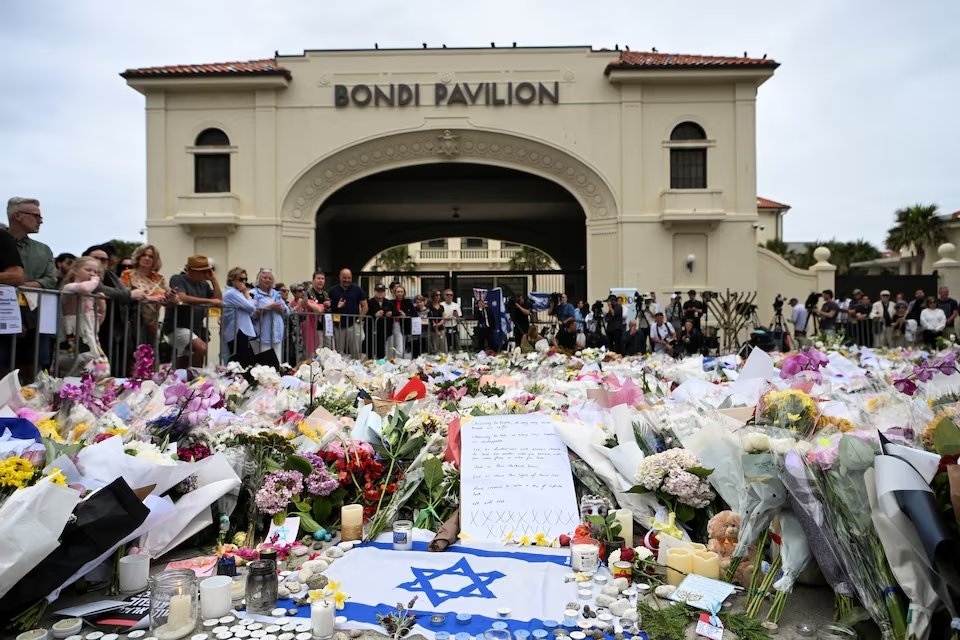
SYDNEY, Dec 16 – Australia is grappling with shock and grief after a mass shooting at a Hanukkah gathering near Sydney’s Bondi Beach, an attack that authorities say was driven by extremist ideology and deliberately targeted the Jewish community. The violence has reopened painful national debates about public safety, extremism, and whether existing gun laws are sufficient to prevent such atrocities. As investigators piece together the background of the alleged attackers, the country is mourning victims whose lives represented generations of history, resilience, and hope.
Terror Links and the Bondi Attack
Police say the attack unfolded over roughly ten minutes on Sunday evening, when two armed men allegedly opened fire on a large crowd attending a Hanukkah celebration at one of Australia’s most iconic beaches. The shooting left 15 people dead at the scene, while one of the alleged gunmen later died after being shot by police, bringing the total death toll to 16. Dozens more were injured, with about 25 survivors still receiving treatment in Sydney hospitals in the days that followed.
Authorities have identified the deceased suspect as Sajid Akram, a 50 year old man who was legally licensed to own firearms. His 24 year old son, Naveed Akram, is accused of acting alongside him and remains in critical condition under police guard in hospital. Investigators say both men were shot by police as officers intervened to stop the rampage.
According to statements from the Australian Federal Police, early evidence suggests the attack was inspired by Islamic State ideology. Police Commissioner Krissy Barrett stressed that the alleged actions were linked to violent extremism rather than any religion, underscoring that such attacks should not be used to stigmatize broader communities. Officers searching a vehicle registered to the younger suspect reportedly found improvised explosive devices and homemade flags associated with Islamic State, strengthening suspicions of terrorist motivation.
Further inquiries revealed that both suspects had travelled overseas shortly before the attack. Immigration officials confirmed that the father and son entered the Philippines in early November, visiting Manila and then traveling onward to Davao, before returning to Australia just weeks prior to the shooting. The father travelled using an Indian passport, while the son held an Australian passport. Investigators are now examining the purpose of the trip and whether the men had contact with extremist networks abroad. While Islamic State linked groups in the Philippines have been significantly weakened in recent years, particularly since the 2017 Marawi siege, authorities acknowledge that small cells remain active in parts of the southern region.
The shooting has been described by officials as the worst mass gun attack in Australia in nearly three decades. Videos circulating online in recent months reportedly showed the younger suspect preaching in public spaces around Sydney, prompting questions about whether warning signs were missed and how radicalization unfolded over time.
Community Impact and the Gun Law Debate
The human cost of the attack has resonated deeply across Australia and beyond. Among the victims were a rabbi who was the father of five children, a Holocaust survivor whose life story symbolized endurance in the face of hatred, and a 10 year old girl, Matilda Britvan, whose death has shaken the nation. Two police officers injured while responding to the attack remain in critical but stable condition.
Family members of the victims have spoken of profound loss. Matilda’s aunt, Lina Chernykh, described her niece as a joyful child full of laughter and affection, saying the family would be forever heartbroken. Such personal stories have transformed the tragedy from a set of statistics into a national wound.
At Bondi Beach, normally crowded with tourists and locals, a temporary memorial of flowers has grown near the Bondi Pavilion. Though the beach reopened, it remained unusually quiet as residents paused to reflect. Olivia Robertson, a young woman who visited the memorial before work, said the attack shattered the sense of safety that drew previous generations of Australians to build their lives in the country.
International reactions have also followed. Israeli Ambassador Amir Maimon visited the site, calling on the Australian government to take stronger measures to protect Jewish communities. He pointed to the reality that many Jewish places of worship now require heavy security, cameras, and guards, a situation he described as deeply troubling.
Amid the grief, one story of bravery has stood out. Ahmed al Ahmed, a 43 year old Muslim father of two, was injured after confronting one of the attackers and seizing his rifle, an act that likely saved lives. He remains hospitalized with gunshot wounds and has been widely praised as a hero. A fundraising campaign established to support his recovery and family has raised more than A$1.9 million, reflecting public admiration and solidarity.
The attack has also reignited scrutiny of Australia’s gun regulations. Police confirmed that Sajid Akram was a licensed gun owner with six registered firearms, having received his licence in 2023. Home Affairs Minister Tony Burke said the government would review existing laws, many of which trace back to reforms introduced after the 1996 Port Arthur massacre. Former Prime Minister John Howard, who led those reforms, warned against allowing gun law debates to distract from addressing antisemitism, which intelligence officials have identified as a growing threat.
As investigations continue, Australia faces difficult questions about extremism, community safety, and social cohesion. The Bondi shooting has not only taken lives but also challenged assumptions about security in public spaces. For many, the hope is that lessons learned from this tragedy will lead to meaningful action, ensuring that such violence does not become part of the nation’s future.