
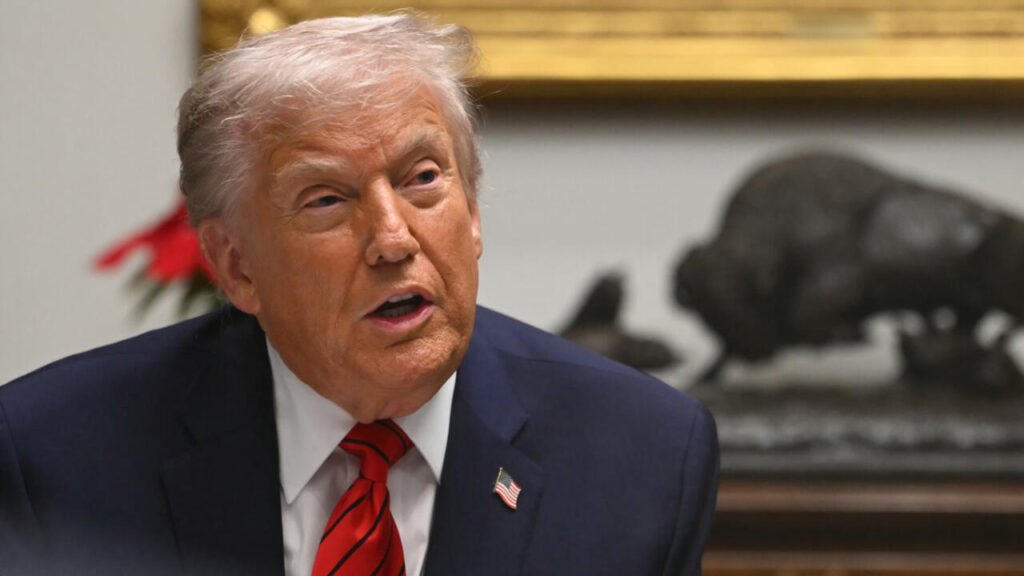
WASHINGTON, Dec 10 – The United States has seized a sanctioned oil tanker off the Venezuelan coast, a move that immediately fueled a sharp rise in global oil prices and reignited already strained relations between Washington and Caracas. President Donald Trump confirmed the operation on Wednesday and described the vessel as one of the largest tankers ever intercepted by US authorities. His remarks came during a period of growing pressure on Venezuelan President Nicolas Maduro, whose government has long accused the United States of seeking regime change.
While Trump did not provide many details, his tone suggested a significant escalation in Washington’s approach toward Venezuela’s oil industry, which remains the country’s primary source of revenue. The Venezuelan government quickly fired back, accusing the United States of what it called blatant theft and international piracy. Officials in Caracas said they plan to bring the incident before international bodies and challenge the seizure at a diplomatic level.
Escalating Maritime Actions
The incident marks the first known seizure of a Venezuelan related tanker since the recent United States military build up in the region. Trump has frequently hinted at the possibility of using force in Venezuela, and this latest action adds new weight to those statements. For several months, the United States has carried out a series of operations targeting vessels believed to be involved in drug trafficking across the Caribbean and Pacific. These missions have sparked debate among lawmakers and legal experts who question the methods used and the lack of public evidence supporting the strikes.
US Attorney General Pam Bondi posted a short video that appeared to show helicopters approaching a vessel, along with armed personnel descending onto its deck. She stated that the FBI, Homeland Security, the Coast Guard and branches of the US military cooperated to enforce a seizure warrant on a crude carrier moving sanctioned oil connected to both Venezuela and Iran. Iran’s embassy in Caracas strongly condemned the operation, describing it as a grave violation of international norms.
Although US officials did not publicly identify the tanker at the time, a maritime risk management group stated that the vessel believed to have been taken was the Skipper, a very large crude carrier previously linked to sanctioned oil movements when it operated under the name Adisa. According to available tracking information and internal Venezuelan data, the Skipper had recently loaded about 1.8 million barrels of Merey heavy crude from the port of Jose. Before the seizure, part of that load reportedly transferred to a Panama flagged vessel near Curacao on a route bound for Cuba.
Authorities in Guyana also stated that the Skipper had falsely flown the country’s flag and that its records showed past shipments of Venezuelan crude to Asian destinations from 2021 to 2022.
Supply Questions and Market Pressure
News of the seizure quickly moved global energy markets. Oil futures rose after initially trading in negative territory. Brent crude settled at 62 point 21 dollars per barrel, while West Texas Intermediate closed at 58 point 46 dollars. Analysts noted that Venezuela exported more than 900 thousand barrels per day in the previous month, one of its highest monthly averages of the year. Despite this, the country has been forced to sell crude at significant discounts due to growing competition from other sanctioned producers, particularly Russia and Iran.
Market analysts suggested that the tanker seizure adds yet another geopolitical barrier to already limited spot supply. However, they also pointed out that these specific barrels were expected to remain unsold for some time due to sanctions that complicate their movement across global markets. Chevron, the main United States company still active in the country through its partnership with PDVSA, stated that operations were continuing normally and that recent shipments had even increased, rising to 150,000 barrels per day from 128,000 in the previous month.
Expanding Pressure on Caracas and Wider Regional Concerns
The Venezuelan government has long insisted that Washington’s military activity in the region is aimed at removing Maduro from office and taking control of the country’s vast oil reserves, which remain the largest proven deposits in the world. Since early September, the United States has carried out more than twenty strikes on boats suspected of drug trafficking. More than 80 people have been killed during these actions, raising concerns among human rights observers and some members of Congress.
Recent reports also revealed that one commander ordered a second strike on a vessel that killed survivors from an earlier attack. Polling data released this week indicated that a significant share of Americans disapprove of the US military’s campaign of deadly maritime strikes, including a portion of Trump’s own political supporters.
In a broad strategy document published last week, Trump reaffirmed that his foreign policy would prioritize maintaining dominance across the Western Hemisphere. The timing of the tanker seizure appears consistent with that approach and signals that Washington may be preparing for even stronger measures against Venezuela’s oil sector.