
NIGERIA, Dec 26 – The United States has carried out air strikes against militants linked to the Islamic State group in north western Nigeria, marking a significant escalation in Washington’s involvement in the country’s long running fight against jihadist violence. The strikes targeted camps used by the extremist group in Sokoto state, close to Nigeria’s border with Niger, an area where militant factions have increasingly tried to expand their presence beyond their traditional strongholds in the north east.
According to statements from the US military, the operation struck multiple locations believed to be used as operational bases by the militants. While exact casualty figures have not been officially confirmed, both American and Nigerian officials have said that a number of fighters were killed in the attacks. The US described the operation as precise and intelligence led, aimed at degrading the group’s ability to plan and launch further assaults.
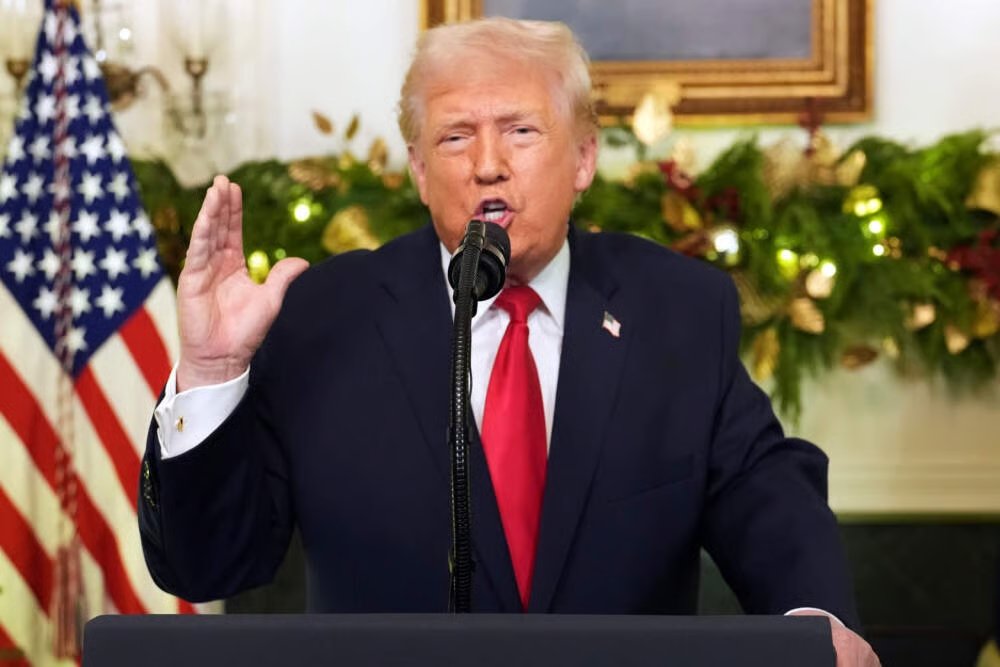
US President Donald Trump publicly acknowledged the strikes, describing them as deadly and vowing that the United States would not allow extremist groups to gain ground. In a strongly worded message released on Christmas Day, he condemned the militants as terrorists and accused them of carrying out brutal attacks on civilians, particularly Christians. His remarks reflected a broader narrative his administration has often used when addressing religiously motivated violence in parts of Africa.
Nigerian officials, however, were quick to push back against the framing of the operation as religiously driven. Foreign Minister Yusuf Maitama Tuggar said the strikes were part of a joint security effort between Nigeria and its international partners and stressed that the campaign had nothing to do with religion. Speaking about the timing of the strikes, which occurred late on Thursday, he made it clear that they were not connected to Christmas and had been planned well in advance based on intelligence gathered by Nigerian security services.
Tuggar explained that Nigeria had shared detailed information about militant movements and camps with its partners, allowing for what he described as a carefully coordinated operation. He did not rule out the possibility of additional strikes if the threat continues, signaling that Nigeria is open to sustained cooperation with the United States and other allies in confronting extremist groups.
For years, Nigeria has been battling multiple jihadist organizations, most notably Boko Haram and factions aligned with Islamic State, primarily in the north eastern states of Borno, Yobe, and Adamawa. However, in recent years, a smaller but increasingly active group known locally as Lakurawa has emerged in the north west. This faction has sought to establish a foothold in Sokoto state and neighboring areas, exploiting porous borders and longstanding security challenges.
On Friday morning, Nigeria’s foreign ministry confirmed that the country is engaged in ongoing security cooperation with international partners, including the United States. The ministry said this collaboration had led to precision air strikes against terrorist targets in the north west, underscoring Abuja’s willingness to accept foreign assistance as the militant threat evolves.
Local authorities in Sokoto state also acknowledged the impact of the strikes. Isa Salihu Bashir, chairman of the Tangaza local government area, said several Lakurawa camps had been hit. While he could not provide an exact death toll, he stated that many fighters were believed to have been killed. He added that patrols on the Niger side of the border reported seeing militants fleeing the targeted areas, suggesting the strikes had disrupted their operations.
There were also reports of a separate strike further south in Sokoto state, near the town of Jabo. Residents there described seeing a flash in the sky followed by an object crashing into nearby fields. Eyewitness Umar Jabo said the incident caused alarm but did not result in casualties. He emphasized that his community had not experienced conflict linked to Islamic State and that people of different faiths had lived peacefully together.
The Trump administration has previously criticized Nigeria over its handling of religious violence, accusing the government of failing to adequately protect Christian communities from jihadist attacks. At one point, Trump labeled Nigeria a “country of particular concern,” a designation used by the US State Department for nations accused of severe violations of religious freedom. That classification can open the door to sanctions and other diplomatic measures.
In November, the US military was instructed to prepare options for intervention in Nigeria, reflecting growing concern in Washington about the spread of Islamic State affiliated groups in West Africa. At the time, advisers to Nigerian President Bola Tinubu emphasized that militants were targeting people of all faiths and said any foreign military action should be conducted jointly with Nigerian authorities.
Nigeria, Africa’s most populous country, is home to roughly 220 million people and is almost evenly divided between Christians and Muslims. Analysts often note that while extremist groups claim religious justifications, the overwhelming majority of victims of jihadist violence in Nigeria have been Muslims. Data from conflict monitoring organizations has consistently shown that attacks frequently target villages, markets, and security forces without regard to faith.
Human rights lawyer and conflict analyst Bulama Bukati has explained that the Lakurawa group began slipping into Nigeria around 2018, initially operating quietly. Over the past two years, however, they have established more permanent camps in Sokoto and neighboring Kebbi state. According to Bukati, the group has carried out attacks and attempted to impose its own harsh rules on local populations, creating fear and instability in rural communities.
The strikes in Nigeria are the second major US military action against Islamic State targets in recent weeks. Earlier, American forces carried out a large scale operation in Syria, hitting dozens of targets linked to the group. That campaign involved fighter jets, attack helicopters, and artillery, with support from regional allies, and was launched in response to the killing of three Americans in an ambush.
Together, these operations highlight a renewed focus by the United States on countering Islamic State networks beyond the Middle East. In Nigeria, where jihadist violence has claimed thousands of lives over more than a decade, the latest strikes signal a deeper level of international involvement as the government seeks to prevent militant groups from entrenching themselves in new regions.