
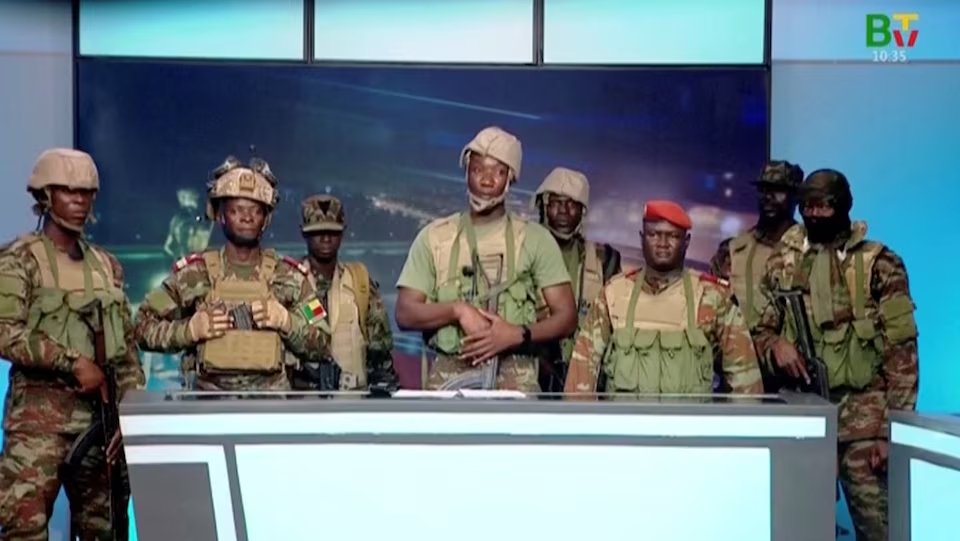
COTONOU, Dec 7 – Benin woke to a tense and uncertain Sunday after a group of soldiers appeared on national television announcing that they had taken control of the country. Within hours, the government declared that the armed forces had blocked an attempted coup and that order was being restored. The incident, which briefly shook the normally stable West African nation, unfolded against the backdrop of rising political pressure ahead of the presidential election scheduled for April. Officials moved quickly to reassure citizens that national institutions remained intact and that loyalist forces were firmly in charge.
Rising Tensions Ahead of Elections
The attempted takeover began early Sunday morning when at least eight soldiers, some visibly armed, appeared on state television declaring that a military committee led by Colonel Tigri Pascal had dissolved government institutions and suspended the constitution. They also claimed that the country’s borders by air, land, and sea had been closed. In their announcement, the soldiers presented their actions as a commitment to offering citizens what they described as a fresh political era anchored in justice, fraternity, and hard work.
Only hours later, the Interior Minister, Alassane Seidou, contradicted the televised declaration. He confirmed that security forces loyal to the government had disrupted the coup attempt and restored control of crucial state facilities. According to him, citizens could continue their daily routines without fear, and there was no indication of ongoing threats to national stability. The Foreign Minister, Olushegun Adjadi Bakari, had already stated that a limited group of soldiers tried to seize power but that most of the armed forces continued to support President Patrice Talon.
Streets Quiet After Morning Gunfire
The public first became aware of instability through reports of gunfire in several areas of Cotonou, the country’s largest city and commercial center. Many residents were on their way to Sunday church services when the shots broke the usual calm. The French embassy reported gunfire near the residence of President Talon and advised its citizens to remain indoors until the situation became clearer.
Witness accounts portrayed a mix of fear and confusion. One furniture seller named Narcisse described hearing shots around 8:00 am local time in the morning. He noticed police vehicles racing through the neighborhood and decided to shut his shop for safety. Later, as the city grew calmer, he reopened but remained cautious. By midday, police checkpoints appeared at major intersections, and witnesses said the gunfire had stopped.
The swift response from government and security leaders indicated that although the coup attempt briefly disrupted the capital, it did not gain wide military backing. Broadcast services, which had been interrupted while the soldiers aired their message, were quickly restored, allowing officials to address the nation and reject the claims made by the coup leaders.
The situation has drawn sharp reactions from regional organizations, which immediately condemned any attempt to seize power by force. The event comes at a time when several neighboring countries have experienced similar upheavals, creating concern about further political instability spreading through the region.
A Country Facing New Security Pressures
Although Benin has built a reputation as one of the more stable countries in West Africa since the early 1990s, its security environment has become more complex in recent years. The northern part of the country has experienced a growing number of attacks by militant groups linked to organizations active in Mali and Burkina Faso. Earlier this year, authorities reported that more than fifty soldiers were killed in one such attack carried out by an armed group affiliated with Al Qaeda.
These rising threats have become a central issue in national politics, particularly as the country prepares for a new presidential election. Some of the soldiers involved in Sunday’s attempted coup referred to the deteriorating security situation and what they described as neglect of soldiers who had died in recent operations. This claim appeared meant to justify their actions, although government officials rejected the narrative and insisted that the instability was the work of a small and unrepresentative group.
Political Climate and Constitutional Changes
President Talon has served since 2016 and is nearing the end of his second term. Although he has been credited with strengthening the economy, political tensions have increased due to recent constitutional amendments. Last month, the government adopted a new constitution that extends the presidential mandate from five to seven years. Critics argue that the revision benefits the ruling coalition and raises questions about the future of democratic processes in the country. The ruling party has already nominated Finance Minister Romuald Wadagni as its candidate for the upcoming election.
Meanwhile, the opposition has faced its own challenges. The main opposition group, the Democrats party, which was founded by former president Thomas Boni Yayi, saw its chosen candidate disqualified due to a court ruling that the party had not garnered enough backing from lawmakers. The decision deepened concerns about the openness of the electoral process and further heightened political tensions before the attempted takeover.
A History of Coups, but Decades of Stability
Benin experienced several coups in the years following its independence from France in 1960. However, since the adoption of multiparty elections in 1991, the country had gone decades without a military attempt to seize power. Sunday’s events marked a sharp reminder of the country’s complicated history and the fragility of political stability in a region increasingly troubled by military interventions.
Benin’s government continued to emphasize that the threat had been neutralized and that the security forces remained loyal. Officials urged residents to remain calm and trust in the country’s institutions. Although the attempted coup did not succeed, it underscored the political and security strains currently shaping Benin’s future, particularly as the nation prepares for a closely watched presidential election next year.