

What’s happening?
- Embassies Closed: U.S. shuts missions in Kuwait, Saudi Arabia, and Beirut.
- Evacuation Alert: Americans urged to leave 14 Mideast countries immediately.
- High-Level Strike: Israel kills Iran’s Quds Force commander in Tehran.
- French Deployment: Aircraft carrier Charles de Gaulle sent to Mediterranean.
- Economic Risk: IMF warns of massive impact on global growth and energy prices.
- Charter Flights: U.S. facilitating emergency travel from UAE, Saudi, and Jordan.
- Hormuz Shutdown: Iranian media reports Strait of Hormuz closed to shipping.
We’re wrapping up this live coverage — but we’ll be back soon
Israeli and U.S. forces have conducted extensive strikes across Iran, triggering retaliatory attacks across the Gulf. As the conflict spreads to Lebanon, global energy markets remain volatile with oil prices surging. It is now past 9 p.m. in Washington and approaching dawn in the Middle East. We are closing this round of coverage, but we will return as new developments unfold.
Key Developments:
- Naval Escalation: Iran has targeted Arab states hosting U.S. bases and effectively strangled shipping through the Strait of Hormuz.
- Strategic Strikes: Trump confirmed the U.S. military hit numerous Iranian naval and air targets. Reports indicate the building housing Iran’s Assembly of Experts has been flattened.
- Casualty Toll: Over 787 people have been killed across the region, including 165 schoolgirls in Iran.
- Diplomatic Fallout: Washington has shut embassies in Kuwait, Saudi Arabia, and Lebanon following drone attacks on diplomatic missions.
- Trade Threats: Trump has threatened a full trade embargo on Spain for refusing the use of its military bases for Iran-linked missions.
Stay tuned for continued reporting on the escalating regional crisis and its impact on global stability.

The U.S. Senate is set to debate the War Powers Resolution on Wednesday. REUTERS (File Photo)
The U.S. Senate is scheduled to vote this Wednesday on a War Powers Resolution aimed at limiting President Trump’s authority to conduct military operations against Iran. The move comes amid mounting criticism from lawmakers that the administration launched significant strikes without prior approval from Congress.
Debate on the resolution is set to begin at 11:00 AM EST, with the final vote expected at 4:00 PM EST. If passed, the bill would require the President to consult with Congress before engaging in further hostilities, marking a major legislative challenge to the current military strategy.
Legislative Watch: This vote represents a critical moment for U.S. foreign policy, as the Senate attempts to reassert its constitutional role in declaring and managing war.
At least six people have been killed and eight others wounded following Israeli air strikes on the Aramoun and Saadiyat areas in Mount Lebanon. The Lebanese Ministry of Health confirmed the casualties after the latest wave of aerial bombardments targeted several residential and strategic locations.
According to Lebanese authorities, the overall death toll from the ongoing military operations has now risen to 50, with over 335 people reported wounded. The humanitarian situation continues to deteriorate as strikes expand beyond the southern border regions into the heart of the country.
Conflict Escalation: The death toll in Lebanon has jumped significantly in the last 24 hours as Israeli forces intensify their “aggression” across the Mount Lebanon governorate.
The Saudi Ministry of Defence has announced that its air defence systems successfully intercepted and destroyed nine drones that entered the Kingdom’s airspace.
This latest interception highlights the continued high state of alert for Saudi Arabia as regional tensions between the U.S., Israel, and Iran spill over into neighboring Gulf states. No damage or casualties have been reported from this specific wave of drone attacks.
Air Defence Alert: Saudi Arabia remains a key frontline in neutralizing unmanned aerial threats during the widening conflict.
The Kuwaiti Ministry of Health has confirmed the tragic death of a young girl following shrapnel-induced injuries in a residential area of the Capital Governorate. Despite resuscitation attempts, she succumbed to her wounds.
This marks at least the fourth fatality in Kuwait since the outbreak of the conflict between the U.S., Israel, and Iran. Shrapnel from ongoing aerial engagements continues to pose a severe threat to civilian areas in the Gulf state.
Civilian Toll: Residential zones in Kuwait City are increasingly being impacted by debris from missile interceptions.
The United Arab Emirates has officially disclosed that it has been subjected to more than 1,000 separate attacks since the US-Israel-Iran conflict expanded across the Gulf. In a firm statement, the UAE Ministry of Foreign Affairs (MoFA) emphasized that while its defensive posture remains unchanged, the nation retains its “legitimate right to self-defence” under international law. The ministry highlighted that its armed forces have intercepted the vast majority of these threats with high efficiency.
Despite the persistent barrages, Abu Dhabi reiterated its position of strict neutrality, stating clearly that it is “not a party to this war.” The government emphasized that it has not authorized the use of its territory, territorial waters, or airspace for any offensive operations against Iran. This stance is rooted in a policy of de-escalation and good neighborliness, even as the country faces unprecedented aerial pressure from Iranian-linked assets.
Adding to the tension, authorities in Dubai reported a drone attack targeting the U.S. Consulate on Tuesday night. The strike caused a “limited fire” in the parking area, which was quickly extinguished without any reported injuries. This incident follows the closure of U.S. embassies in Kuwait City and Riyadh, where similar threats led to an “indefinite” suspension of consular services. The State Department continues to monitor the safety of its diplomatic staff across the region.
Flashpoint: The attack in Dubai marks a significant breach of security in one of the region’s most prominent commercial hubs, further complicating the safe evacuation of foreign nationals.
French President Emmanuel Macron has ordered the aircraft carrier Charles de Gaulle, along with its air assets and frigate escort, to set sail for the Mediterranean. The mission aims to help secure maritime traffic amid the intensifying regional conflict.
In a televised address, Macron stated that while Iran bears primary responsibility for the current situation, France does not approve of U.S. and Israeli attacks conducted outside international law. He also confirmed that France is facilitating the evacuation of its citizens, with two flights expected to land in Paris on Tuesday evening.
Military Deployment: The Charles de Gaulle is the flagship of the French Navy and its deployment marks a significant European military involvement in the crisis.
The U.S. State Department has announced it is facilitating special charter flights for citizens wishing to leave the UAE, Saudi Arabia, and Jordan. While commercial options still exist in these countries, the department is actively assisting Americans with bookings and providing alternatives where aviation is limited.
According to official data, over 9,000 American citizens have successfully returned from the Middle East in the past few days, including more than 300 from Israel. The department continues to facilitate travel to third countries as safety conditions allow.
Status Update: Commercial aviation remains operational in Saudi Arabia, the UAE, Oman, and Egypt. Citizens in countries without commercial flights are being directed to state-facilitated transport.
The Israeli military has announced the killing of a top commander of Iran’s Quds Force during a strike on Tehran. The Quds Force, a specialized branch of the Islamic Revolutionary Guards Corps (IRGC), is responsible for Iran’s overseas operations and military influence.
Historically, the Quds Force has been instrumental in building the “Axis of Resistance,” establishing Hezbollah in Lebanon in 1982 and providing critical support to Hamas in the Gaza Strip. This strike marks a major escalation in the direct confrontation between Israel and Iran’s military leadership.
High-Level Escalation
The International Monetary Fund (IMF) has warned that the ongoing conflict has the potential to severely disrupt the global economy, affecting everything from inflation to overall growth.
Speaking at the Milken Institute in Washington, IMF Deputy Managing Director Dan Katz stated that the scale of the impact depends on the war’s duration and damage to regional infrastructure. Key concerns include a persistent spike in energy prices, disruptions to air travel, and a decline in regional tourism.
Economic Risk: The IMF is closely monitoring physical damage to production facilities and energy infrastructure across the Middle East.
The U.S. Embassy in Beirut announced on Tuesday that it has officially closed its doors due to “ongoing regional tensions.” This follows similar emergency closures in Saudi Arabia and Kuwait earlier today.
In a statement, the mission confirmed that all regular and emergency consular appointments have been cancelled. “We will communicate when the Embassy returns to normal operations,” the statement added.
Note: Beirut joins Riyadh and Kuwait City as the third major U.S diplomatic mission to suspend operations in the last 24 hours.
The State Department is urging Americans to leave 14 countries across the Middle East as the war with Iran intensifies. U.S. embassies in Kuwait and Saudi Arabia have officially closed following direct threats and drone attacks.
In Riyadh, the U.S. Embassy was targeted by two drones, leading to a “shelter-in-place” order for citizens in Riyadh, Dhahran, and Jeddah. Meanwhile, the embassy in Kuwait remains closed “until further notice” following Iranian strikes on the country yesterday.
TRAVEL ADVISORY: DEPART NOW
Americans are urged to depart immediately from Bahrain, Egypt, Iran, Iraq, Israel, Jordan, Kuwait, Lebanon, Oman, Qatar, Saudi Arabia, Syria, UAE, and Yemen using available commercial transportation.
The UAE Ministry of Defence has confirmed that its air defence systems are currently engaging a fresh barrage of ballistic missiles launched from Iran. This marks a significant escalation in the direct targeting of Gulf states.
Interception efforts are ongoing across the country. Authorities have urged residents to follow official instructions and seek shelter during active alerts. This attack follows earlier drone strikes on Abu Dhabi’s fuel infrastructure.
A fire broke out at the Musaffah fuel tank terminal in Abu Dhabi today after the facility was targeted by a drone. The Abu Dhabi Media Office confirmed that emergency teams responded quickly to the incident.
The blaze was “promptly contained,” and authorities report no injuries or impact on the terminal’s ongoing operations. This follows a series of regional escalations involving drone strikes on critical infrastructure.
In a solemn ceremony at the White House, President Donald Trump awarded the Medal of Honor to three U.S. Army soldiers for their extraordinary gallantry and valor.
The awards come at a critical time as U.S. forces remain engaged in Operation Epic Fury. The President emphasized that the bravery of these individuals represents the “unbreakable spirit” of the American military, reiterating his commitment to protecting those who serve.
The retaliatory strikes by Iran have put over 24 million foreign workers in the Gulf and Israel in immediate danger. The UAE has confirmed three fatalities—nationals from Pakistan, Nepal, and Bangladesh—while the Philippines reported the death of a caregiver in Tel Aviv.
As South Asian and Southeast Asian nations scramble to protect their citizens, the Philippines, Indonesia, and Thailand have issued urgent “shelter-in-place” orders. Plans for large-scale evacuations are currently being drafted as the conflict threatens the lives of the region’s vast migrant workforce.
Defense Secretary Pete Hegseth issued a defiant statement this morning, framing the current military operations as the conclusion of a nearly 50-year conflict. “We didn’t start this war, but under President Trump, we are finishing it,” Hegseth declared.
Referring to the Iranian regime’s history since 1979, Hegseth warned that the U.S. would “hunt down without apology” anyone who threatens Americans. He emphasized that the current joint U.S.-Israeli strikes are a direct response to what he termed a “savage, one-sided war” waged by Tehran for 47 years.
CENTCOM Update
— U.S. Central Command (@CENTCOM) March 2, 2026
TAMPA, Fla. – As of 7:30 am ET, March 2, four U.S. service members have been killed in action. The fourth service member, who was seriously wounded during Iran’s initial attacks, eventually succumbed to their injuries.
Major combat operations continue and our…
U.S. Central Command has confirmed that a fourth American service member has died following injuries sustained during Iran’s initial retaliatory strikes. This brings the total U.S. combat fatalities to four since the start of Operation Epic Fury.
The Pentagon maintains a strict 24-hour policy on identifying the fallen until families are notified. The three individuals previously confirmed dead were members of an Army sustainment unit stationed in Kuwait.
Qatar has intercepted a series of Iranian attacks specifically targeting civilian infrastructure, including its primary international airport. Qatari Foreign Ministry spokesperson Majed Al Ansari told CNN that these strikes “cannot remain unanswered.”
Al Ansari further confirmed that Qatar is not engaging in any diplomatic talks with Iran at this moment, signaling a sharp breakdown in regional relations as the conflict spills into the Gulf.
A massive travel crisis is unfolding across the Middle East as major hubs, including Dubai International (DXB) and Hamad International in Doha, remain closed following Iranian strikes and airspace restrictions. All flight operations at DXB are suspended “until further notice.”
Emirates has halted all operations, while Lufthansa has cancelled flights to multiple regional capitals until at least Sunday. Reports indicate nearly 30,000 German tourists alone are currently stranded on cruise ships and in hotels, unable to find a way out of the conflict zone.

The US said Kuwaiti air defences mistakenly shot down three F-15 fighter jets. REUTERS
The Pentagon has confirmed that “apparent friendly fire” brought down three U.S. F-15D Strike Eagle jets over Kuwait during Operation Epic Fury. The incident occurred as Kuwaiti air defenses mistakenly engaged the aircraft amidst intense combat involving Iranian missiles and drones.
CENTCOM reported that all six aircrew members ejected safely and have been recovered in stable condition. Kuwait has acknowledged the tragic error, and a full investigation into the communication failure is currently underway.
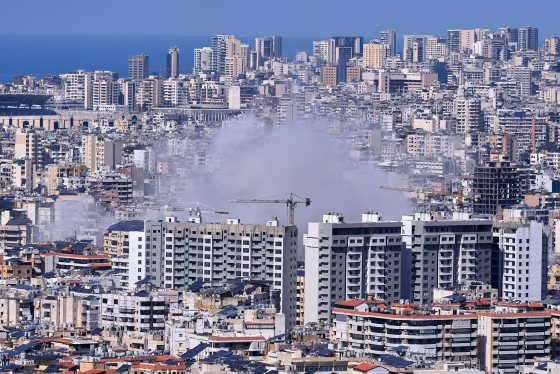
Smoke rises from Israeli airstrikes on Dahiyeh, a southern suburb of Beirut, Lebanon, today. Hassan Ammar / AP
Israel has officially launched an offensive against Hezbollah in Lebanon following retaliatory missile strikes from the group. The Israeli Defense Minister, Israel Katz, has declared Hezbollah’s Secretary-General, Naim Qassem, a “marked target for elimination.”
The Israeli army reported a precise strike on a senior operative in Beirut this morning, while military chief Eyal Zamir warned the nation to prepare for “many prolonged days of combat ahead.”
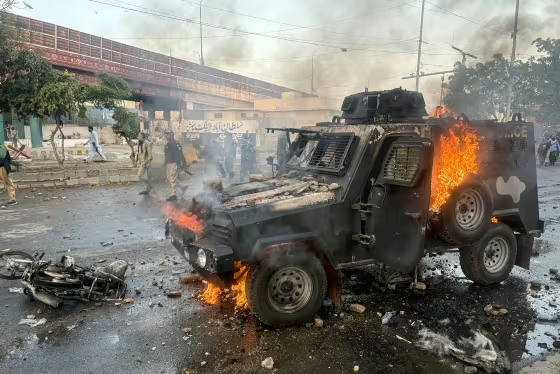
An armored vehicle set on fire by Shia Muslim protesters outside the U.S. Consulate in Karachi yesterday. AFP via Getty Images
Authorities in Pakistan have imposed a three-day curfew and deployed troops in Gilgit and Skardu after violent protests left at least 12 people dead. The unrest was sparked by the killing of Iran’s Supreme Leader Ayatollah Ali Khamenei.
In Karachi, demonstrators stormed the U.S. Consulate, leading to deadly clashes with police that resulted in 10 additional fatalities. UN offices in the north were also targeted as the backlash against U.S.-Israeli strikes spreads across the country.

Saudi Arabia’s energy ministry confirmed that the Ras Tanura refinery was partially shut down following a drone attack this morning. Two drones were intercepted over the facility, which is one of the world’s largest oil stabilization plants.
While the facility sustained minor damage from falling debris and a small fire was extinguished, no casualties were reported. Precautionary shutdowns of some units are in effect, though the ministry maintains that domestic petroleum supplies remain unaffected.
The World Health Organization has issued an urgent plea for the absolute protection of civilians and health care infrastructure in the Middle East as regional tensions reach a breaking point.
Hanan Balkhy, WHO’s Regional Director, stated on X that all parties must uphold international humanitarian law. She emphasized that medical facilities must remain protected zones to ensure the survival of those caught in the crossfire.
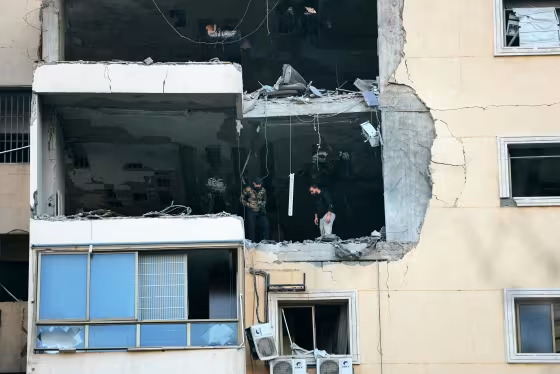
People inspect a damaged building after an Israeli airstrike in Beirut’s southern suburb neighborhood of Haret Hreik today. Ibrahim Amro / AFP via Getty Images
The distinct buzz of a drone echoed over the Lebanese capital this morning as residents were jolted awake by gunfire—a desperate warning of incoming Israeli air strikes.
Local witnesses reported that the strikes arrived in three distinct waves, following only minutes after the warning shots. The southern suburb of Haret Hreik has seen significant damage as the aerial campaign intensifies.
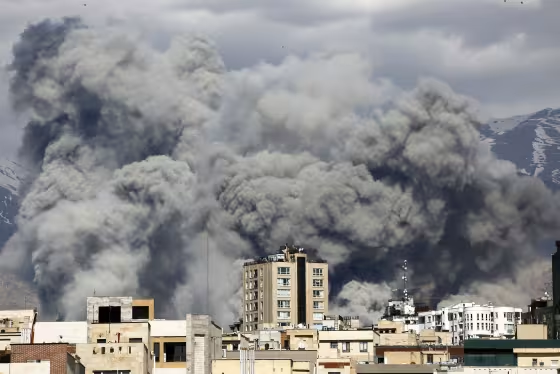
Smoke rises as a series of explosions are heard in Tehran, Iran yesterday. Fatemeh Bahrami / Anadolu via Getty Images
Iran’s Red Crescent said 555 people have been killed in U.S.-Israeli strikes since the beginning of the war on Saturday, state-run news agency IRNA reported.
The casualties are reported from more than 130 cities across Iran, highlighting the massive scale of the aerial campaign.
Millions of people in Iran have been left without access to the Internet for over 48 hours, according to cybersecurity watchdog NetBlocks.
This nationwide blackout follows a pattern of digital crackdowns in the country, similar to the several-week shutdown seen during protests in January. The current outage is severely limiting the flow of information amidst the ongoing regional escalation.
China’s Foreign Minister Wang Yi criticized the killing of Ayatollah Ali Khamenei as “unacceptable” during a high-level call with Russian Foreign Minister Sergey Lavrov.
Wang Yi stated that the “blatant killing of a sovereign leader” violates international law and basic norms of relations. Meanwhile, China confirmed that one Chinese national was killed in Tehran, and more than 3,000 nationals have already been evacuated from the country as tensions escalate.
Iran will not negotiate with the U.S., the secretary of the country’s Supreme National Security Council, Ali Larijani, said today.
Larijani made the comments on X in response to reporting that suggested he had made a push through mediators to resume nuclear talks. This contradicts earlier statements from Trump, who told NBC News that Iranian officials were interested in continuing talks.
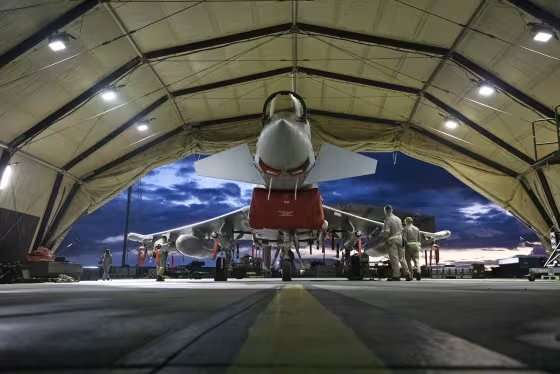
The United Kingdom’s foreign secretary, Yvette Cooper, has defended an agreement to allow the American military to use British air bases to strike Iranian ballistic missile sites.
This follows an Iranian drone strike on a Royal Air Force base in Cyprus last night. Cooper stated the government is supporting “limited defensive action” against a “deeply malign regime”.
Kuwait’s Ministry of Defense said today that “several U.S. warplanes crashed this morning,” but all crew members survived.